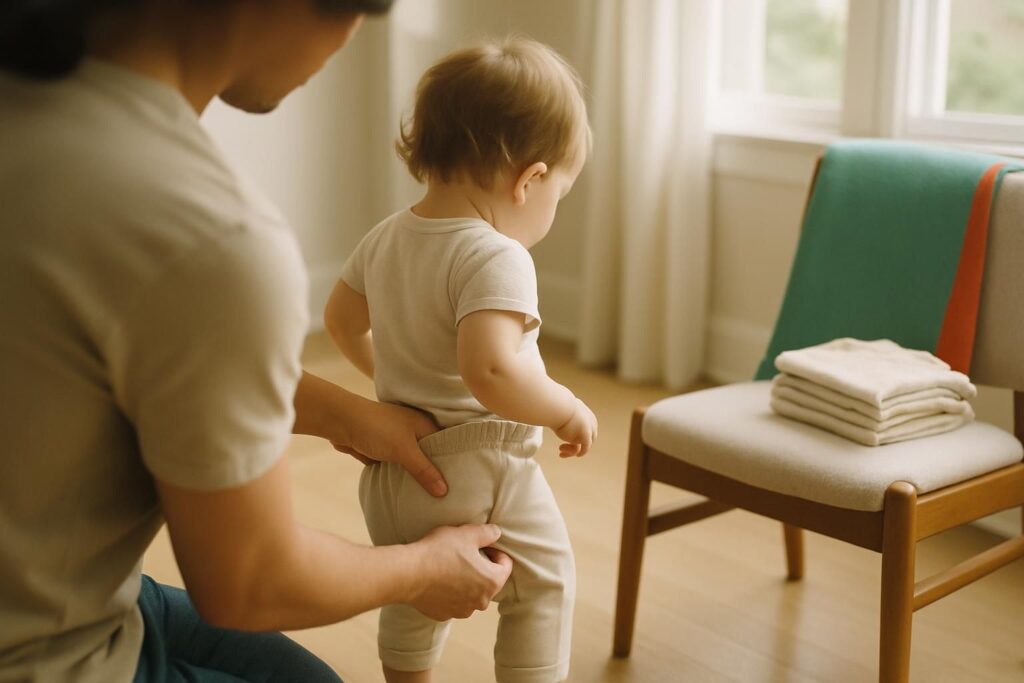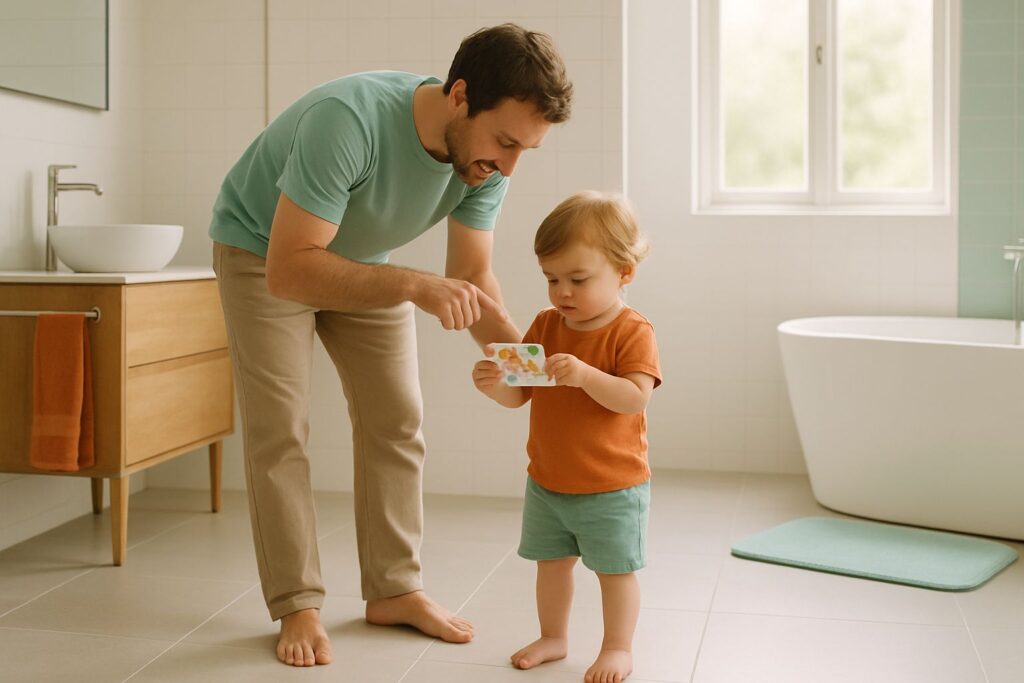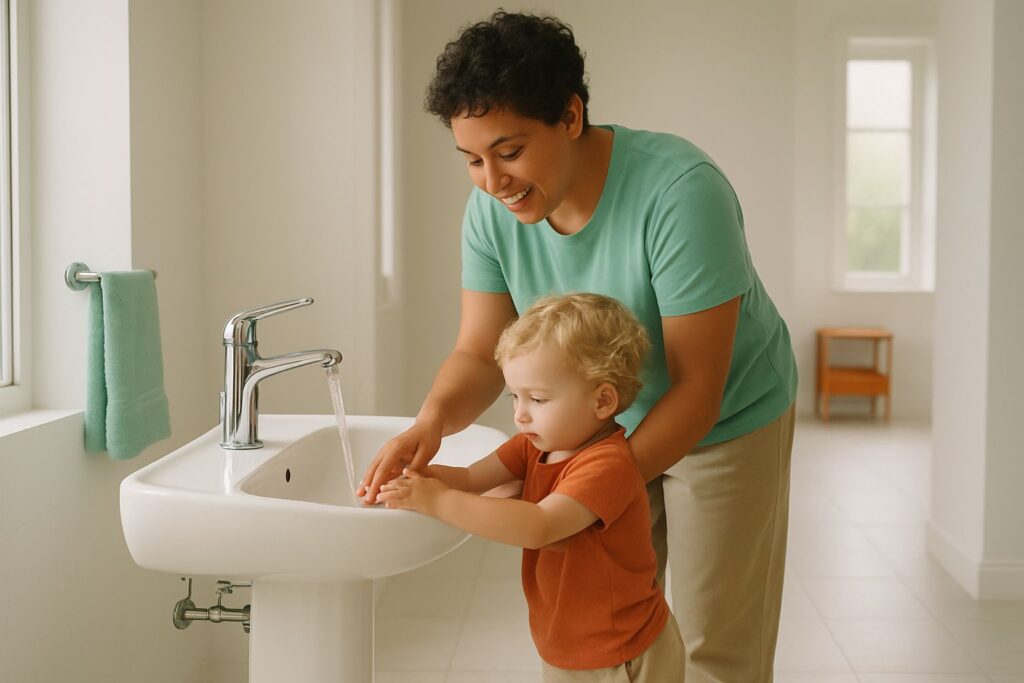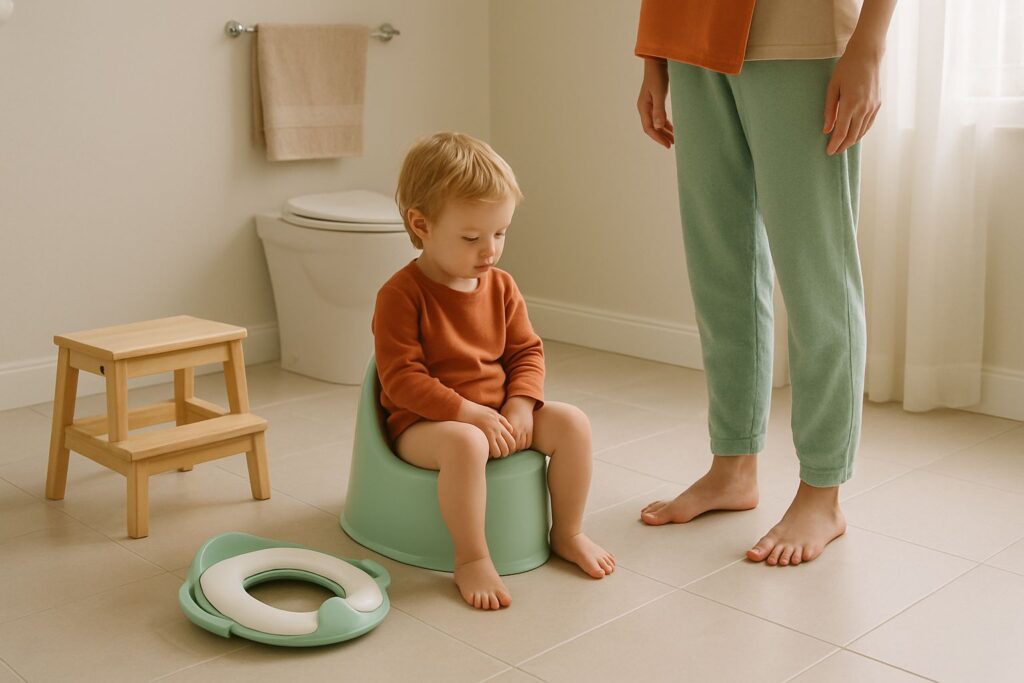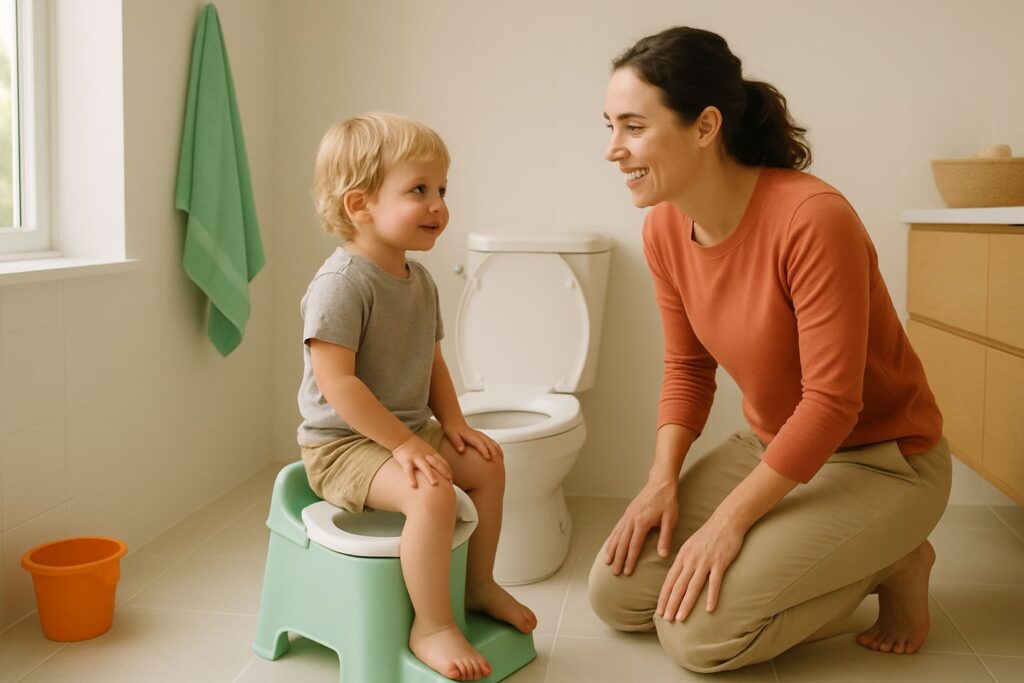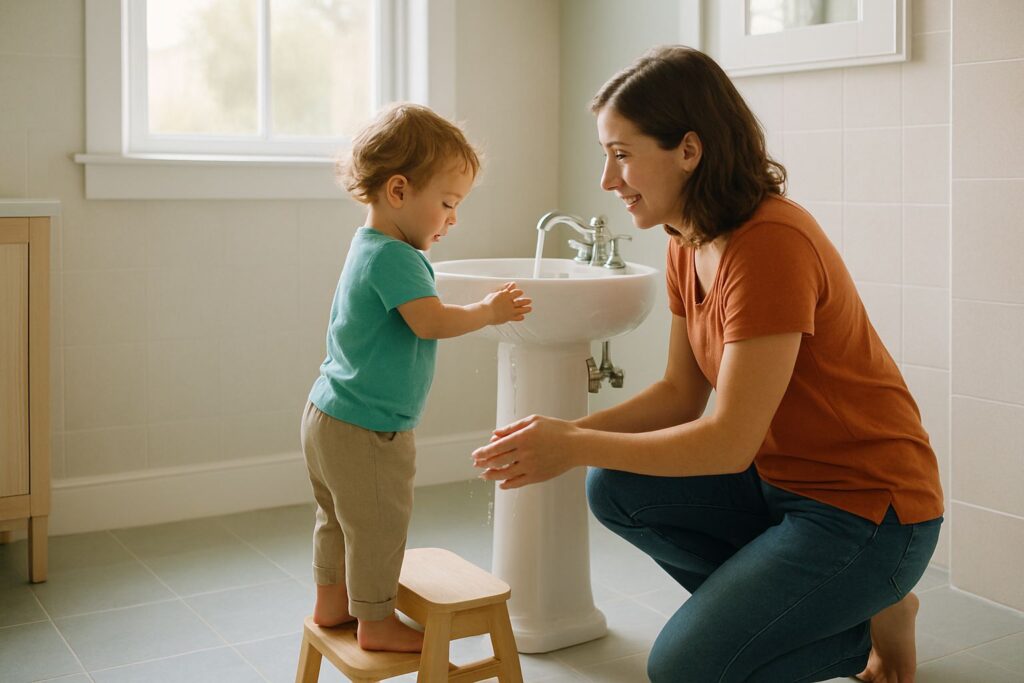

Your child is likely ready when several signs appear together: longer dry spells, awareness of doing a wee or poo, ability to follow a simple instruction, interest in the toilet, and some way of telling you something. There is no fixed age. If fear, distress or no awareness at all are present, it is better to wait and build familiarity first.
Readiness is not a single milestone you tick off on a certain birthday. It is a handful of signs that tend to show up together, usually somewhere between 18 months and 3 years old. Some children show most of them early, others take longer, and both are entirely normal.
How do I know if my child is ready to start potty training?
The signs worth watching for are physical, practical and to do with communication. A child who stays dry for an hour or two rather than constantly damp, who notices and reacts when they are doing a wee or poo, who can pull pants up and down with a bit of help, who follows a simple two-step instruction like ‘get your shoes, then come here’, and who shows curiosity about the toilet or the potty, is showing the physical and practical side of readiness.
The sign that matters most for this particular method is different from the rest: can the child tell you something, in words, in a sound, in a gesture, in their own way? The whole aim of potty training is not getting a child onto a potty on schedule. It is reaching the point where the child says, in whatever way they can, that they need to go. Everything else builds towards that moment.
It is worth being honest that no checklist is a pass or fail test. NCT is upfront that there are no definite, universally agreed signs of readiness, and that parents know their own child best. Use the list as a guide to watch for, not a form to fill in before you are allowed to start.
The readiness checklist: tick these before you start
Group the signs into three kinds: physical, understanding, and willingness. A child who is genuinely ready usually shows several signs across all three groups, not every single sign on the list.
| Readiness sign | What it looks like | Ready, nearly, or wait |
|---|---|---|
| Longer dry spells | Nappy dry for an hour or two at a time | Ready |
| Awareness of going | Pauses, points, or reacts while weeing or pooing | Ready |
| Pulling pants up and down | Manages with a bit of help | Ready |
| Follows a simple instruction | Understands and does a two-step request | Ready |
| Interest in the loo | Wants to watch, copy, or ask about it | Ready |
| Tells you something | Word, sound or gesture used consistently | Ready |
| Fear of the potty or toilet | Cries, refuses, or goes rigid nearby | Wait |
| No awareness at all | Nappy is soiled and the child shows nothing | Wait |
If your child has several signs but not all of them, the practical answer is to keep watching for a few more weeks rather than force the missing ones. Readiness tends to arrive in a cluster, not one sign at a time, and a child who is nearly there today is often properly there by next month. A quick way to check where your child stands is the free potty training readiness quiz at wizard.pottytrainingbox.co.uk, which asks through these same signs in a few minutes.
What age do UK children usually start potty training?
There is no single right age, and UK guidance is clear on that point. The NHS states that almost all children can be potty trained by the time they are between 18 months and two and a half years old, while also noting that some are not ready until they are three. ERIC, The Children’s Bowel and Bladder Charity, puts it slightly differently: many children are able to lead parts of the process from around 18 months, provided the adults around them are reading their signals rather than working to a fixed date.
Later starts have become more common in general, and a later start is not a delay and not a failing on the parent’s part.
Neither being a boy or a girl, nor being a second or third child, is a rule for how quickly any particular toddler will get there. Comparing your toddler’s pace with a friend’s child, or with an older sibling, tends to create pressure that does nothing useful. The honest answer is that the right age is whenever your own child is showing the signs, not a date on a calendar.
What is a red flag for potty training? Signs to wait a while longer
A child who is frightened of the potty or the toilet is not ready, and pushing past that fear tends to make it worse rather than better. The better move is to build familiarity first, let the child sit on the potty fully clothed, read books about it, watch a sibling, and start the actual training later. If this describes your child, it is worth reading if your child is afraid to poo before attempting anything.
A simple picture book you can look at together, with no pressure to actually sit on anything, is a gentle way to make the potty feel ordinary, such as this one:
Some links in this article are affiliate links, which means we earn a small commission if you buy through them. It costs you nothing extra and does not affect what we recommend.
Some red flags are medical rather than behavioural, and these belong with a doctor or health visitor rather than with any potty training plan. Holding on to poo, straining or crying with pain when going, or ongoing distress around toileting are all worth raising with your GP or health visitor before you start, not worked around.
A hard no from the child, running away at the sight of the potty, or clamping down and refusing to sit, is the child telling you plainly that now is not the moment. Some children are also more sensitive to the whole experience than others; if that sounds familiar, the article on a highly sensitive child covers this in more depth.
Big upheaval is another reason to wait: a new baby arriving, a house move, starting nursery, or a spell of illness all make this a bad window to introduce something new. And if a child cannot yet stay dry for even an hour, or shows no reaction at all to a wet or dirty nappy, the physical and awareness side of readiness simply is not there yet.
Waiting is a decision, not a failure or a delay you have to apologise for. If you already own a potty training kit, it keeps perfectly well until your child is ready; nothing in it goes off.
What if you have already tried once and it did not work?
The method’s own advice, if a first attempt did not work, is to stop and leave it a while rather than pushing on through. Continuing to force an attempt that is clearly not working tends to build negative associations that make the next attempt harder, not easier.
In practice, a while usually means a few weeks to a couple of months, though there is no fixed rule. Use that pause to watch for the readiness signs building back up: longer dry spells returning, curiosity about the toilet reappearing, the child mentioning it themselves.
Nothing from the first attempt is wasted. Children retain a surprising amount from an attempt that looked, at the time, like it went nowhere; words, associations and a basic understanding of what a potty is for tend to carry over quietly into the next go.
A stopped attempt is information about timing, not a judgement on you or your child. Plenty of families need two goes, and the second one usually moves faster because of what the first one taught everyone involved.
Is my child ready if they are autistic, non-verbal or developmentally delayed?
Readiness for these children is read from signals and body cues rather than from words, because waiting for a spoken cue may mean waiting much longer than necessary. A facial expression, a change in posture, going quiet, or moving off to a particular corner of the room can all be a child’s own version of telling you something is happening.
The same method is used successfully with autistic children, children with Down syndrome, and non-verbal children, usually over a longer stretch than a week and with more repetition built in. The principle stays the same: the aim is still reaching the point where the child signals their need, just via whatever channel that child actually uses.
Practical signal reading is largely about paying close attention over a few days: does the child always go still before a wee, or head somewhere quiet before a poo? Those patterns become the cues a parent responds to, in place of a spoken word.
Anything medical or developmental, including questions about delay, continence conditions, or whether a particular child is ready given a diagnosis, belongs with the child’s paediatrician, health visitor or specialist team. This article can describe an approach; it cannot assess an individual child.
You have decided they are ready. What happens next?
Once the signs are there, the method spends the first three days at home, because that is when a child learns the most, with short outings following once things settle. Nappy comes off during the day and ordinary cotton pants go on instead, because a child feels a wet cotton pant properly in a way they simply do not feel through a nappy or a padded training pant, and that feeling is part of how they learn.
Before starting, it helps to gather what you will need rather than discover gaps on day one: several pairs of cotton pants, something to protect the mattress and sofa, small rewards, and pull-ups for sleeping, alongside a potty for the first few days, a toilet seat reducer and a step stool. The article on what to have ready before you start runs through all of it.
The question that drives the whole approach is ‘will you tell me when you need a wee?’, asked of the child, rather than sitting them on the toilet at fixed intervals because a clock says so. Two moments stay fixed for good, even once the training itself is finished: before and after sleeping, and before leaving the house.
Tracking is done through a simple schedule that records when this particular child actually goes: time of drinking, time on the toilet, whether nothing happened, and whether a wee or poo was a success or an accident, plus a notes column. The potty training tracking chart explains this in full and includes the printable version for this market. It works best when a drink is given in one go rather than sipped over the afternoon, because that is the only way to see how long it takes this child to need the toilet afterwards.
The Potty Training Box is one way to run through all of this: a day-by-day booklet, tracking schedules, and sticker cards that step up from three squares to nine as the child improves, plus a year of access to a community where the brand’s experts answer questions seven days a week. A parent who is not ready to buy anything can follow the same principles described here without it, and the box itself simply keeps for whenever the time is right. For the fuller step-by-step picture, the complete guide to potty training covers the whole week in detail.
Results are genuinely mixed and that is worth saying plainly: most children are dry in the daytime in about a week, some manage it in three days, others take two or three weeks, and a child who shows none of the readiness signs yet should simply wait rather than start on a schedule. Night-time dryness is a separate matter that tends to come later, sometimes much later, and no honest method promises it alongside daytime training. If a school start date is adding pressure, toilet trained before reception looks at that specific worry.
What is the 10-10-10 rule, and does it fit this method?
Parents sometimes come across the idea of sitting a child on the potty for ten minutes, ten times a day, or some similar fixed interval. It is a real approach some families try, built around a set schedule regardless of what the child is actually doing or feeling.
Clock-based sitting trains a child to be put on the toilet by someone else rather than to say they need to go themselves, which runs against the whole point of this method. A child who learns to sit because a timer went off has learned a routine, not a signal, and that difference matters once the parent stops setting timers.
What replaces it here is simpler: ask ‘will you tell me when you need a wee?’, record what actually happens on the tracking schedule, and let the prompting fade as the child starts to signal on their own. The two exceptions that stay, before and after sleep and before leaving the house, are practical safety nets rather than a schedule to run the whole day by.
Day four or five is often the hardest day of the week, more so than day two, because by then the child is bored of being asked the same question over and over and starts pushing back. The fix at that point is to ask less often, not more, and hand a bit more responsibility to the child; that shift is usually what gets the week back on track.
Frequently asked questions
How do I know my child is not ready for potty training?
A child is likely not ready if they show fear or distress around the potty or toilet, cannot stay dry for even an hour, or show no reaction at all to a wet or dirty nappy. Running away, going rigid, or refusing outright when asked to sit are also clear signs to wait. If several readiness signs are missing at once rather than just one, it is better to hold off and revisit things in a few weeks.
What is a red flag for potty training?
Fear of the potty or toilet is the clearest red flag, since it means the child needs familiarity building up before any training attempt. Holding on to poo, pain when going, or ongoing distress are medical red flags that belong with a GP or health visitor rather than a training plan. A recent big change, such as a new baby, a house move or starting nursery, is also a reason to wait.
What are three signs a child is ready for toilet training?
Three strong signs are staying dry for an hour or two at a time, showing awareness when they are doing a wee or poo, and being able to tell you something, in words or their own way, about needing to go. A child showing all three alongside some interest in the toilet is usually ready to begin.
At what age is a child usually fully potty trained?
The NHS states that almost all children can be potty trained between 18 months and two and a half years old, though some are not ready until age three. ERIC notes that many children can lead parts of the process from around 18 months onwards. There is no single correct age, and readiness signs matter more than the calendar.
Should I wait until my child can tell me they need a wee before starting?
You do not need to wait for full sentences, but some way of communicating a need, whether a word, a sound or a consistent gesture, is one of the strongest readiness signs. The whole aim of training is reaching the point the child signals themselves, so a child showing early signs of this is usually ready to begin, even if the signal is not yet fully reliable.
Can I start potty training before my child is two?
Some children under two show enough of the readiness signs, particularly around 18 months as ERIC notes, but many are not ready until closer to two and a half or three, per NHS guidance. Watch for the cluster of physical, understanding and communication signs rather than the birthday itself before deciding to start.
Ready for the next step?
The Potty Training Box holds the day-by-day programme this article is built on: tracking charts that show you when your child actually needs to go, instruction cards for each day, and a reward system that tapers off on its own.
Sources
This article was written with AI assistance and checked by Dustin van de Sande.