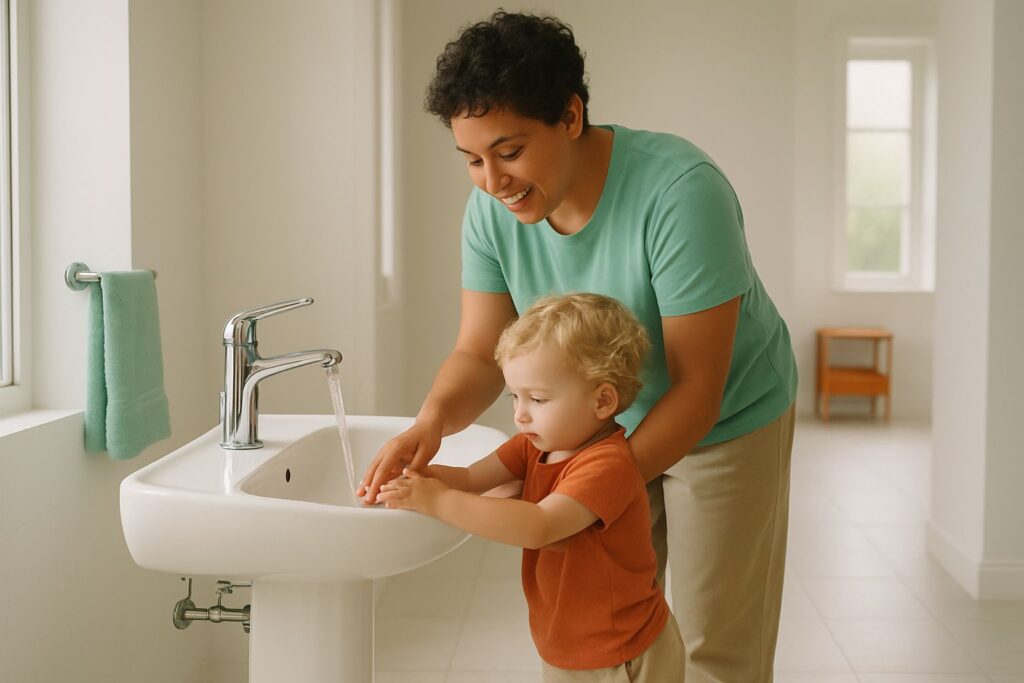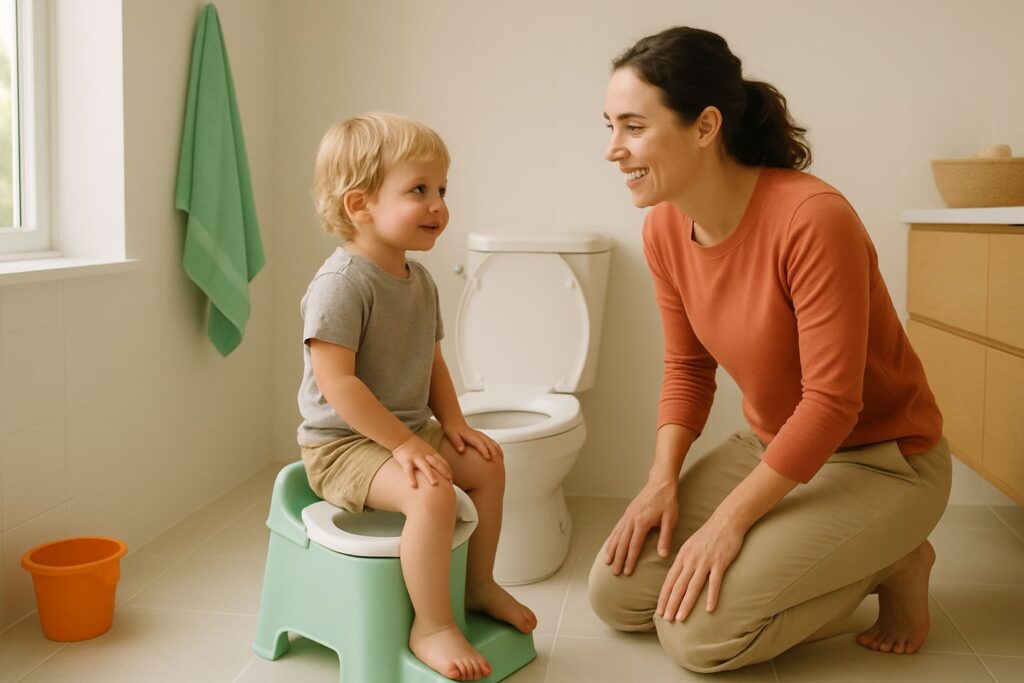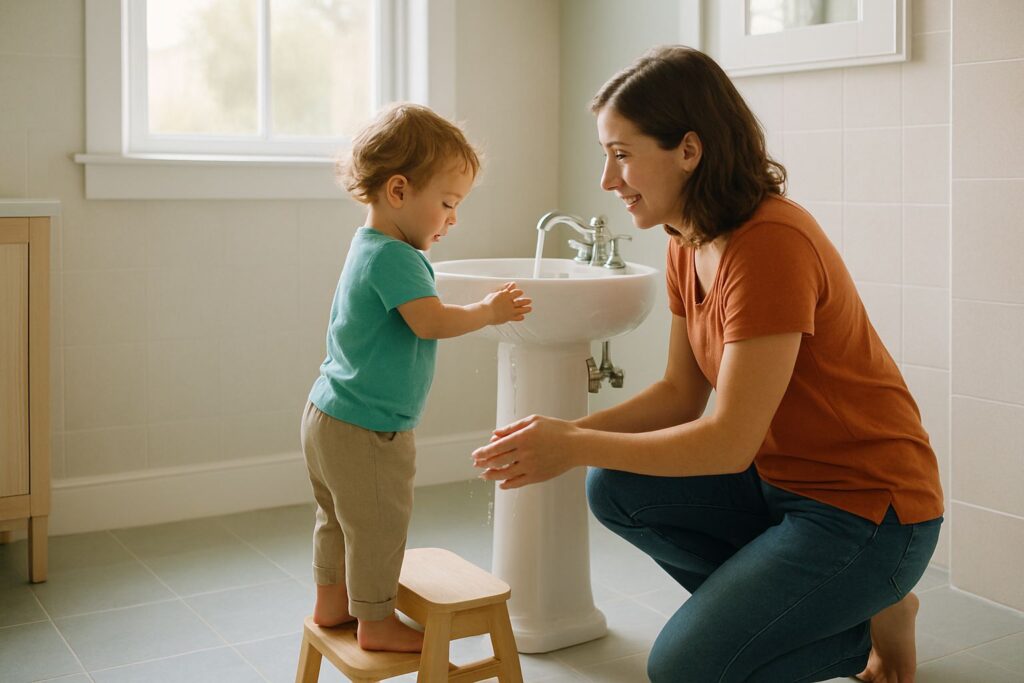


The hardest day of potty training is usually day four or five, not day two. By then the novelty has worn off and the child is tired of being asked whether they need a wee, so resistance appears. Days one to three feel messy but the child stays curious. Most children are dry in the daytime within about a week.
Day two has a reputation as the difficult one, and it is true that the first burst of excitement can fade by then. But the real wall tends to arrive a couple of days later, once the child has understood the game and started to push back against it. Some children get there in three days, others take two or three weeks, and a child who is not ready yet is better off waiting than being pushed through a bad week.
Why does my toddler suddenly refuse the potty on day 4?
A toddler refusing the potty on day four is usually reacting to being asked too often, not to the potty itself. The question will you tell me when you need a wee is meant to hand responsibility to the child, but repeated many times a day it starts to sound like nagging, and toddlers push back on anything that feels like being managed.
This resistance is actually a sign that the child now understands what is being asked of them. It is not evidence that the training has collapsed. Accidents at this stage are part of learning, not a failure of the method or the child, and treating them that way keeps the week moving.
The stickers and the fuss that felt thrilling on day one have usually lost some shine by day four as well. Combine a bored child with a tired parent who has been asking the same question all week, and mid-week resistance turns out to be very common, more the rule than the exception, rather than a sign something has gone wrong.
The fix: ask less, hand the child more responsibility
The fix for day four resistance is to ask less, not more. Cutting back how often you prompt, and leaving longer stretches where you say nothing at all, gives the child room to notice the feeling themselves instead of waiting to be asked.
Some moments stay fixed whatever day of the week it is, before and during training and afterwards too: before and after sleeping, and before leaving the house. Outside those anchor points, let the gaps grow longer as the week goes on.
It also helps to let a small accident happen rather than pre-empting every single wee. Praise the moment the child says it themselves, even quietly and even late, rather than praising the sitting itself. What you are rewarding is the initiative, not the compliance.
What does not help at this stage is switching to putting the child on the potty by the clock every thirty minutes because things feel shaky. That undoes the very thing you have spent three days building and hands the initiative straight back to you. If you want the fuller run of what each day is meant to look like, the day-by-day plan for the week lays out what to expect and adjust for, including the wobbly days.
What the tracking chart tells you on day 4 and 5
The tracking chart is there to record when this particular child actually goes, not to set a timetable you then impose on them. By day four or five it has usually built up enough entries to show a rough pattern, and that pattern is what lets you stop guessing and start following.
A typical chart has these columns: time of drinking, time on the toilet, whether nothing happened, wee marked green for a success and red for an accident, poo marked the same way, and a notes column for anything else worth remembering.
| Column | What it records | Why it matters |
|---|---|---|
| Time drinking | When the child had a full cup | Links intake to timing |
| Time on toilet | When they were offered or went | Shows the gap after drinking |
| Wee / poo, green or red | Success or accident | Reveals the child’s own rhythm |
For the amount and timing link to be visible, it helps if the child drinks the cup in one sitting rather than in sips spread across the afternoon. A half cup sipped over an hour does not tell you much, but a full cup drunk at once, followed by a note of how long it took before the child needed the toilet, is exactly the kind of pattern the chart is designed to catch. There is a free printable tracking chart if you want to start recording this without anything else.
What is the 10-10-10 rule for potty training, and does it help here?
Parents commonly describe the 10-10-10 rule as something like ten minutes of sitting on the potty, ten reminders through the day, and ten small rewards, though the exact numbers vary depending on who is telling you about it. It is a shorthand that circulates among parents rather than a formally defined method.
Timed sitting rules like this pull in the opposite direction from a method built on the child’s own initiative. A long, fixed sit on day four or five, at exactly the point when a child is already tired of being managed, tends to increase resistance rather than reduce it.
What tends to work better on a rough day is a short sit, offered rather than enforced, alongside the fixed anchor moments of before and after sleep and before leaving the house. Beyond those, wait for the child’s own signal rather than running a clock in your head.
A realistic day-by-day map of the week, including the bad days
The first three days are usually spent at home, nappy off, in ordinary cotton pants rather than anything padded, because the child needs to actually feel a wet accident to learn from it. Short outings tend to start after day three, once the child has had a few days to build confidence at home.
| Day | What it usually looks like | What to do |
|---|---|---|
| Days 1 to 3 | Messy, frequent accidents, child stays curious | Stay home, cotton pants, create opportunities and note what happens |
| Days 4 to 5 | Resistance, boredom, the odd flat refusal | Ask less, keep only the anchor moments |
| Days 6 to 7 | Fewer accidents, child starts to say it first | Praise the signal, let outings run longer |
Day six and seven usually bring a shift where the child starts to signal on their own, sometimes only occasionally at first. Pull-ups for sleeping are still worth keeping in place at this point, since night-time dryness is a separate matter that tends to come later and is not something any daytime method promises.
If you have read up on faster methods elsewhere, it is worth knowing what the 3-day potty training method really involves before comparing it to a full week, since the two are not doing quite the same job.
When is resistance a sign to stop rather than push on?
Resistance is a sign to stop when the child seems genuinely frightened of the potty or the toilet, rather than simply bored of being asked. A frightened child is not ready yet, and the honest response is to build familiarity gently and try again later rather than push through fear.
If several days have passed and nothing is landing at all, the Potty Training Box Method‘s own advice is to stop and leave it a while before trying again. That pause is part of how the method is meant to work, not a sign of failure on anyone’s part.
The same approach is used successfully with children who are autistic, have Down syndrome, or are non-verbal, usually over a longer stretch of time and by watching for the child’s own signals rather than waiting to be told in words.
Ongoing constipation, withholding poo, or pain and frequency with weeing are matters for a GP or health visitor rather than something to work through with a training method, and are worth raising promptly if you notice them.
What parents supply themselves for the mid-week wobble
Alongside whatever training materials a family uses, most households need a good stock of cotton pants, something to protect the mattress and sofa, a step stool and toilet seat reducer, a handful of small rewards, and pull-ups for sleeping. A potty is useful mostly in the first few days before the child moves across to the toilet.
The Potty Training Box is built around exactly the week described above, with a day-by-day plan for what to do on the days that go badly and sticker cards that grow from three squares up to nine, so the reward system does not collapse just because day four is flat. If you get through a set on a later child, refill packs are sold separately as an extra reward system.
None of this requires the box to work. The method described here, easing off the asking, keeping the anchor moments, reading the child’s own chart rather than a clock, can be followed with nothing more than pants, a potty and patience. Where the box adds something is a plan for what to do specifically on the days that go badly, plus a year of community access where the brand’s team answers questions when day four goes sideways at nine in the evening. For more on why easing off works better than tightening up, see why the method works over the longer term.
Frequently asked questions
What day is the hardest when potty training?
Day four or five is usually the hardest day of potty training, not day two as many parents expect. By this point the novelty has worn off and the child is often tired of being repeatedly asked if they need a wee, which shows up as resistance or refusal. Days one to three tend to be messy but the child usually stays curious and engaged.
What is the 10, 10, 10 rule for potty training?
The 10-10-10 rule is a phrase parents use informally to describe roughly ten minutes of sitting on the potty, ten reminders across the day and ten small rewards, though the exact numbers vary by who is describing it. It is not a formally studied method, just a shorthand that circulates between parents. Timed sitting rules like this can work against a method built on the child taking the initiative themselves.
Why is my toddler refusing the potty on day 5 when day 1 went well?
A toddler often refuses on day five because they now understand exactly what is being asked and are pushing back against the frequency of it, not because the training has failed. Day one usually carries novelty and excitement that has worn off by day five. Cutting back how often you prompt, while keeping fixed moments like before sleep and before leaving the house, usually eases this within a day or two.
What is a red flag for potty training?
A child who seems genuinely frightened of the potty or toilet, rather than simply reluctant, is not ready and should build familiarity before starting again. Ongoing constipation, withholding poo, or pain and frequency with weeing are medical matters and should be discussed with a GP or health visitor rather than worked through with a training method. Neither of these should be treated as something to push past.
How often should I ask my child if they need a wee?
Ask fairly often in the first day or two, using something like 'will you tell me when you need a wee?', then reduce the frequency steadily as the week goes on, keeping only fixed anchor moments such as before and after sleeping and before leaving the house. Constant asking through the middle of the week tends to feel like nagging and increases resistance rather than reducing accidents. The tracking chart is a useful guide to this child's own rhythm rather than a fixed schedule to enforce.
Should I stop potty training if day 4 is a disaster?
No, a difficult day four is normal and expected, not a reason to stop. It is usually the dip where the child pushes back against being asked so often, and easing off the asking while keeping the anchor moments is enough to get past it. Stopping is only the right call if the child seems genuinely frightened, or if nothing at all has landed after several days, in which case a pause before trying again is part of the method rather than a failure.
Ready for the next step?
The Potty Training Box holds the day-by-day programme this article is built on: tracking charts that show you when your child actually needs to go, instruction cards for each day, and a reward system that tapers off on its own.
Sources
This article was written with AI assistance and checked by Dustin van de Sande.