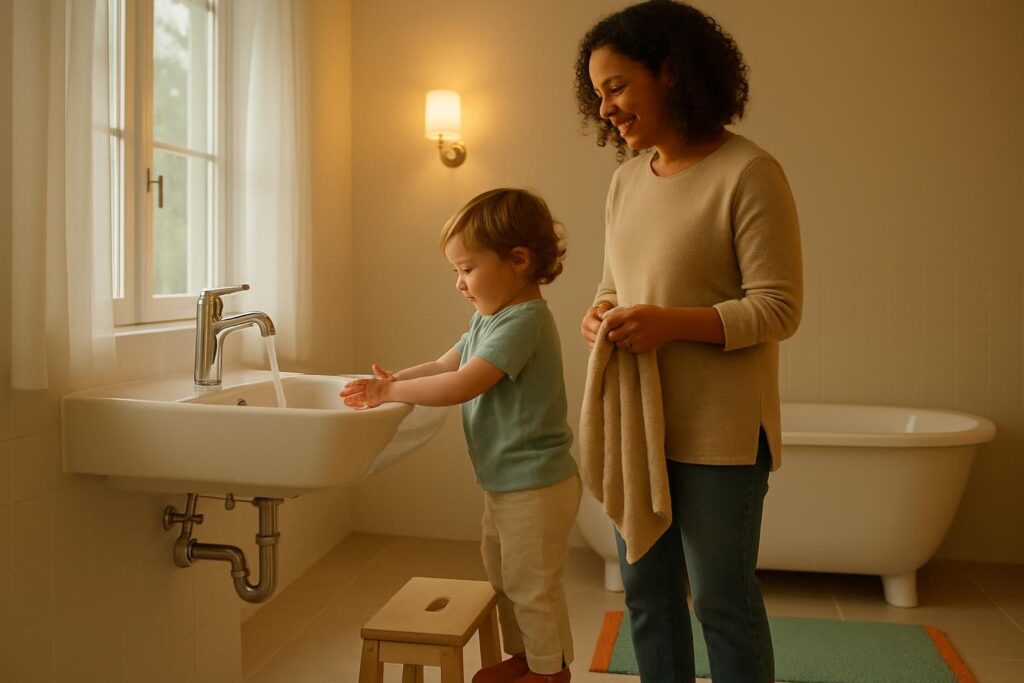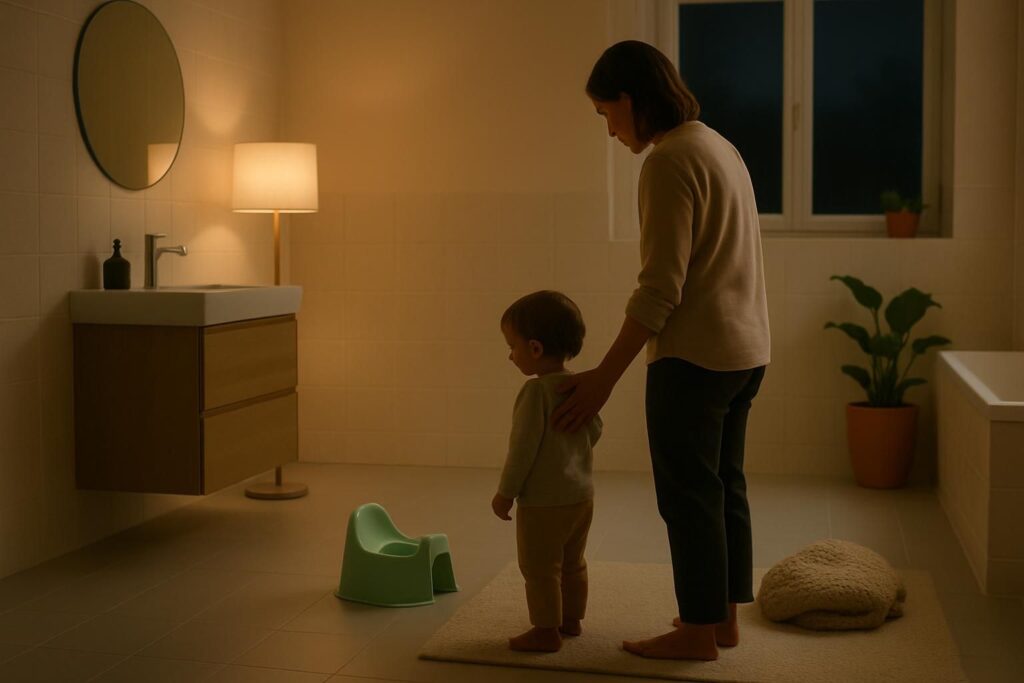

To start potty training, check your child is showing real readiness signs, pick a start date two to three weeks out, clear three full days at home, get a potty, pants and a plan ready, and tell your child what is coming. Most children are dry in the daytime within about a week. Night-time dryness comes later and separately.
Some children get there in three days. Others need two or three weeks of steady practice, and that is not a sign anything has gone wrong. A child who is not ready yet simply does better if you wait and try again later rather than pushing through.
Is your child actually ready, or are you ready and they are not?
The clearest sign a child is ready is behaviour, not age: staying dry for an hour or two at a stretch, telling you the nappy is wet or dirty, showing curiosity about the toilet, being able to pull pants up and down, and following a simple instruction like fetching their shoes. Most children show these signs somewhere between eighteen months and three years old, though exactly when varies a great deal from child to child, and night-time dryness usually follows daytime dryness on its own, often much later.
A child who is genuinely frightened of the potty or the toilet is telling you something useful: they are not ready yet. The honest move is to build familiarity first, with no pressure attached, and start properly later. Whatever kit you have bought keeps perfectly well until then.
Not sure where your own child sits? Answer a short readiness quiz before you set a date.
If you want to go further than a gut feeling, you can also work through 12 readiness questions to score before you start at your own pace.
Picking your start date: why three days at home comes first
Choose a date around two to three weeks away, not tomorrow. That gives you time to buy what you need, talk to your child, and tell nursery without rushing any of it.
Block out three consecutive days where your child is mostly at home with you, ideally a long weekend or a few days of annual leave. The early days are when a child learns the most, before you attempt any outings at all. Short trips out, to the shop or the park, start from around day four.
Avoid starting in the same fortnight as a house move, a new sibling, the first week of nursery, or a holiday. A child coping with one big change at a time does far better than one coping with several. It also helps to know, going in, that many families find the fourth or fifth day the hardest, not the second: resistance tends to show up once a child is tired of being asked constantly whether they need a wee. You can read more about why day 4 or 5 is usually the hardest and how to plan a lighter diary around it. For a fuller picture of how the week tends to unfold, the day-by-day plan for the week shows what each day is actually for.
| When | What you do | Why it matters |
|---|---|---|
| Two weeks before | Pick the date, book time off if needed, tell nursery | Gives everyone time to prepare without rushing |
| One week before | Buy pants, potty, protection, small rewards | Nothing missing on the morning it counts |
| The weekend before | Shop for pants together, read a potty book, start the key phrase | Child arrives at day one already familiar with the idea |
| The night before | Lay out pants, pack the mattress protector, set the alarm | A calm morning sets the tone for the day |
What to have ready before day one
Have ready, alongside whichever plan you are following: a potty (mostly useful for the first three days), a toilet seat reducer, a step stool, and at least 15 pairs of plain cotton pants rather than padded training pants, since a child feels a cotton pant properly and that feeling is part of how they learn. You will also want something to protect the mattress and sofa, a handful of small rewards agreed in advance, and pull-ups for sleeping. The Potty Training Box is the plan itself: a day-by-day programme that tells you what to actually do each morning, rather than another item to add to the pile.
Some links in this article are affiliate links, which means we earn a small commission if you buy through them. It costs you nothing extra and does not affect what we recommend.
| Item | Why you need it |
|---|---|
| My Carry Potty travel potty | Useful for the first few days, and easy to take along once you start short outings |
| Dreambaby Non-Slip Toilet Seat | Helps once you move your child from the potty to the toilet |
| Dreambaby 2-Up Step Stool | Lets your child climb up and down without help |
| Huggies DryNites pyjama pants | Keeps night-time separate from the daytime training |
For more on the cotton pants point specifically, why plain cotton pants work better covers the reasoning in full.
How to talk to your toddler about it in the week before
Tell your child on an ordinary, calm day, not as a threat and not as a bribe. Something simple works: pants are coming, nappies are nearly done, and you will help them learn.
Shop for the pants together and let them choose a pattern. Let them watch you use the toilet sometimes and name what is happening in plain words. Introduce the sentence they will hear often that week: you tell me when you need a wee. That one phrase, repeated gently rather than constantly, is what teaches a child to notice and signal their own need rather than waiting to be asked.
A picture book at bedtime that week can help too, something like Pirate Pete’s Potty, read without any pressure attached to it.
If your child seems genuinely nervous about the idea, a short video watched together can take some of the fear out of it before you start.
The one thing parents get backwards: the schedule is for watching, not for clock-watching
You are not meant to sit your child on the potty every 15 or 30 minutes because a timer says so. That treats the clock as the authority, when the whole point is to learn this particular child’s own timing.
A tracking schedule does that job properly. One card records the time of drinking, the time on the toilet, whether nothing happened, wee marked green for success or red for an accident, poo marked the same way, and a notes column. Filled in honestly over a few days, it shows you how long after a drink this child typically needs to go, which is information no generic timetable can give you.
For that pattern to show up clearly, have your child drink the cup in one go rather than in sips spread across the hour. Only then do you know how much went in and how long it then takes, which is exactly the link the schedule is built to reveal. The offering of the potty is scaffolding you put up early and take down again: the fixed moments that stay for good, even once training is finished, are before and after sleep, and before you leave the house. Everything else gives way, as quickly as the child allows, to them telling you themselves. You can start filling in a copy of the tracking chart before day one if you want a head start on noticing the pattern.
How the reward system works, and why you set it up before day one
The reward system in the box is not a single sticker chart with a fixed number of squares. It is a set of sticker cards in four sizes, with three, five, seven and nine squares, used in that order. The reward comes quickly at three squares so a child sees straight away that it works, then grows rarer as they improve, so the habit outlasts the stickers rather than stopping the moment they do.
Alongside the sticker cards sit 100 animal stickers and 20 poo stickers, plus a wee certificate and a poo certificate to mark real progress. Agree your small rewards in advance, a few minutes of a favourite game, a sticker on a jar, so you are not inventing something on the spot in the middle of a wobbly afternoon. If you would rather build your own version of this system from scratch, a separate reward system is sold on its own too.
Telling nursery, the childminder and grandparents before you start
Tell everyone who looks after your child your start date and the exact phrase you are using, so your child hears the same message wherever they are. Consistency between home and nursery matters more than any single technique.
Send in a stack of spare pants and a bag for wet clothes, and ask staff to use cotton pants rather than pull-ups during the day, since a pull-up feels too much like a nappy for the lesson to land. Agree in advance how accidents will be handled: no telling off, no fuss, just a change and moving on.
If a nursery insists on pull-ups during their hours, it is not the end of the plan. Simply start on days your child is at home with you, and extend the same approach to nursery once it is holding steady there.
What the Potty Training Box Method gives you that a checklist cannot
The Potty Training Box Method is a structured approach built around three full days at home followed by short outings, moving the child from potty to toilet while they learn to signal their own need and hold on, over roughly a week. It is not a flat set of rules; it is a sequence that adjusts as the child’s own signals come through.
Inside the box sits a programme booklet that coaches you through each day, 14 tracking schedules to learn your child’s own pattern, and a year of access to a community where our potty training experts answer your questions seven days a week. What it adds over a free checklist is specific guidance for the days that go badly, not just the ones that go well, and somewhere to ask when yours does. It is also reusable for a younger sibling later, with refill sticker sets sold separately.
If a physical box is not the right fit and you would rather work from a written guide, the Potty Training Box, Digital Handbook covers the same day-by-day plan in digital form. Once day one actually arrives, what to do from the moment the nappy comes off picks up exactly where this article leaves off.
When to postpone, and what to do if the first attempt does not take
If your child is unwell, frightened of the potty, or in the middle of a big change at home, wait. There is no prize for starting on the date you originally picked if the child in front of you is not ready for it that week.
If a few days in it clearly is not working, the method’s own advice is to stop and leave it a few weeks before trying again, rather than grinding on through daily tears. That pause is part of the plan, not a failure of it, and there is no shame in putting the kit away for a while. It keeps perfectly well until you are both ready to pick it back up.
Ongoing constipation, a child withholding poo, repeated urinary infections, or bedwetting that continues well past age six are matters for your GP or health visitor rather than a training plan, however good the plan is.
Frequently asked questions
At what age should I start potty training?
Most children can be potty trained somewhere between 18 months and three years old, but the age matters far less than the signals your own child is showing, such as staying dry for longer stretches and telling you about a wet nappy. Start when those signs are there rather than aiming for a particular birthday.
Is it better to put my child on the potty every 15 minutes or every 30 minutes?
Neither: sitting a child down on a strict timer treats the clock as the authority instead of the child. The better approach is to record when your child actually goes on a tracking schedule for a few days, so you learn their real pattern, then let them take over telling you themselves as quickly as they're able.
How long before day one should I start preparing?
Give yourself around two to three weeks. That is enough time to buy pants and a potty, tell nursery, and talk to your child, without the preparation itself feeling rushed or stressful.
Do I need training pants, or can I go straight to cotton pants?
Plain cotton pants work better than padded training pants, because a child feels wetness properly in cotton, which is what teaches them to notice and act on the feeling. Aim for at least 15 pairs so you never run short mid-week.
How do I tell nursery we are starting potty training?
Give them your start date and the exact phrase you are using at home, such as 'you tell me when you need a wee', so your child hears consistent language everywhere. Send in spare cotton pants and a bag for wet clothes, and agree that accidents are handled calmly with no fuss.
What if my child is scared of the potty?
A child who is frightened of the potty or toilet is not ready yet, and that is useful information rather than a setback. Spend some time building familiarity with no pressure attached, perhaps with a picture book or a short video together, and start the proper training later.
Ready for the next step?
The Potty Training Box holds the day-by-day programme this article is built on: tracking charts that show you when your child actually needs to go, instruction cards for each day, and a reward system that tapers off on its own.
This article was written with AI assistance and checked by Dustin van de Sande.