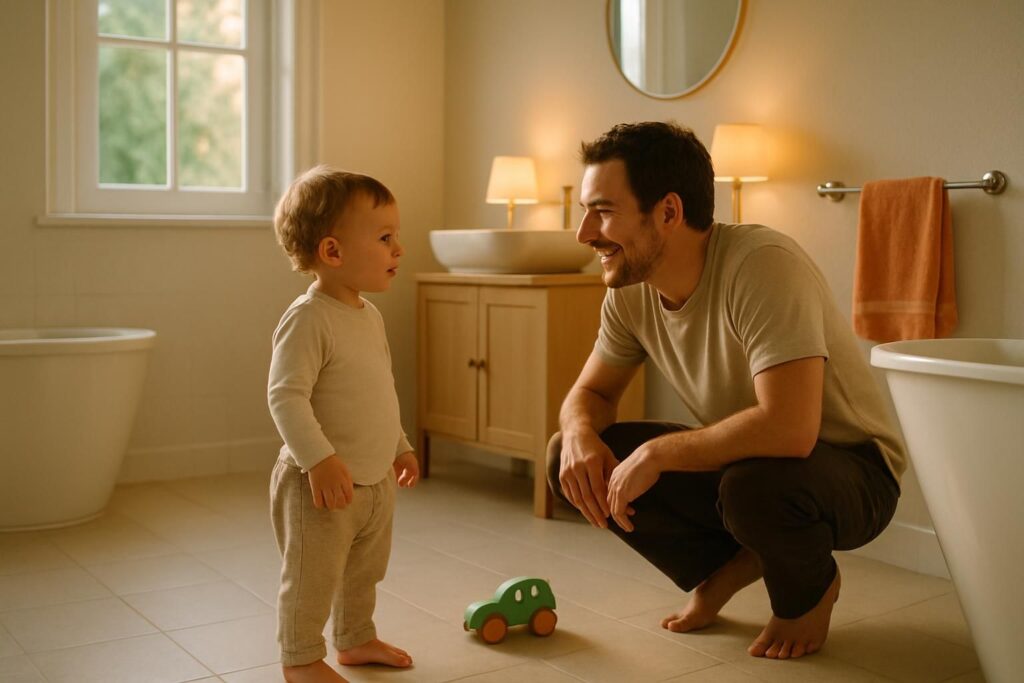

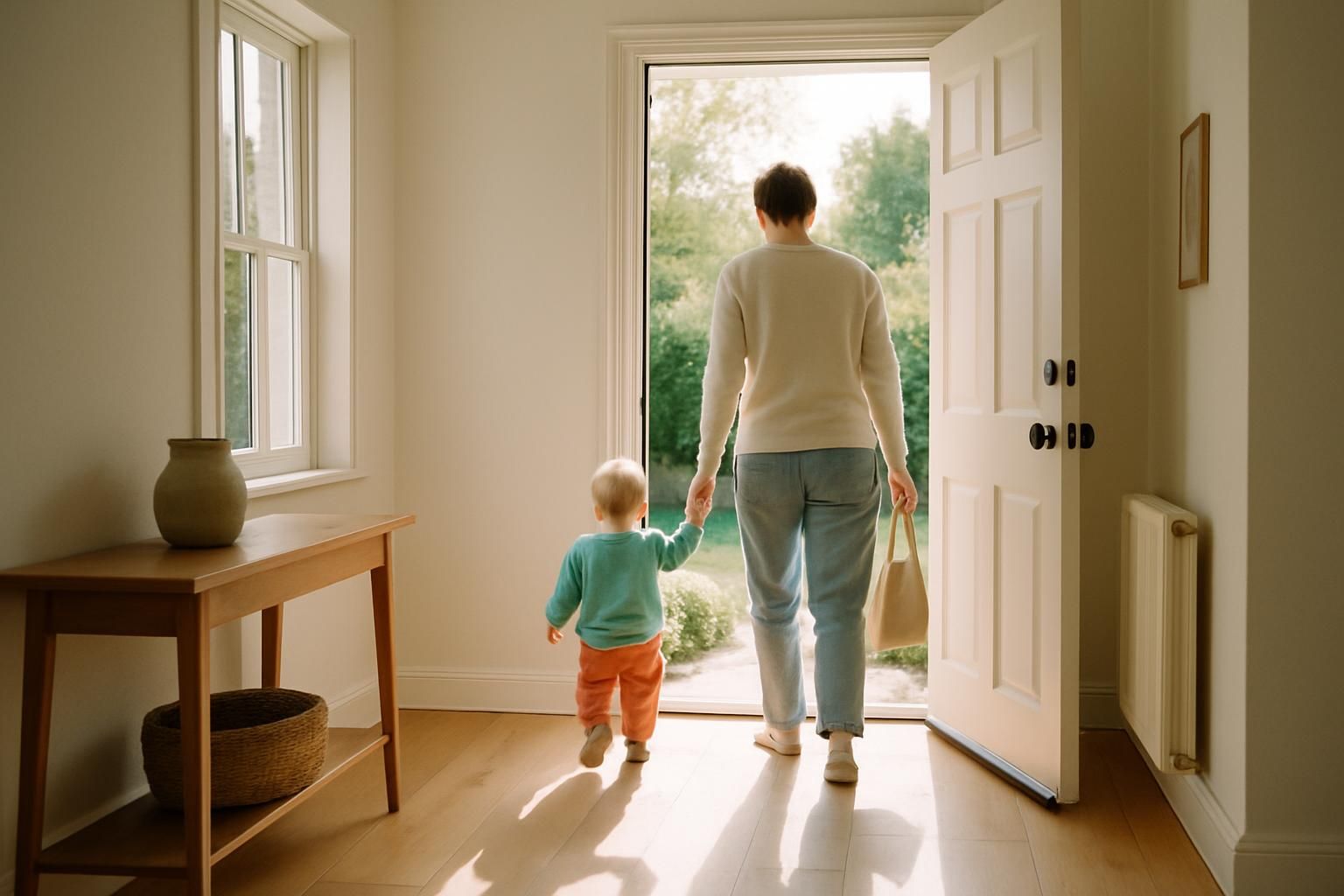
Most families spend the first three days at home, then begin short outings of ten to twenty minutes from around day four, with the toilet question settled before leaving. Staying in first lets your child learn fastest with the fewest distractions, and the tracking schedules show you their timing before you take training out into the world.
The first outing is deliberately tiny. A walk to the postbox, a few minutes in the garden, a trip to a neighbour two doors down. Nothing that locks you in if things go wrong, nowhere you cannot turn round from in under five minutes. The point of the small outing is to find out how your child handles a change of scene, not to test how far you can push it.
This staged approach, three days at home followed by short outings, is the shape of the Potty Training Box, which coaches a parent through a day by day plan using instruction cards, tracking schedules and a sticker reward system that builds from small reward cards to larger ones as the child improves. It is often called the Potty Training Box Method: three days at home to establish the basics, short outings after that, and tracking schedules used throughout to learn when this particular child needs to go, so the child is the one signalling rather than being put on a timetable.
If you want the whole week laid out before you commit to day one, the complete guide to potty training covers the full plan from start to finish.
Why the first three days are spent at home
Staying home for the first three days is not about avoiding mess. It gives you the fewest distractions and the most chances to notice what your child does in the seconds before they go: the pause, the shuffle, the sudden quiet. Those tells are easy to miss in a shop or a soft play and obvious in your own kitchen.
The tracking schedules exist to record this. Each one has columns for the time your child drank, the time they sat on the potty or toilet, whether nothing happened, and whether a wee or a poo was a success (marked green) or an accident (marked red), with a notes column for anything else. They are there to teach you this child’s timing, never to run your child on a fixed schedule. You can download the exact format as a printable tracking chart if you want to see it before you start.
One detail makes the schedule actually useful: give your child the cup to drink in one go rather than in sips spread across the hour. Only then can you see how much went in and how long it took before they needed a wee, and that link between quantity and timing is exactly what the schedule is designed to show you.
The potty itself is mainly a first three days tool. Most children move from the potty to the toilet seat within the week, which is part of why the early days stay close to home: there is less to carry and less to get wrong while that transition happens.
What to ask before you walk out of the door (and what not to say)
Before leaving the house is one of the few moments where you do prompt your child, alongside before and after sleep. Outside of those moments, the question stays open: “will you tell me when you need a wee?”, which keeps the decision with your child rather than you.
This matters because constant prompting backfires. A child asked every fifteen minutes stops listening to their own body and starts waiting to be asked instead, which is the opposite of what potty training is for. The pre-outing check is kept deliberately separate from that: it is a practical safety step, not a return to asking all day.
If your child refuses the pre-outing try, do not turn it into a standoff on the doorstep. Note it, go anyway, and keep a change of clothes within reach. One refusal does not undo the week, and this exception to “just ask once at the door” continues long after training finishes, not just during the first week.
What to take with you on the first outings
Pack more spare pants than feels necessary: three pairs, not one, plus spare trousers and socks, a wet bag, and wipes. Cotton pants work better than padded training pants for this stage, because your child feels wet properly through cotton and that feeling is part of what teaches them to notice the need before it happens.
A folding toilet seat reducer or a travel potty that lives in the car boot solves most of the “where do we go” panic before it starts. Have a potty, a toilet seat reducer and a step stool ready at home too, so the same routine your child knows is there whichever bathroom you end up in. None of this needs to be elaborate: a bag that lives by the front door with pants, trousers, wipes and a wet bag covers almost every outing in the first fortnight.
Potty training in the car: what actually works
Make the pre-journey wee part of leaving the house, every single time, even for a five minute drive. It takes thirty seconds and prevents most of the accidents that happen in the first mile.
Protect the car seat with a waterproof liner or a folded towel rather than putting a nappy back on. Going back to a nappy for the car sends a mixed signal: it tells your child that wees are something to be contained rather than something to announce, which undoes exactly what the week is trying to build.
Start with short journeys where you know what is along the route: a petrol station, a relative’s house, a café with a toilet. As your child’s holding time becomes clearer from the tracking schedule, you can judge longer trips with more confidence.
If an accident happens mid-journey, stay calm, pull over when it is safe, change your child in a quiet spot and carry on. A reaction that is bigger than the accident teaches your child to dread the car, not to get to the toilet faster next time.
Public toilets: how to get a toddler to use one without a fuss
Hand dryers and automatic flushes are the most common reason a toddler refuses a public toilet outright. Covering their ears before you flush, warning them it is loud, or flushing after you have both left the cubicle all help, and most children get used to it within a few outings.
A seat that is too big for a small bottom is the other common sticking point. A folding seat reducer you bring with you solves this, or simply hold your child steady with their feet against something solid, since being able to push properly matters for a poo and is hard to do with feet dangling.
Keep the hygiene routine quick and consistent: wipe, then wash hands, every time, with no exceptions for being in a hurry. For girls, wiping front to back is worth getting right from the start, and wiping front to back is explained in more detail if you want the reasoning. For more on keeping things clean and simple day to day, hygiene during potty training covers it properly.
Scout the toilets the moment you arrive somewhere new, before you need them. Knowing where they are means you are walking your child there calmly rather than scanning signs with a child who is already dancing on the spot.
| When | How far you go | Before you leave |
|---|---|---|
| Days 1 to 3 | Home only | Nothing, you stay in |
| Day 4 | 10 to 20 minutes, close to home | Ask at the door |
| Days 5 to 6 | A short shop or park trip | Ask at the door and check where the toilets are on arrival |
| Day 7 onwards | Normal routine | Same as above, becoming automatic |
Day 4 and day 5 are often the hardest, and here is why
Day 4 or day 5 tends to be the hardest day of the week, not day 2 as is sometimes claimed. By this point your child is often simply bored of being asked “will you tell me when you need a wee?” so often, and that boredom shows up as resistance: refusing the potty, ignoring the question, or having more accidents than the day before.
The fix is to ask less, not more. Handing the responsibility back to your child, rather than checking in constantly, is usually what breaks the standoff. It feels counterintuitive when things are going badly to pull back, but it is the responsibility itself your child is pushing against, not the toilet.
This often lands right in the middle of your first outings, which can make it feel like the outings themselves are going wrong. They usually are not. A wobble on day 4 or 5 is a normal part of the week, not a sign that training has failed or that you have gone out too soon.
Accidents at this stage are part of learning, never a reason to go back to nappies. Treat them the same way you treated the ones on day one: calmly, and without drama.
What to do when an accident happens while you are out
Keep your reaction small: say little, change your child somewhere quiet, and offer the next opportunity normally once you are both settled again. A big reaction in public teaches your child that accidents are frightening or shameful, which makes the next outing harder, not easier.
Watch this together once you are both home and calm, if your child is upset about what happened.
Log the accident on the tracking schedule when you get home, marked red, the same as you would a success marked green. The pattern across a few days matters more than any single accident, and the schedule is what shows you that pattern.
Nursery, grandparents and other people’s houses
Tell every other adult involved the exact wording you use at home: “will you tell me when you need a wee?” and the pre-outing or pre-sleep check. Children respond better when the question sounds the same wherever they hear it, rather than a different adult inventing their own version.
Send a small bag with your child: several pairs of cotton pants, a spare set of clothes, and a bag for anything wet. Nursery staff are generally used to this and will ask if they are unsure of anything.
Keep the reward system running wherever your child spends the day. The sticker cards in the box build from 3 squares up to 5, then 7, then 9, so the reward comes quickly at first and then gets rarer as your child improves, and that pattern is worth keeping consistent between home and nursery. If you want a second set running at nursery or at a grandparent’s house without pulling the original cards out of circulation, the (Extra) Reward system Potty Training is sold separately for exactly that.
When to stay in a bit longer instead of pushing on
Some children are not ready yet, and the honest answer is to wait rather than force the week through. Signs worth watching for include a child who is frightened of the potty or toilet, who shows no awareness at all of being wet or dirty, or who cannot yet follow a two step instruction.
If you are not sure where your child stands, the readiness quiz talks you through the signs that matter.
If an attempt genuinely is not working after a proper try, the method’s own advice is to stop and leave it a few weeks before trying again, rather than grinding on through daily battles. That pause is part of the plan, not a failure of it, and the box keeps until you are both ready to pick it back up.
Night-time dryness is a separate skill that usually comes later than daytime dryness, often by months, and pull-ups for sleeping are a normal part of that gap rather than a sign training has not worked.
If you are dealing with ongoing constipation, a child who seems to be holding poo in, or repeated urinary symptoms, that belongs with a GP or health visitor rather than anything in an article. Those are medical questions and deserve a proper medical answer.
If you are planning to be away from home for longer than an afternoon, potty training during the holidays covers how to handle a longer trip once the first few outings have gone well.
Frequently asked questions
How long should you stay home when you start potty training?
Most families stay home for the first three days. This gives your child the fewest distractions and gives you the best chance of noticing the signs they are about to go, before you take any of it out into the world.
Should I make my toddler wee before we leave the house?
Yes, this is one of the few moments where prompting is part of the approach, alongside before and after sleep. The rest of the time the question stays open, "will you tell me when you need a wee?", so your child keeps the initiative.
What do I do if my child has an accident in the supermarket?
Keep your reaction small, change your child somewhere quiet, and carry on normally once you are both settled. A strong reaction in public tends to make the next outing harder, because it teaches your child that accidents are something to fear rather than something to learn from.
Should I put a nappy or pull-up on for a long car journey?
No, putting a nappy back on for the car sends a mixed message about what wees are for. Protect the car seat with a waterproof liner instead, make the pre-journey wee part of leaving the house, and know where you can stop if you need to.
My child will use the potty at home but refuses public toilets. What now?
This is common and usually comes down to hand dryers, automatic flushes or a seat that feels too big. Warn your child before a flush, bring a folding seat reducer, and scout the toilets as soon as you arrive somewhere so there is no last minute hunting.
When should you stop trying to potty train and start again later?
If your child is frightened of the potty or toilet, shows no awareness of being wet, or an attempt genuinely is not working after a proper try, stopping and trying again a few weeks later is the method's own advice rather than a sign of failure. The readiness quiz can help you judge where your child actually stands.
Ready for the next step?
The Potty Training Box holds the day-by-day programme this article is built on: tracking charts that show you when your child actually needs to go, instruction cards for each day, and a reward system that tapers off on its own.
This article was written with AI assistance and checked by Dustin van de Sande.