Oh Crap! Potty Training: What the Method Actually Involves (and How It Compares)

Some links in this article are affiliate links, which means we earn a small commission if you buy through them. It costs you nothing extra and does not affect what we recommend.
The Oh Crap method is the approach set out in Oh Crap! Potty Training by Jamie Glowacki: nappies off, child naked from the waist down at home, moving through staged blocks as you prompt less and let your child take over. It suits children roughly 20 to 30 months old, and most children manage daytime dryness within about a week.
It is a book written for parents, not a physical kit. There is no potty, no sticker chart and no set of cards included, just a plan you read and follow yourself. The book itself sets an intended starting window of roughly 20 to 30 months, though every child is different and some parents start a little later than that.
One thing that surprises parents coming from other approaches is that the book deliberately avoids rewards. Praise stays low key and matter of fact rather than built into a system, because the aim is for the child to feel proud of the skill itself rather than of collecting something. As with any method, results vary: most children are dry in the daytime in about a week, some manage it in three days, and others take two or three weeks before it settles.
What are the Oh Crap blocks, and what happens in each one?
The Oh Crap method moves a child through a sequence of stages, commonly described as blocks: naked at home, then clothes without pants, then leaving the house, then nappy free naps and nights, and finally full self initiation where the child tells you before you ask. These are stages a child works through, not fixed calendar days, and the book is clear that pace varies hugely from one child to the next.
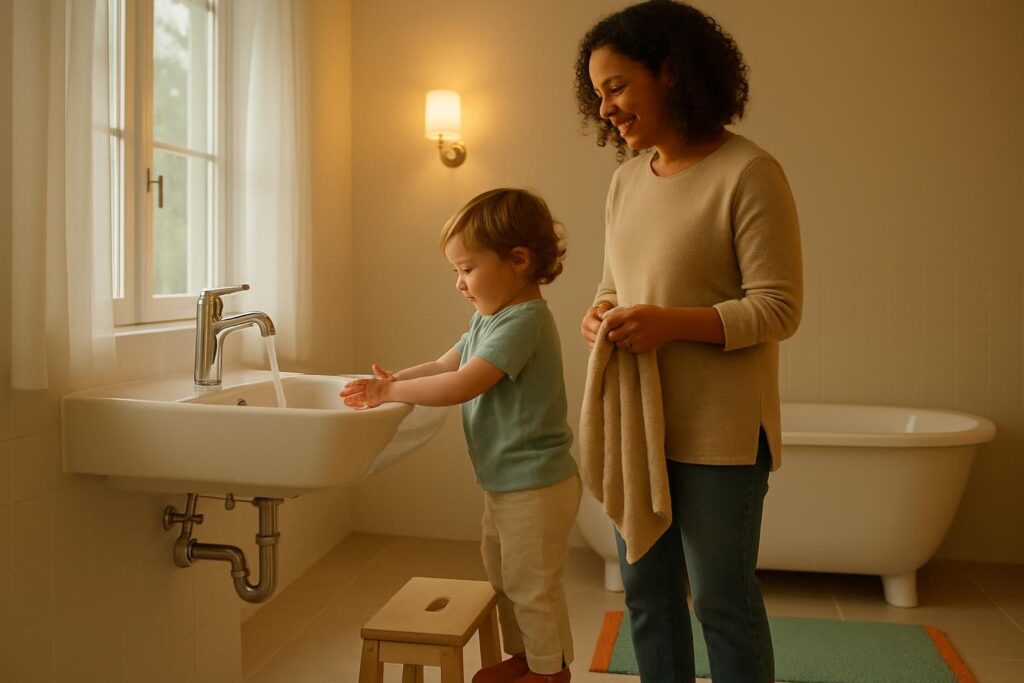
In the first block the child wears nothing below the waist so they can see and feel what is happening the moment it happens. As confidence grows, clothes and then pants go back on, outings become possible, and the parent gradually says less. “Prompting less” is the deliberate engine of the whole book: early on you ask often, then you ask less often on purpose, so the responsibility for noticing the need shifts from you to the child.
It is entirely normal for a child to slide back a block for a few days, particularly around a change like starting nursery or a new sibling. The book treats this as part of the process rather than a sign that something has gone wrong.
Why do parents start naked, and does it actually help?
The naked stage exists so the child feels the wee or poo happen in real time, with nothing absorbing it or hiding the sensation, which is how the connection between the feeling and the act gets made. Many parents find the first day or two of this stage genuinely helps a child who has previously seemed oblivious to what their body is doing.
In practice this means protecting your floors, sofa and mattress for a few days, and having at least fifteen pairs of pants ready for the stage once clothes go back on, since accidents in the early days are frequent and ordinary. Cotton pants rather than padded training pants matter here too: a child feels wetness much less clearly through a thick training pant, which works against the whole point of the stage.
Where it gets genuinely awkward is winter, shared or rented housing, childminders who cannot run a naked household, and siblings underfoot. None of that makes the method wrong, but it is worth being honest that the naked stage asks a lot of a household’s daily routine for a few days, which is exactly why some families prefer a structure built around short bursts at home followed by dressed outings instead.
Where does Oh Crap work well?
Oh Crap is strongest on mindset: it pushes parents to commit properly and drop nappies completely rather than going half in with pull ups during the day, which the book argues undermines the whole process. It is also genuinely good at normalising accidents and the resistance that often turns up partway through, so parents do not panic the first time a child refuses point blank.
The tone is conversational and often funny, and a lot of parents say that reassurance is worth as much as the technical content. If what you want is something to read before you start, rather than a box of physical materials to work through together, it fits that brief well.
Where do parents get stuck with it?
It is a long book to sit down and read properly while you are already mid way through a hard week, and plenty of parents end up skimming for the next step rather than absorbing the reasoning behind it. The hardest point for most families is not day two, as is sometimes assumed, but day four or five, when a child who is bored of constantly being asked “do you need a wee?” pushes back out of irritation rather than genuine difficulty. The practical answer at that point is to ask less often, not more, and hand a bit more of the responsibility back to the child.
Poo holding is a separate and very common sticking point that the naked stage alone does not solve for every child. If your toddler is avoiding poo on the potty entirely, our piece on when your toddler will not poo on the potty covers it in more detail. If a child is constipated or appears to be withholding stool for several days at a time, that belongs with a GP or health visitor rather than being managed through any potty training method alone.
Night time dryness is a different process again and usually comes later than daytime dryness, often by months, so it should never be judged against the same week. For what that stretch actually looks like, see what the first weeks out of night nappies look like.
Oh Crap vs the 3-day method vs the Potty Training Box Method
For an honest comparison of the main potty training methods, it helps to see them side by side rather than pitted against each other, since all three ultimately aim at the same endpoint: a child who tells you they need to go, without being asked.
| Method | How it starts | Rewards |
|---|---|---|
| Oh Crap! Potty Training | Naked at home, blocks progress as prompting decreases | None, low key verbal praise only |
| 3 Day Potty Training | Intensive three days of close watching at home | Minimal, occasional small treats |
| Potty Training Box Method | Three days at home, then short outings | Sticker cards of 3, 5, 7 and 9 squares, plus certificates |
The 3 Day Potty Training book by Lora Jensen is a short, intensive plan built around three concentrated days of watching a child closely at home. Our own article on the 3-day potty training method looks at that intensity in more depth.
The Potty Training Box Method is a boxed day-by-day programme where the first three days are spent at home, short outings follow once things settle, tracking schedules record when this particular child actually goes, and sticker cards of 3, 5, 7 and 9 squares are used in that order so the reward comes quickly at first and then thins out as the habit takes over. The Potty Training Box contains the programme booklet, instruction cards, compliment cards, those tracking schedules, the sticker cards, animal and poo stickers, two certificates, and a year of access to a community where questions get answered. Alongside it you still gather the usual things yourself, such as a potty, a step stool and plenty of pants.
How tracking schedules change what you notice
A tracking schedule is there to record when a specific child actually goes, so you learn their own timing and signals, not to impose a fixed timetable on them. The card used in the Potty Training Box has columns for the time your child drank, the time they were on the toilet, whether nothing happened, wee marked green for a success or red for an accident, poo marked the same way, and a notes column.
When filling it in, it helps to let your child drink a cup in one go rather than sipping it across the afternoon, because only then can you see how much went in and how long it genuinely took before they needed a wee. A half finished cup sipped over an hour tells you very little about that connection.
If you have been wondering how often you should actually put a child on the potty, the honest answer is to stop thinking in intervals altogether. Instead of a clock, ask your child directly, “will you tell me when you need a wee?”, with a few fixed exceptions that hold both during training and afterwards: before and after sleep, and before you leave the house. For a copy of the card itself, see the printable tracking chart.
Rewards or no rewards: does a sticker chart undo the learning?
Oh Crap avoids rewards on purpose, on the reasoning that a child should feel proud of mastering the skill rather than chasing a prize for it, and that reasoning is fair as far as it goes. The counter argument behind a sticker system is about sequencing rather than disagreeing on the goal: a card of three squares fills up fast, so a child sees early on that the new skill genuinely works, and then cards of five, seven and nine squares make the reward steadily rarer, so the habit has time to outlast the stickers rather than stopping the moment they do.
In the Potty Training Box, that builds towards two certificates, one for wees and one for poos, as a clear and celebratory end point. If you want to run a version of this yourself without the full box, a separate reward system with the same stepped sticker cards is also available on its own.
To see what a first success often looks like and feels like for a toddler, this is worth watching together straight after it happens:
Is your child ready for any of these methods yet?
Common signs that a child is getting ready include staying dry for longer stretches between changes, telling you after they have gone rather than during, showing curiosity about the toilet or potty, and being able to pull their own trousers up and down. None of these on their own proves readiness, but together they are a reasonable guide.
A child who is frightened of the potty or the toilet is not ready yet, whatever method you use. The sensible response is to build familiarity gently first, with no pressure to perform, and start the method properly once that fear has eased.
Take our readiness quiz to see where your child is right now.
Children who are autistic, have Down syndrome, or are non-verbal are often trained successfully using these same principles, usually over a longer stretch and by reading the child’s own signals closely rather than waiting for them to say the words.
What to do if your attempt does not work
Stopping and leaving it for a few weeks is a legitimate choice, not a failure of you or your child, and the method you were using will still be there when you try again. Comparing your timeline with another family’s is one of the least useful measures available, since so much of this depends on temperament and timing rather than effort.
Accidents and backsliding partway through are common and rarely mean the process has failed outright. Our piece on why accidents and regression happen goes through the usual causes without suggesting a purchase is the fix.
Some situations do need a medical opinion rather than a change of method: ongoing constipation, a child who seems to be withholding stool for days at a time, suspected signs of a urine infection, or bedwetting that continues well past age six. The NHS’s guidance on potty training covers general age expectations and when to involve a health visitor or GP, and its bedwetting page sets out when ongoing night-time wetting is worth raising with a doctor.
Frequently asked questions
What is the Oh Crap method of potty training?
It is the approach described in Oh Crap! Potty Training by Jamie Glowacki, in which a child goes nappy free at home, starting naked from the waist down, and moves through staged blocks as the parent prompts them less and less until the child signals the need themselves. It is a book to read, not a kit of materials.
How old should my child be to start the Oh Crap method?
The book itself is generally aimed at children roughly 20 to 30 months old, though every child develops differently and some families start a little later. A child who is frightened of the potty or toilet, at any age, should build familiarity first and start properly once that fear has eased.
Is Oh Crap potty training better than 3 day potty training?
Neither is objectively better, they simply structure the same goal differently. Oh Crap moves through staged blocks with gradually less prompting over however long it takes, while 3 Day Potty Training by Lora Jensen concentrates close watching into three intensive days at home.
Does the Oh Crap method work for poo as well as wee?
The same naked, close watching approach applies to poo, but poo holding is a very common sticking point that can take longer to resolve than daytime wee training. If a child appears constipated or is withholding stool for several days, that is worth discussing with a GP or health visitor rather than managing through any method alone.
Is it normal for a toddler to regress during potty training?
Yes, accidents and short periods of regression are a normal part of learning this skill and do not mean the process has failed. Changes like starting nursery, a new sibling, or even just tiredness commonly trigger a few days of backsliding before things settle again.
How often should I put my child on the potty?
Rather than offering the potty on a fixed interval, ask your child directly whether they will tell you when they need a wee, and use a tracking schedule to learn their own natural timing instead of imposing one. The exceptions that stay fixed both during and after training are before and after sleep, and before leaving the house.
Ready for the next step?
The Potty Training Box holds the day-by-day programme this article is built on: tracking charts that show you when your child actually needs to go, instruction cards for each day, and a reward system that tapers off on its own.
Sources
- NHS: Potty training your child (General age expectations for potty training and when to seek help from a health visitor…)
- NHS: Bedwetting (When ongoing bedwetting is worth discussing with a doctor)
This article was written with AI assistance and checked by Dustin van de Sande.