
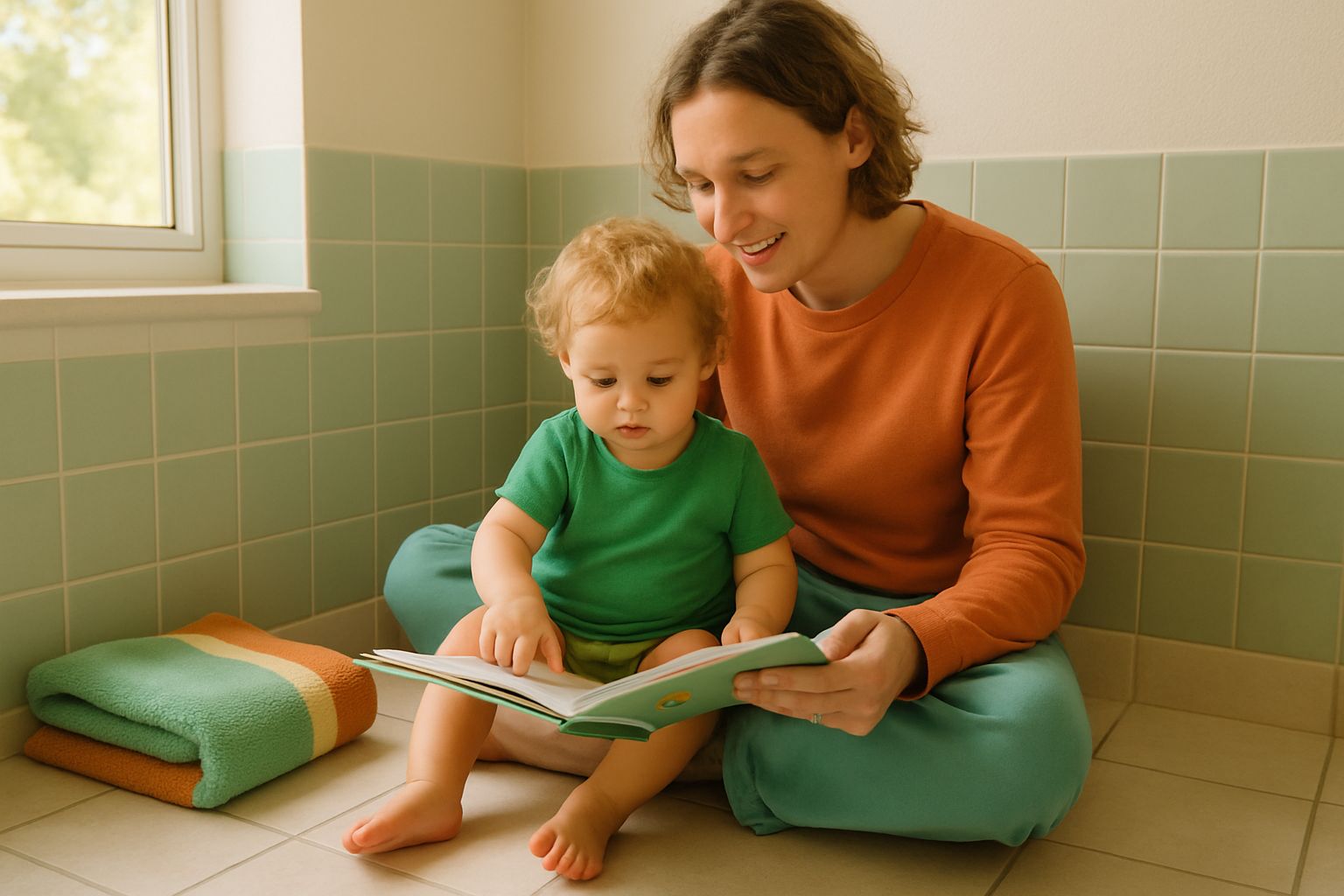
Toddlers who wee on the potty but won’t poo are usually dealing with one of three things: fear of a painful poo, underlying constipation, or the feeling that a poo is part of them they are not ready to let go of. This is common, not a sign that potty training has failed, and it usually responds to patience and small gradual steps rather than pressure.
Weeing is quick, familiar and easy to relax into. Pooing takes longer, needs the body to properly let go, and asks a toddler to feel safe enough to do that in a new place. A child who has only ever pooed standing up in a nappy, often tucked behind a sofa or curtain, is being asked to change the whole physical experience at once.
Nappy-only pooing is a coping strategy, not naughtiness and not a step backwards. Plenty of toddlers who wee confidently on the potty within days will still ask for a nappy, or hold on until nappy time, for weeks afterwards. That gap between wee and poo is one of the most common patterns parents report.
It helps to tell the difference between refusal and withholding early on. A child who refuses will hold on for a while and then go, usually in a nappy or pull-up, once they cannot hold any longer. A child who is withholding holds on for days at a time, which is a different and more physical problem that needs a professional’s attention rather than a parenting adjustment.
How do I tell the difference between poo refusal and constipation?
Poo refusal is behavioural: the child can go, but chooses not to on the potty. Constipation is physical: the poo itself has become hard, painful or difficult to pass, and that pain is often what starts the avoidance in the first place.
Signs worth watching for include hard or pellet-like poos, straining or crying when they do go, several days without a poo, small smears in pants between proper poos, tummy ache, and a loss of appetite. ERIC, the children’s bowel and bladder charity, notes that constipation is a common factor behind children who will only poo in a nappy and behind toilet avoidance more generally.
Constipation and stool withholding are matters for a GP, health visitor or child health clinic, not something to work through with an article alone. The NHS sets out clear signs of constipation in children and when to see a doctor, and that guidance is worth reading if any of the signs above sound familiar.
Withholding can turn into a cycle: a painful poo leads to holding on, holding on makes the next poo harder and larger, and a harder poo hurts more. Sorting out the physical side first, with proper medical support, makes far more difference than any potty training technique on its own.
What helps a toddler feel safe enough to poo on the potty?
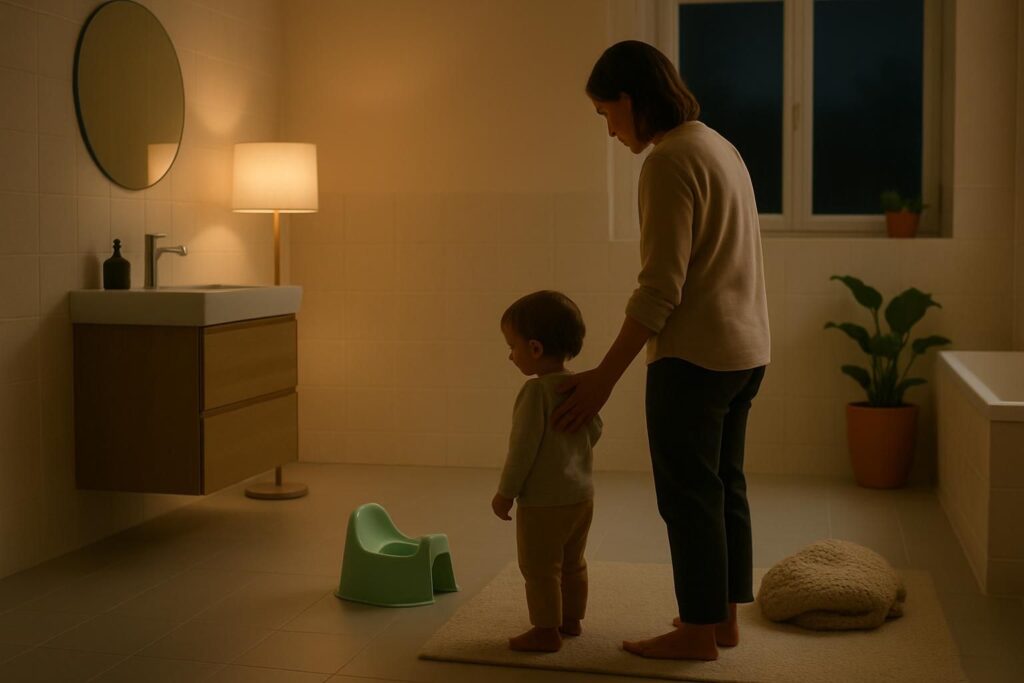
A toddler needs to feel physically supported and unhurried before their body will relax enough to poo. Small, practical changes to posture and privacy usually matter more than any script or reward.
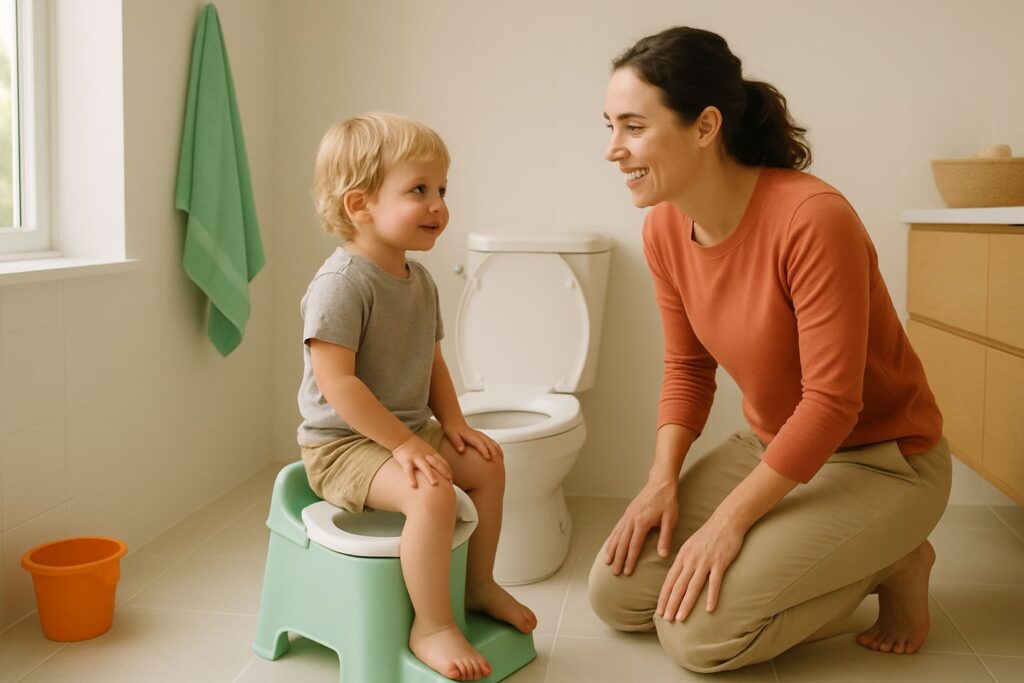
Feet need somewhere solid to push against, whether that is a step stool under a potty on the floor or a toilet seat reducer with a stool underneath at the toilet, so the knees sit higher than the hips and the back is supported rather than dangling.
Some children want the door shut and nobody watching; others want a parent right there talking to them. Follow what the individual child seems to want rather than a rule about it.
- Do not flush straight away. Some toddlers like to look, wave, or say goodbye to the poo before it disappears.
- Keep clothing below the waist loose or off entirely during the first few days at home, so nothing feels restrictive or fiddly in the moment.
- Name the feeling out loud, such as saying “your tummy is doing a wobble, that’s the poo feeling” so the child slowly learns to recognise and trust the sensation rather than fighting it.
- Never hold a child on the potty and never turn it into a stand-off. A toddler who feels trapped will simply hold on harder, and a battle here tends to make the whole stage last longer, not shorter.
Should I put my toddler on the potty at set times to catch a poo?
The aim is not to catch a poo on a schedule; the aim is for the child to eventually say they need to go themselves, and everything works towards that moment. A fixed timetable of sitting a child on the potty every half hour, regardless of how they are behaving, tends to backfire specifically with pooing, because letting go needs relaxation, not a summons.
Most toddlers do poo at a fairly predictable point in the day, often shortly after a meal, so the useful job for a parent is to learn when that is for this particular child rather than impose a time on them. That means noticing and writing down, for a week or two, roughly when poos happen, what the child was doing beforehand, and any signs that came just before it.
Common signs to watch for include going quiet or still, wandering off to hide behind furniture or a curtain, standing on tiptoe, holding onto a chair or table leg, or a particular concentrating face. Once a parent recognises these in their own child, they can offer the potty at the right moment instead of on the hour.
The 14 tracking schedules in the Potty Training Box are built for exactly this job: recording when a child actually goes, not dictating when they should. Offering the potty early in the process creates opportunities and gathers that information, and it is meant to taper away as the child starts to signal on their own, rather than becoming a permanent routine.
| Step | Move on when |
|---|---|
| Poo in nappy, anywhere | Child poos without distress wherever they naturally are |
| Poo in nappy, in the bathroom | Child is calm being brought to the bathroom beforehand |
| Nappy on, standing by the potty | Child poos as usual with the potty simply present nearby |
| Nappy on, sitting on the potty | Child sits and poos in the nappy without fuss |
| Nappy loosened underneath them | Child stays relaxed even if some poo falls through |
| No nappy | Child has been settled and unbothered at every earlier step |
The nappy-to-potty steps that work when a child will only poo in a nappy
The most reliable approach for a child who will only poo in a nappy is a gradual bridge, moving the location and the equipment closer together in small steps rather than removing the nappy all at once. Keep the poo happening throughout; never withhold the nappy to try to force the issue, since that risks turning a behavioural stage into constipation.
The sequence runs from poo in a nappy anywhere, to poo in a nappy in the bathroom, to standing next to the potty in a nappy, to sitting on the potty with the nappy still on, to the nappy loosened underneath them, and finally to no nappy at all. Each step can take anywhere from a couple of days to a couple of weeks, and the right moment to move on is when the child looks and behaves as relaxed at the new step as they were at the last one, not when a parent feels ready for progress.
Reward sitting and trying, not only a poo actually landing in the potty. A child who sits calmly for two minutes and then asks to get up and finish in a nappy has still done something worth praising, and building the reward around effort keeps the pressure off the result.
Praise goes stale fast if it is the same phrase every time, which is often the point at which parents run out of ideas by day four or five. Varying it, and having something ready for the moments when enthusiasm has worn thin, is one of the small practical things that makes a longer stretch easier to sustain.
A poo landing in the potty for the first time is worth marking as its own milestone, separate from wees. Poo stickers and a wee and poo diploma exist for precisely this reason, giving the child something concrete to show for a step that often took considerably longer and more patience than weeing did.
When is it better to pause and try again later?
It is better to pause when a child is holding on for poo for days at a time, screaming or panicking at the sight of the potty, or when every attempt has become a daily source of dread for the parent as well as the child. Pushing on through that kind of distress tends to make the whole stage longer, not shorter.
A child who is genuinely frightened of the potty or the toilet is not ready for this part of training yet, whatever their age. The honest answer is to build familiarity first through play, books and sitting fully clothed with no expectation attached, and to come back to it properly later.
The Potty Training Box Method‘s own advice is to stop and leave it a while before trying again, rather than grinding on through a bad run. That pause is part of the approach, not an admission that something has gone wrong, and most families who take a break find the next attempt goes more smoothly for having waited.
Results vary honestly from child to child. Most children are dry in the daytime in about a week using this kind of approach, some manage it in as little as three days, and others take two or three weeks, particularly where poo refusal is part of the picture. Night-time dryness is a separate skill that tends to come later and is not something any potty training approach can promise.
Putting nappies or pull-ups back on for a few weeks while a child settles is not going backwards. It is simply working with where the child actually is, and most children who pause and restart do so faster the second time around.
Where a day-by-day plan helps more than another list of tips
What most families are missing when poo refusal drags on is not more information but a plan for the specific days that go badly, and someone to ask when they do. The Potty Training Box is a physical box built around a day-by-day programme; it is not a potty, and not an ebook or an online course.
Inside is a training programme booklet that coaches a parent through the week step by step, 7 instruction cards as a short daily reminder of what to do, 6 compliment cards for the moments praise has run dry, 14 tracking schedules for learning this child’s own timing, 20 sticker cards running from 3 up to 9 squares so reward frequency tapers off gradually rather than stopping abruptly, 100 animal stickers and 20 poo stickers, a wee and poo diploma, and a year of access to a community where the brand’s experts answer questions seven days a week, including on exactly the days poo refusal flares up.
Alongside the box, it helps to have a few things ready before day one: a potty, mostly needed for the first three days, a toilet seat reducer, a step stool, at least 15 pairs of pants, something to protect the mattress and sofa, a handful of small rewards, and pull-ups for sleeping.
The first three days are spent at home, since that is when a child learns the most, with short outings following once things settle. The approach moves from potty to toilet, and works towards the child signalling their own need and learning to hold on, treating accidents as part of learning rather than failure.
It has also been used successfully with autistic children, children with Down syndrome and non-verbal children, usually over a longer stretch than a week and by reading a child’s own signals rather than waiting to be told in words. The same box is reusable for a later child, and a refill reward system is available separately for families who need fresh sticker cards for a longer or slower poo-training stretch.
None of this is the only way to get there. The method described here, gradual steps, recording rather than imposing, rewarding effort, pausing when it is not working, can be followed without the box using a notebook and the same principles.
Frequently asked questions
Why will my toddler pee on the potty but not poop?
Weeing is quick and easy to relax into, while pooing needs the body to fully let go, which feels bigger and less controllable to a toddler. Most children who do this are not being difficult; they are usually managing a fear of pain, mild constipation, or simply not yet feeling safe enough to let go outside a nappy.
How do I deal with my toddler's fear of pooing on the potty?
Build familiarity gently rather than pushing: let them sit on the potty fully clothed, praise sitting and trying rather than only results, and move through small steps such as pooing in a nappy while sitting on or near the potty before removing the nappy altogether. If the fear is intense or lasts many weeks, it is worth ruling out constipation with a GP or health visitor first.
Is it OK to let my toddler poo in a nappy while potty training?
Yes. It is far better for a toddler to keep pooing regularly in a nappy than to hold on and risk constipation, and this is a normal, temporary stage for many children during potty training. The gradual method of moving the nappy closer to, then onto, the potty works with this stage rather than against it.
What is a red flag when potty training?
Red flags include a child holding on to poo for several days, straining or crying when they do go, hard or pellet-like stools, tummy pain, or a loss of appetite. These point towards constipation or withholding and should be checked with a GP, health visitor or child health clinic rather than managed through potty training technique alone.
How long does poo refusal usually last?
It varies a great deal by child, lasting anywhere from a few days to several weeks, and sometimes longer for children who are anxious or have an underlying physical issue. Most children move through it gradually with patience and small steps rather than all at once.
Should I go back to nappies if my toddler will not poo on the potty?
It is reasonable to let a child poo in a nappy or pull-up while daytime weeing continues on the potty; this is not going backwards, it is working with where the child is. If distress is daily or the child seems frightened of the potty altogether, the method's own advice is to stop and leave it a while before trying again.
Sources
This article was written with AI assistance and checked by Dustin van de Sande.
Ready for the next step?
The Potty Training Box holds the day-by-day programme this article is built on: tracking charts that show you when your child actually needs to go, instruction cards for each day, and a reward system that tapers off on its own.