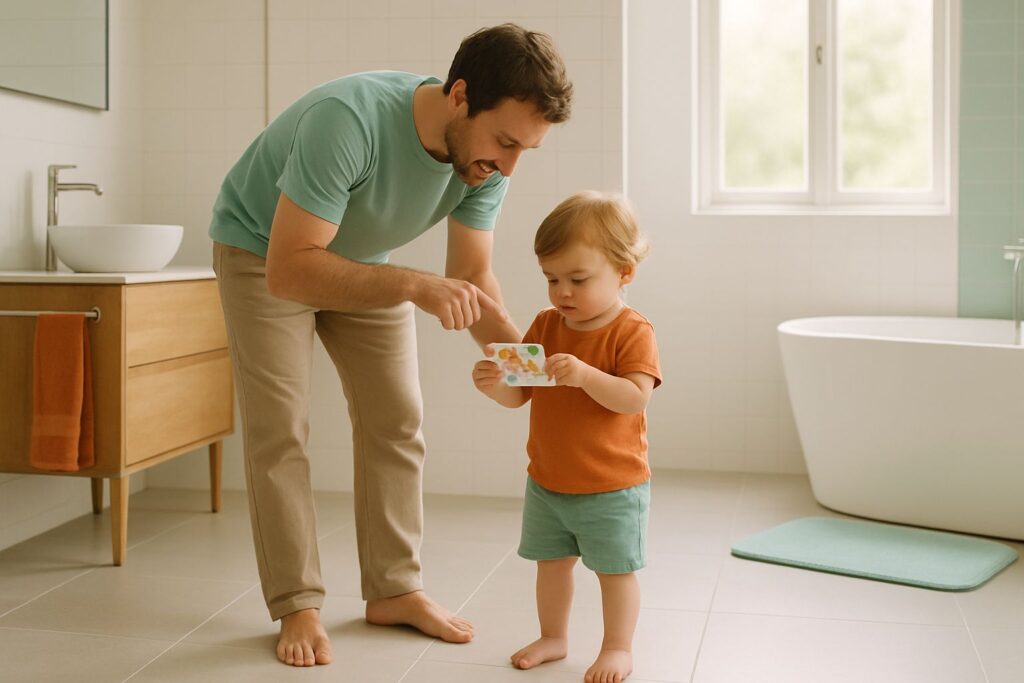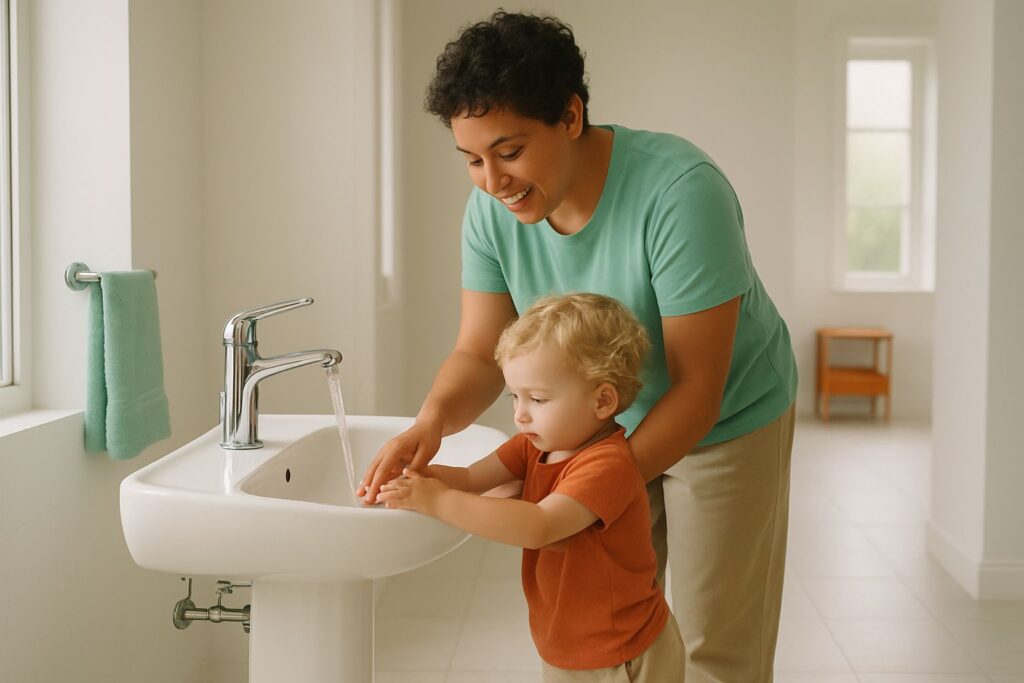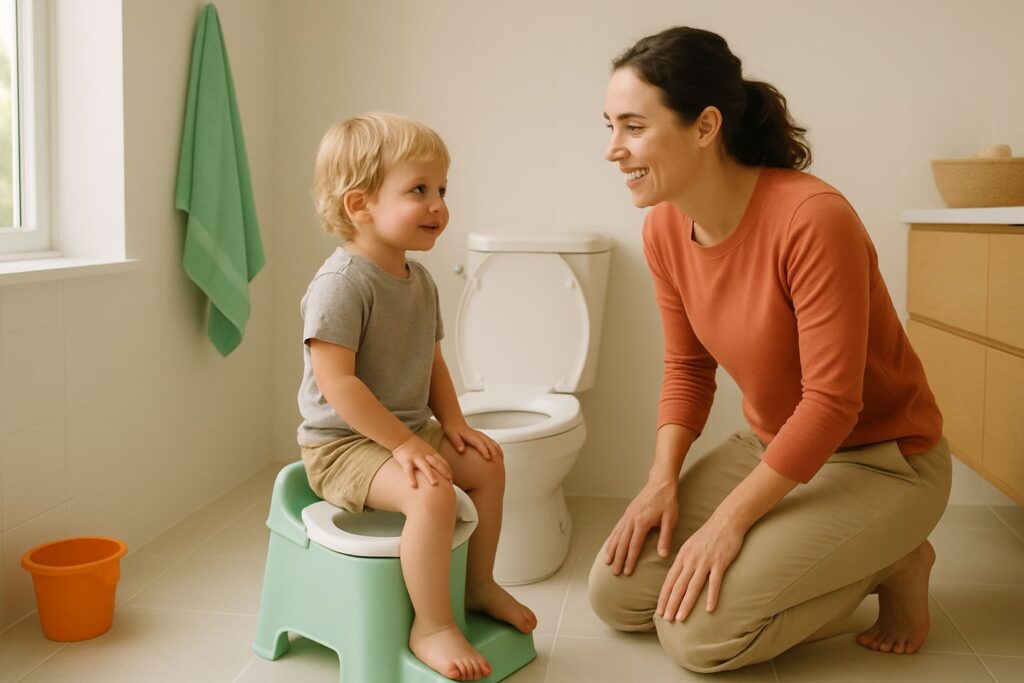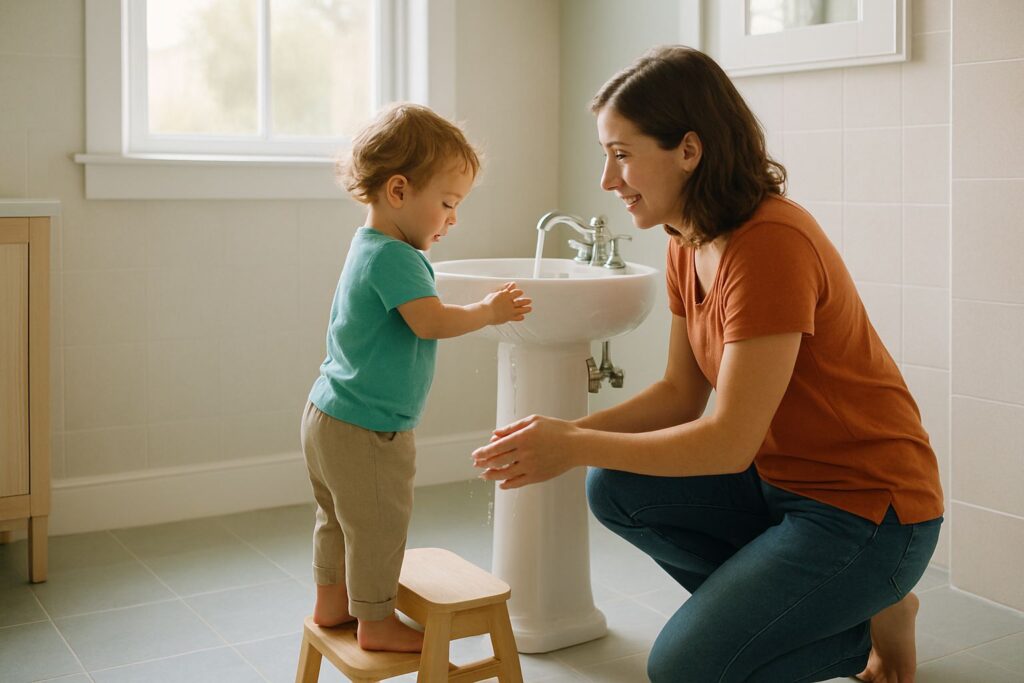

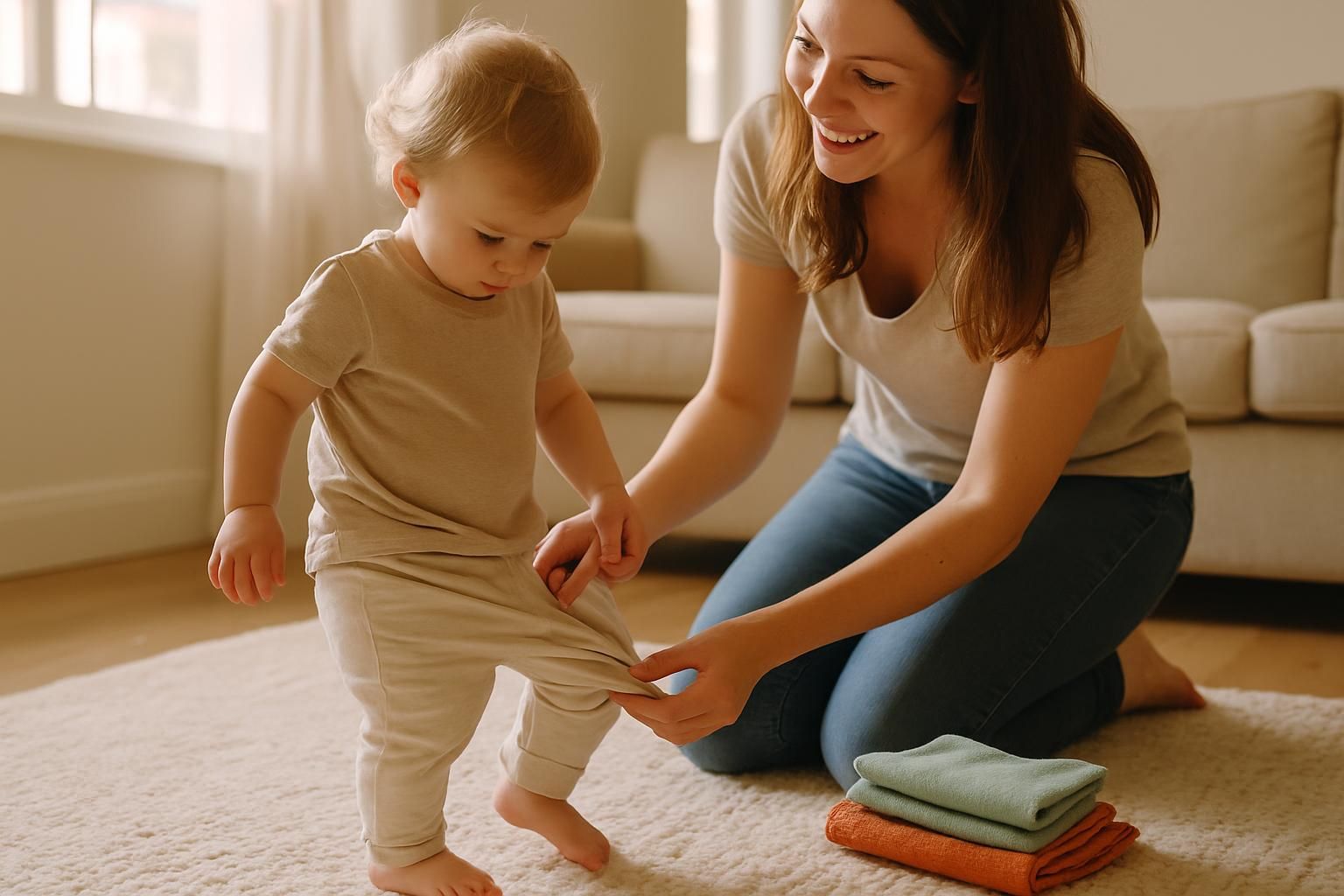
Check your toddler is ready, gather a simple kit (potty, toilet seat reducer, step stool, cotton pants, pull-ups for sleep), then clear three days at home to start. Most children are dry in the daytime within about a week. The Potty Training Box Method works by teaching your child to tell you, rather than asking on a timer.
That last part is the bit most guides skip, and it is the bit that actually decides whether the week works. The goal is not a child who gets put on the potty every twenty minutes. It is a child who comes to you and says they need a wee, because you have spent a few days learning their timing well enough to let them take over.
Night-time dryness is a separate matter and usually comes later, often months after daytime dryness is settled. Nothing in this week is designed to achieve it, and pull-ups for sleep stay in use for as long as your child needs them.
Is your toddler actually ready?
Most children show signs of readiness somewhere between eighteen months and three and a half years, though age on its own tells you very little. Some two year olds are ready and some are not ready until closer to three, and starting before a child is ready usually means a longer, more frustrating week rather than a faster one.
Look for a cluster of these rather than just one: staying dry for an hour or two at a stretch, showing curiosity about the toilet or potty, telling you after a wee has already happened, managing to pull pants up and down with help, and following a simple instruction like fetch your shoes. A child who is frightened of the potty or the toilet is not ready yet, whatever their age. The honest move there is to build familiarity gently, let them watch, sit on it clothed, read about it, and start the actual training later.
If you are not sure where your child sits, it helps to check against a proper list rather than guessing from one good or bad day.
Check your child’s readiness in two minutes
What do I need for potty training? The full kit list
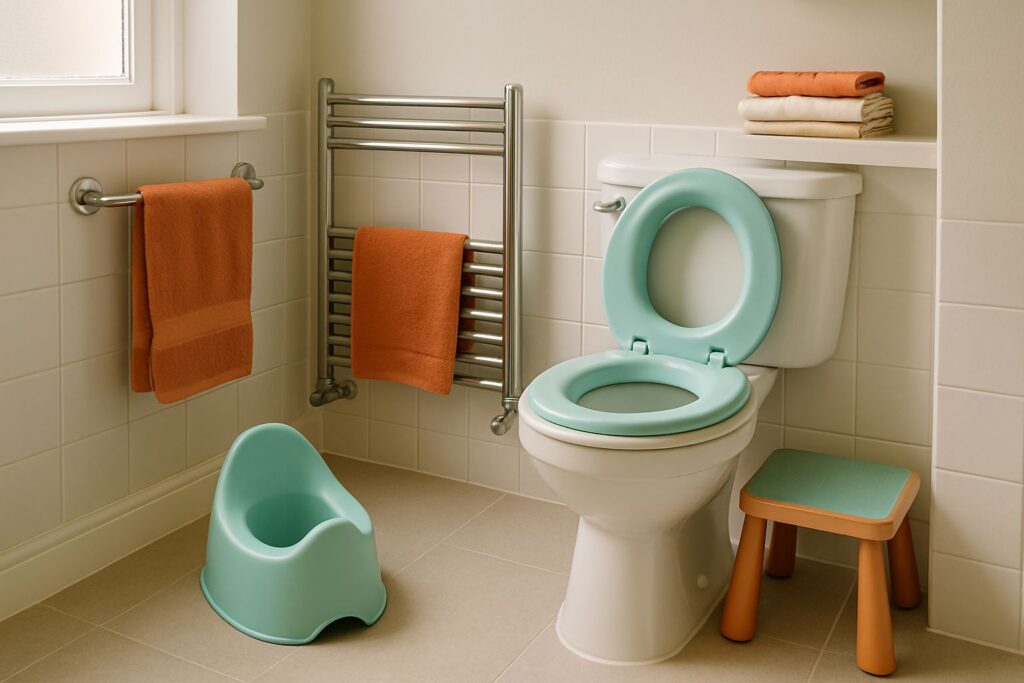
Before you start, it helps to have ready: a potty, a toilet seat reducer, a step stool, at least fifteen pairs of plain cotton pants, something to protect the mattress and sofa, a handful of small rewards, and pull-ups for sleeping. None of this needs to be expensive or elaborate, it just needs to be in the house before day one, so you are not hunting for pants mid-morning.
Plain cotton pants rather than padded training pants matter more than people expect. A child needs to actually feel wet to connect the feeling with the action, and why plain cotton pants work better explains the reasoning in more depth. Thick training pants that absorb everything quietly undo that feedback loop.
Some links in this article are affiliate links, which means we earn a small commission if you buy through them. It costs you nothing extra and does not affect what we recommend. A simple option for the potty itself is the BabyBjörn Potty Chair, for the toilet seat reducer the Munchkin Sturdy Potty Seat, and for the step stool the Dreambaby 2-Up Step Stool. For sleep, something like Huggies DryNites pyjama pants is a reasonable pull-up to have in, and bed mats such as the Huggies DryNites Bed Mats save a lot of 2am stripping of sheets.
If you want the fuller version of this list, including what you can safely skip, the complete potty training kit checklist goes through it item by item.
On top of what you gather yourself, the Potty Training Box gives you a day-by-day plan rather than another potty: a training booklet that coaches you through the week, and a set of sticker cards that grow harder to earn as your child improves. The rest of the kit, instruction cards, compliment cards, tracking schedules, certificates and a year of community access, all exists to support that same week.
The method in one line: your child tells you, you do not ask every half hour
Instead of offering the potty on a fixed interval, the method asks your child directly: will you tell me when you need a wee? That single question is the whole mechanic. You are not training a routine into the child, you are handing them the job of noticing their own body and reporting it.
The only moments where you still offer rather than wait are before and after sleep, and before you leave the house, and that stays true during the week of training and afterwards too. Everything else is led by the child.
Putting a child on the potty every ten or fifteen minutes regardless of signals mostly trains the parent to watch the clock. It does not teach the child to notice their own body, because there is never a gap in which noticing matters. Accidents in week one are information about timing, not evidence that something has gone wrong.
What the tracking schedule is for (and how to fill it in)
A tracking schedule records when your particular child actually goes, not a timetable you impose on them. Filled in for a few days, it shows you the gap between a drink and a wee, and the rough times a bowel movement tends to happen, which is exactly the information you need before you can stop offering and start waiting.
| Column | What it records |
|---|---|
| Time of drinking | When the drink happened |
| Time on the toilet | When they sat on the potty or toilet |
| Nothing (yes/no) | Whether anything happened that visit |
| Wee (green/red) | Green for a success, red for an accident |
| Poo (green/red) | Green for a success, red for an accident |
| Notes | Anything else worth remembering |
One detail matters more than it looks: let your child drink the cup in one go rather than sipping it across the morning. Only then do you actually know how much went in and how long it takes before they need a wee, which is the exact link the schedule is built to show you. How long after drinking a toddler needs a wee covers typical gaps in more detail. A printable version of this chart sits at the potty training tracking chart if you want to start filling one in today.
Potty training day one: what you actually do
Nappy comes off first thing in the morning and cotton pants go on, and you stay home all day. Offer plenty to drink, give the first cup in one go, and start filling in the tracking schedule from that first drink onwards.
Sit them on the potty for the first proper visit and use a sticker card with three squares, the smallest and quickest one, so a success comes fast and your child sees straight away that this works. Expect at least one accident, and treat it plainly: change them, say something like never mind, next time, and carry on rather than making it a moment. Keep day one free of outings, visitors and anything that adds pressure.
Days two to seven: what changes each day
Days one to three stay at home, because this is when your child learns the most and accidents are cheapest to deal with. Short outings start from around day four, timed against what the schedule has already told you about their typical gaps.
| Day | What you do | What to expect |
|---|---|---|
| 1 | Nappy off, home all day, start the schedule | At least one accident, first potty success |
| 2 to 3 | Stay home, ask a little less each day | Pattern starting to emerge on the schedule |
| 4 to 5 | First short outings, move towards the toilet | Resistance is common, often the hardest days |
| 6 to 7 | Fewer prompts, more waiting | Most children starting to tell you themselves |
Day four or five is usually the hardest day, not day two as some guides suggest, because by then your child is often bored of being asked will you tell me so often. The fix is to say it less, not more, and hand more responsibility back to them. Why day 4 or 5 is usually the hardest goes through why this happens and how to ease off without losing the progress you have made.
Moving from potty to toilet happens gradually across the week, with the seat reducer and step stool making the toilet usable on their own terms. Poos typically lag behind wees by some days, which is normal rather than a sign anything is wrong, and when your toddler will not poo on the potty is worth reading if that is where you are stuck by the end of the week. By day seven, most children are initiating at least some of their own visits.
For the fuller breakdown of each day with more detail than fits here, the full day-by-day plan for the week walks through it properly.
How the rewards work, and why the sticker cards get harder
The sticker cards come in four sizes, three, five, seven and nine squares, used in that order rather than as a single fixed card. The reward lands fast at three squares so your child sees quickly that this works, and then becomes steadily rarer, so the habit keeps going after the stickers have stopped being the main point.
Compliment cards exist for the days you have genuinely run out of new ways to say well done, and the two certificates, one for wees and one for poos, mark the end of the programme rather than every single success. Watch this one together right after the first success.
What if it is not working?
If the week is going badly, the method’s own advice is to stop and leave it a few weeks before trying again, rather than push through a run of accidents. That pause is a normal, planned part of the process, not an admission of defeat.
Resistance around day four or five is usually boredom with being asked so often, not a sign the approach has failed. Easing off the prompts for a day or two is often enough to get past it. Children who are autistic, have Down syndrome, or are non-verbal are also trained successfully this way, usually over a longer stretch, by reading their individual signals closely rather than waiting to be told in words.
Some things sit outside what any potty training approach should try to solve. Constipation, a child withholding poo, repeated urinary infections, or bedwetting that continues past the age of six are worth raising with a GP or health visitor rather than working through alone.
Can I do this without the box?
Yes, the same method can be followed without the box, using the printable tracking chart, and there are separate reward systems you can buy if you want to run your own version. What the box adds on top is a written plan that says exactly what to do on each day, including the days that go badly, plus a community of people to ask when something does not fit the plan.
If you would rather build your own reward system, separate sticker sets are sold on their own too, including an extra reward system you can use however suits your child. The box itself is also reusable for a younger sibling later, with refill sticker sets available separately when you need them.
Frequently asked questions
What is the fastest way to potty train a toddler?
The fastest results tend to come from clearing three full days at home, going straight into cotton pants with no nappy, and letting your child lead rather than offering the potty on a timer. Some children manage daytime dryness in as little as three days this way, though most take closer to a week.
What is the normal age for a toddler to be potty trained?
There is no single normal age, most children show the first signs of readiness somewhere between eighteen months and three and a half years. Readiness depends far more on the individual child's signals than on their exact age in months.
Is it normal for a 2 year old to not be potty trained?
Yes, it is entirely normal. Many children are not ready until closer to three, and starting before a child shows real signs of readiness usually makes the process longer rather than faster.
How often should I put my toddler on the potty?
Rather than a fixed interval, the method asks your child directly whether they will tell you when they need a wee, with the potty only offered automatically before and after sleep and before leaving the house. A tracking schedule in the early days shows you your child's actual timing so you know when to step back and let them lead.
Should I use training pants or normal pants?
Plain cotton pants work better than padded training pants, because your child needs to actually feel wet to connect the sensation with the action. Padded pants absorb too well and quietly remove that feedback.
How long does potty training take?
Most children are dry in the daytime within about a week, with some managing it in three days and others needing two to three weeks. Night-time dryness is separate and usually comes later, and is not something any week-long programme promises.
Ready for the next step?
The Potty Training Box holds the day-by-day programme this article is built on: tracking charts that show you when your child actually needs to go, instruction cards for each day, and a reward system that tapers off on its own.
This article was written with AI assistance and checked by Dustin van de Sande.