
Parents commonly find a toddler needs a wee somewhere between 10 and 30 minutes after a decent drink, though it can take up to an hour, and small sips may cause no urge at all. Bladders also empty on their own schedule, so a toddler can need a wee an hour or two after their last drink with no clear trigger. There is no fixed rule, and the gap varies widely between children.
Parents ask this question hoping for a number they can set a timer to, and it is easy to see why. A specific figure feels safer than watching and waiting. But a toddler’s bladder does not run on a stopwatch, and the honest answer is a range, not a rule.
Why the gap is different for every child (and every day)
A toddler’s bladder capacity grows with age, so a two year old and a three and a half year old can hold on for quite different lengths of time even after the same drink. How much they drank, and what it was, matters too: a full beaker of water behaves differently to a few sips of milk or a small cup of squash.
Heat changes things noticeably. On a warm day, or after time spent running around a garden or soft play, more of what a toddler drinks is lost through sweat rather than turned into wee, so the gap after a drink can stretch out. Being unwell has the opposite effect for some children and no effect at all for others, which is part of why a single rule never quite fits.
Being engrossed in play changes the picture just as much as anything physical does. A toddler deep in a game of trains may hold on far longer than usual, not because their bladder has changed but because their attention has, and some children will hold on to the point of visible discomfort rather than stop what they are doing. The same child who wees ten minutes after a drink at breakfast might go an hour after a drink at teatime.
Waking up from a nap is its own special case. A toddler’s bladder carries on filling while they sleep, so a drink offered the moment they wake can be followed by a wee within minutes, not because the drink worked fast but because the bladder was already close to full before it was topped up.
Constipation and a full bowel can also affect how often a child needs to wee, because a full rectum presses on the bladder. This is not something to try to manage yourself if it is ongoing: a health visitor or GP is the right person to speak to about persistent constipation in a young child.
Watch the child, not the clock: the signals that come before the wee
The clearest sign a toddler needs a wee is a change in behaviour, not a length of time since their last drink. Common signals include going quiet mid-play, crossing legs, jiggling or wriggling, holding themselves, suddenly going still, going red in the face, or disappearing behind the sofa or a curtain.
These signals often appear only seconds to a couple of minutes before the wee itself, which is exactly why staying close to the potty in the first few days of training matters so much. Some toddlers give almost no visible signal at all, and for those children the pattern of timing becomes the useful clue instead of a physical cue.
The end goal is not a parent who guesses correctly every time. It is a child who says, out loud or by heading to the toilet themselves, that they need to go. Watching for signals is a bridge to that point, not the destination.
What you notice and what usually helps
| What you notice | What usually helps |
|---|---|
| Just had a big drink | Stay nearby and offer soon after |
| Going quiet in play | Ask gently, don’t demand |
| Jiggling or holding themselves | Move towards the potty calmly, no rush of panic |
| Just woken from a nap | Offer the potty straight away |
| Engrossed in the telly | Pause the screen and offer before it restarts |
How to work out your own child’s timings in two days
The most useful thing a parent can do is write down the time of every drink and every wee, whether it lands in the potty or not, for two full days at home. This is not about hitting a target number of successes. It is about building a picture of that particular child’s pattern.
Look for that child’s own average gap between drinking and needing a wee, rather than searching for a general figure that applies to all toddlers. Every child’s pattern is slightly different, and a record beats a guess every time.
It is worth being clear about what this record is for. It is a way of learning what the child does, not a timetable to impose on the child. Offering the potty regularly in the early days creates chances for the child to succeed and gives the parent information to work with, but that offering is scaffolding, and it comes down as the child starts to signal for themselves.
Sitting a child on the potty every 20 or 30 minutes because a clock says so teaches a different lesson than the one most parents intend. Instead of learning to notice their own body, the child learns to wait for an instruction. The aim of potty training is the opposite: a child who recognises the feeling and acts on it, with or without a parent’s prompt.
This recording task is exactly what the 14 tracking schedules in the Potty Training Box are built for. They give a simple place to note down drinks, wees and accidents over the first few days, so the pattern becomes visible rather than guessed at. The box also includes a year of access to the community, where the brand’s experts answer parents’ questions seven days a week, which is worth knowing given how many small judgement calls a parent makes in that first week.
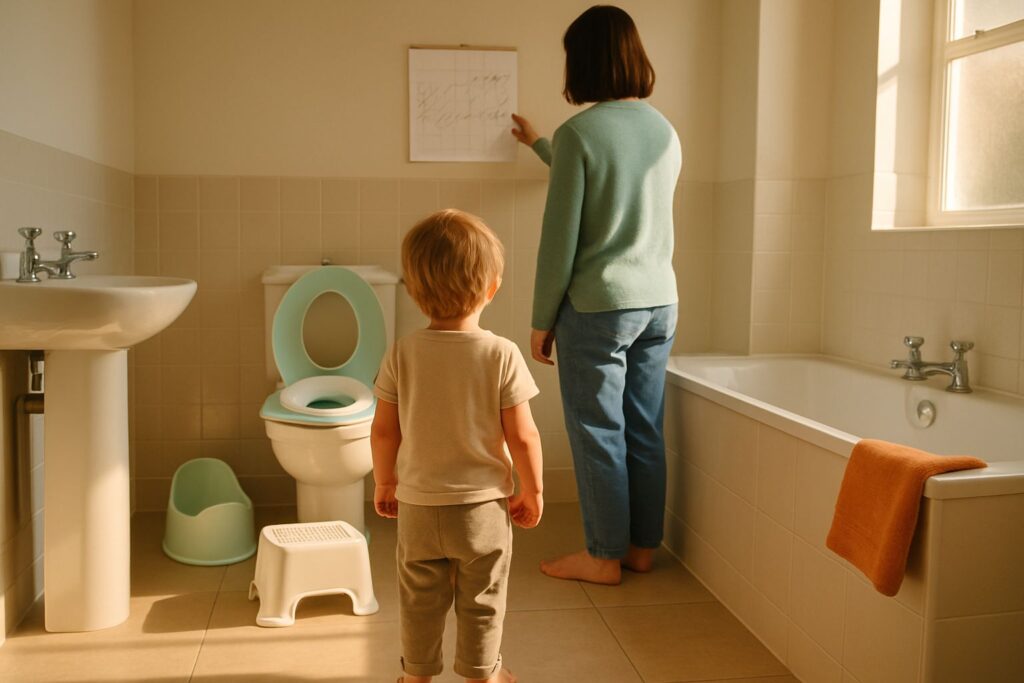
It is worth having a potty, a toilet seat reducer, a step stool, plenty of pants, something to protect the mattress and sofa, a few small rewards, and pull-ups for sleeping ready before day one. The Potty Training Box Method itself can also be followed without the box, using a notebook and the same principles.
Should you cut back drinks to reduce accidents?
No. Restricting drinks to try to avoid accidents is a common instinct but not a helpful one, and it works against what a toddler’s bladder needs to learn during training.
NHS guidance is that children should be offered regular drinks through the day during potty training rather than having fluids cut back, because a bladder needs to fill and empty repeatedly to learn to do that job well. Spreading drinks across the day, rather than one large drink all at once, tends to make patterns easier to read too, since a huge single drink produces one big surge rather than a series of readable gaps.
Night-time dryness is a separate matter that usually comes later than daytime training, and the Potty Training Box does not promise it. A child in nappies or pull-ups overnight while dry in the day during this period is entirely normal.
If there is ongoing constipation, pain when weeing, unusually frequent weeing, or any suspicion of a urinary infection, that is a matter for a GP or health visitor rather than something to work through with training alone.
What the timings look like across the first week
In the first three days, spent mainly at home, a parent is mostly noticing and offering, and there will be plenty of near misses and accidents along the way. Day one often means offering the potty often, after drinks and at natural breaks in play, simply to gather information about when this child actually goes, and it is common for a parent to feel like they are guessing more than they are succeeding.
Day two usually brings the first clear signals, a jiggle here, a sudden pause there, and the parent starts to trust those over guesswork.
By day three, many toddlers are heading towards the potty themselves for at least some of their wees, though accidents are still entirely normal and are treated as part of learning rather than a setback.
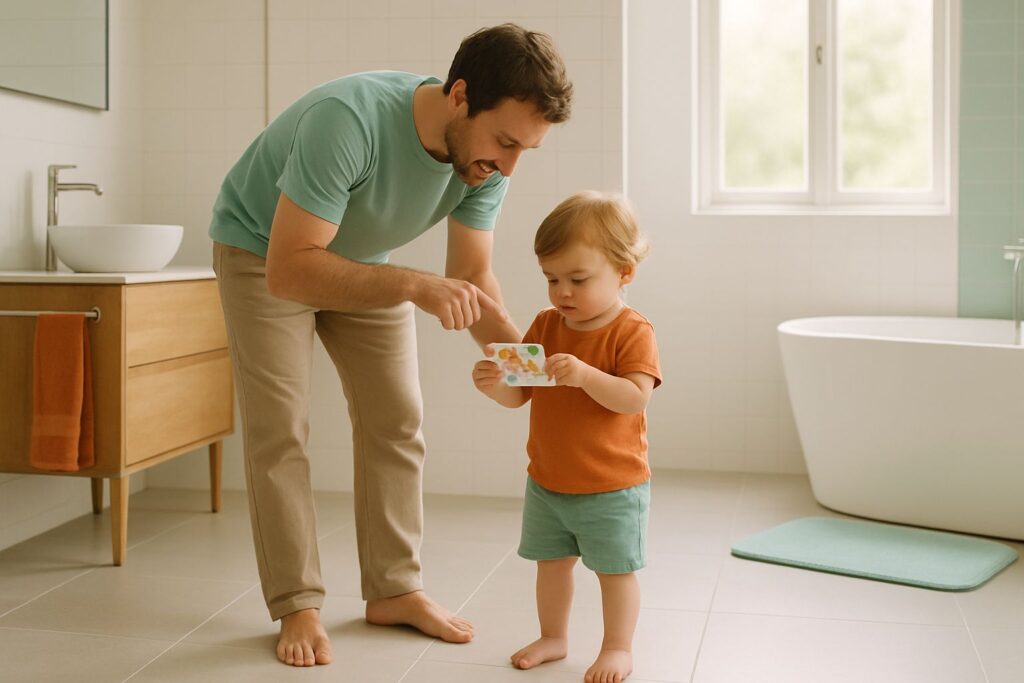
Short outings usually follow once the child is showing their own signals reasonably reliably, rather than being scheduled by the calendar. As the days go on and successes build up, the sticker cards taper from larger grids down to smaller ones, so praise and reward naturally reduce as the child needs them less. If a family gets through the stickers included and wants to keep the same approach going for a younger sibling later, or simply needs more, refill sets and the extra reward system are sold separately.
Most children are dry in the daytime in about a week using this kind of approach, though some manage it in as few as three days and others take two or three weeks, and that range is entirely normal too. A child who is frightened of the potty or the toilet, or who simply is not ready yet, is better off waiting and starting again later rather than being pushed through it.
If an attempt is not working, the method’s own advice is to stop and leave it a few weeks before trying again, rather than persisting through repeated distress. For a fuller picture of what the daily plan actually involves, including the days that go badly, it’s worth reading why the Potty Training Box works in about a week.
Frequently asked questions
How long after drinking does a toddler need a wee?
Parents commonly find a toddler needs a wee somewhere between 10 and 30 minutes after a decent drink, though it can take up to an hour, and small sips sometimes cause no noticeable urge at all. Bladders also empty on their own schedule, so a toddler can need a wee an hour or two after their last drink with no obvious trigger. There is no fixed rule, and the gap varies widely from child to child.
How often should a 2 year old wee in a day?
There is no single number that fits every toddler, since bladder capacity increases with age and varies between children. ERIC, the children's continence charity, notes that as a child's bladder matures they typically wee less often but pass a larger amount each time, so a general pattern of several wees spread across the day is normal and the gaps between them grow with age. Recording your own child's pattern over a couple of days gives a far more useful answer than a general figure.
Should I put my toddler on the potty every 20 minutes?
No, sitting a child on the potty at fixed intervals because a clock says so tends to teach them to wait for an instruction rather than notice their own body's signals. Offering the potty is useful in the early days to create chances to succeed and to gather information, but this offering should reduce as the child begins to signal for themselves. The aim is a child who recognises the feeling, not a parent who guesses on schedule.
Should I limit my toddler's drinks during potty training?
No, drinks should not be restricted during potty training. NHS guidance is that children should be offered regular drinks through the day, because a bladder needs to fill and empty repeatedly to learn to do that job properly.
How do I know if my toddler needs a wee if they do not tell me?
Watch for physical signals such as going quiet mid-play, crossing legs, jiggling, holding themselves, going still or red in the face, or hiding behind furniture or curtains. These signs often appear only seconds to a couple of minutes before the wee itself, so staying close by helps in the early days. Some children give very few visible signals, in which case a written record of their timing pattern becomes the more useful clue.
Why does my toddler wee straight after getting off the potty?
This usually means they did not fully empty their bladder while sitting, often because they got up too soon or were distracted. It is common in the early days of training and tends to settle as the child gets used to sitting long enough and relaxing. It is not a sign that anything has gone wrong with the training.
Sources
This article was written with AI assistance and checked by Dustin van de Sande.
Ready for the next step?
The Potty Training Box holds the day-by-day programme this article is built on: tracking charts that show you when your child actually needs to go, instruction cards for each day, and a reward system that tapers off on its own.