
For most families, the hardest stretch to potty train is from around age 3 onwards, not toddlerhood itself. The easiest window usually falls between 18 and 30 months, when children are physically ready but have not yet built the words to negotiate or refuse. Readiness matters more than age, and a child who is not ready should simply wait.
If you are reading this because your three or four year old is pushing back hard, you are not doing anything wrong, and you are far from alone. Plenty of children start later than 30 months, for all sorts of good reasons, and most still get there in about a week once they are ready. The NHS notes that almost all children can be potty trained somewhere between 18 months and two and a half years, which gives you a useful sense of the range, not a deadline.
Why does 3 plus feel harder than 2?
A three year old is usually harder to potty train than a two year old because they have a stronger sense of ‘no’ and far more invested in resisting a change to their routine. Nappies have been normal for longer, the habit runs deeper, and your child now has the words to argue with you about it.
A two year old who is offered the potty might simply go along with it. A three year old can refuse outright, negotiate for five more minutes, hold on deliberately to prove a point, and read your frustration the second it shows on your face. That is not defiance for its own sake. It is a child who is developmentally capable of asserting themselves, and potty training happens to be the territory where that assertion plays out.
The encouraging part is that once an older child is on board, the physical side of learning is often quicker, because the bladder control was already there. ‘Harder’ at this age usually means more pushback in the early days, not more weeks of learning overall.
Is 3 too late to potty train?
No, three is not too late, and plenty of children start at three or even later with good results. Bladder and bowel control typically develop well before a child is willing to cooperate with training, so an older child often picks up the mechanics fast once they decide to engage.
What changes with an older child is your approach. Less persuading, more handing your child the responsibility for noticing and acting on their own body. You ask less and expect more, rather than the other way round.
There are a few things that fall outside the scope of potty training itself and belong with a professional: ongoing constipation, a child who seems to be withholding poo, no progress at all with an older child who was previously showing no interest, or soiling outside the nappy. A GP or health visitor is the right person to talk to about any of those, rather than trying to manage it through a potty training programme.
Age by age: what tends to be easy and what tends to be hard
Here is a rough guide to what usually helps and what usually gets in the way at each stage. None of this is a guarantee, every child differs, but the pattern holds often enough to be useful.
| Age band | Usually in your favour | Usually makes it harder |
|---|---|---|
| Under 18 months | No real opinions to fight yet | Bladder and bowel control often simply is not there yet physically |
| 18 to 30 months | Physically ready, not yet skilled at refusing | Limited vocabulary to describe the feeling of needing to go |
| Around 3 | Learns fast once they decide to try | Strong opinions, more negotiating, more deliberate holding on |
| 3 and a half plus | Can follow instructions and manage pants independently | Habit is deeply set, resistance can be stubborn and loud |
ERIC, the children’s bowel and bladder charity, notes that most children are ready to lead parts of the process themselves from around 18 months, which is why that window tends to go smoothly for so many families. If you want the fuller picture of timing, the 18 to 30 month window is covered in more depth elsewhere on this site.
Signs your child is ready, whatever their age
Readiness looks the same whether your child is 20 months or 4 years old. Watch for these signs rather than counting birthdays: staying dry for an hour or two at a stretch, telling you or showing you they are going, being able to pull trousers up and down on their own, following a simple two step instruction, and showing some interest in the potty or the toilet.
For an older child, or a child who is non-verbal, the signs are read rather than spoken. This approach is used successfully with autistic children and children with Down syndrome, usually over a longer stretch and by watching the child’s own signals rather than waiting to be told in words.
If your child is frightened of the potty or the toilet, that is a clear sign they are not ready yet. The sensible move is to build familiarity first, in a low pressure way, and start the actual training later. Not every child shows every sign at the same time, so if you are unsure where yours stands, a short readiness check can help.
How do you avoid a potty training power struggle with a 3 year old?
The fastest way into a battle with a three year old is sitting them on the potty every 30 minutes on a fixed schedule. That turns the whole thing into something being done to them, and a three year old with strong opinions will fight you on principle.
Instead, ask your child directly: ‘will you tell me when you need a wee?’ That single shift hands the responsibility to your child rather than keeping it with you, and it is the question at the centre of the Potty Training Box Method, a day by day programme that moves a child from nappy to pants over about a week using tracking schedules to learn this particular child’s timing and stickers that step up as they improve.
There are only a few fixed moments worth keeping even with this approach: before and after sleep, and before you leave the house, both during the training itself and afterwards. Outside those, you record what actually happens rather than imposing a timetable on your child, which is exactly what a tracking schedule is for. You can use a free printable tracking chart to do this yourself if you are not using the box.
Give your child real choices where you can. Which pants to wear, which sticker to pick. And when the asking itself starts to wear thin around day four or five, as it often does with an older child, dial it back and let them carry more of it themselves.
My 3 year old is refusing the potty completely. What now?
Resistance in an older child commonly peaks around the middle of the week, once they are tired of being asked the same question over and over. Many families find day 4 or 5 is usually the hardest day, not day one or two as you might expect.
If you are in the middle of that, lower the pressure rather than pushing harder. Ask less often, react calmly or not at all to accidents, and keep praise short and specific rather than lavish. A bored, defiant three year old usually responds better to less fuss, not more.
If it genuinely is not working after a real attempt, the honest and recommended move is to stop and leave it a few weeks before trying again, rather than grinding on through daily battles. That pause is part of the method, not a failure of it.
If your child is specifically wary of the potty itself rather than the whole process, this might help as something to watch together.
What a week looks like when you start later
The plan does not change much for an older child, though the tone of your conversations does. Three days at home to start, nappy off, straight into cotton pants rather than training pants, because your child feels wetness less clearly through a padded pant and that dulls the very feedback training depends on.
After those first three days, short outings follow, and the focus moves gradually from potty to toilet. For the full breakdown of what each day actually involves, the full week, step by step walks through it in order.
Results are genuinely good but not guaranteed: most children are dry in the daytime in about a week, some manage it in as little as three days, and others need two or three weeks, which is entirely normal for an older or more resistant child. Night time dryness is a separate skill that develops later on its own and is not something any potty training approach promises on a timeline. If you have not looked at the subject broadly yet, how to toilet train is a good general starting point.
What helps most when your child is older
For a lot of families with an older, more opinionated toddler, having a concrete plan in hand matters more than it did at 20 months, simply because there is more pushback to work through. The Potty Training Box is a physical box built around a day by day programme, with tracking schedules that record the time your child drinks, the time on the toilet, and whether a wee or a poo was a success or an accident, so you can see this particular child’s own pattern rather than guessing at one. For the drink to tell you anything useful, it helps if your child drinks a full cup in one go rather than sipping it across the afternoon, since that is what lets you see how long it takes between a drink and a wee.
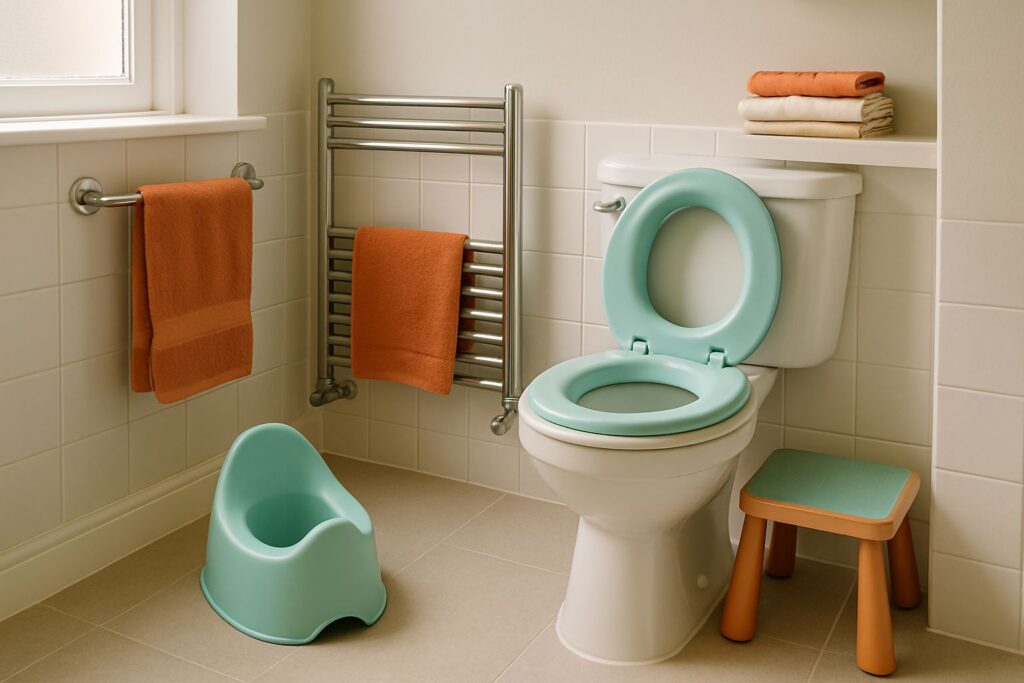
The sticker cards that come with it matter more with an older child than a younger one, because they come in four sizes used in order, 3, 5, 7 and then 9 squares. The reward lands quickly at just three squares so your child sees straight away that it works, then becomes rarer as they improve, so the habit itself outlasts the stickers rather than stopping the moment they do. Alongside the box, it is worth having a potty ready for the first few days, a toilet seat reducer, a step stool, plenty of cotton pants, something to protect furniture, small rewards, and pull-ups for sleeping. The box also comes with a year of access to a community where the brand’s own experts answer questions daily, which tends to matter most on the days that are not going smoothly.
If you would rather try your own version of this, with your own rewards and your own way of recording what your child actually does, there are loose reward systems available separately, such as the (Extra) Reward system Potty Training, for a parent who wants to put something together their own way. There is also a Potty Training Box – Digital Handbook for parents who prefer to work from a written guide rather than physical cards.
Frequently asked questions
Is age 3 too late to potty train?
No, three is not too late at all, and plenty of children start then or later. Bladder control is usually already in place by this age, so the physical side often goes faster than it would have at two. What takes longer is the cooperation, since an older child has more say in whether they are willing to join in.
What is the hardest age to potty train?
For most families, the hardest age is 3 and over rather than toddlerhood itself, because older children have the words and the will to resist. The window between roughly 18 and 30 months is usually the easiest, since children tend to be physically ready without yet having the pushback of an older toddler. Readiness matters more than the exact age either way.
At what age are most girls fully potty trained?
There is no reliably sourced figure specific to girls, and readiness varies far more by the individual child than by sex. The NHS states that almost all children can be potty trained somewhere between 18 months and two and a half years, which applies broadly regardless of gender. Watching for your own child's readiness signs is a better guide than an average age.
Is it normal for a 5 year old to not be potty trained?
It is less common by age 5 and worth raising with a GP or health visitor, particularly if there is soiling, ongoing accidents, or signs your child is withholding poo. Occasional accidents at night are a separate matter at this age and a professional can point you towards the right guidance if that is relevant. Daytime training that has not started by 5 deserves a proper conversation with a professional rather than guesswork at home.
How often should I put my 3 year old on the potty?
Rather than a fixed interval, the better question to ask your child directly is whether they will tell you when they need a wee, so they own the signal rather than you imposing a timetable. The only moments worth keeping fixed are before and after sleep and before you leave the house. A tracking schedule is there to record what your child actually does, so you learn their pattern instead of guessing at one.
My 3 year old was trained and has started having accidents again. What does that mean?
Occasional accidents after being trained are common and often linked to a change at home, a new sibling, starting nursery, or simply tiredness, and they are not a sign training has failed. Stay calm about it, keep your reactions low key, and avoid reaching straight for a full retraining programme as the fix for a run of accidents. If the accidents are frequent, ongoing, or come with soiling, it is worth checking in with a GP or health visitor.
Ready for the next step?
The Potty Training Box holds the day-by-day programme this article is built on: tracking charts that show you when your child actually needs to go, instruction cards for each day, and a reward system that tapers off on its own.
Sources
- NHS (Almost all children can be potty trained between 18 months and two and a half years old…)
- ERIC (Education and Resources for Improving Childhood Continence) (Most children are ready to lead parts of the potty training process themselves from aro…)
This article was written with AI assistance and checked by Dustin van de Sande.