

A child is usually ready for potty training when they show bladder awareness, can get around and manage clothing, understand simple instructions, and are willing to cooperate, generally somewhere between 18 months and 3 years. A scored quiz turns that vague feeling into a clear answer: ready now, nearly there, or wait a few weeks.
Age on its own tells you very little. Two children born a week apart can be a year apart in readiness, and pushing ahead of it usually means more accidents and more frustration for both of you, not a faster result. The useful question is not “how old is my child” but “which of these specific things can they already do”. That is what the quiz below checks, one item at a time.
Is my child ready for potty training? The short answer
Readiness comes down to four things: a bladder that can hold on for a stretch, enough mobility and hand control to get to the potty and manage clothing, understanding of simple instructions, and a willingness to cooperate rather than fight you at every step. Most children show a workable combination of these somewhere between 18 months and 3 years, though the exact month varies hugely from one child to the next.
A proper readiness quiz takes all four areas into account at once, rather than letting one strong sign (like being dry overnight, which is a different skill entirely) stand in for the whole picture. There is a link to a free online version of that test further down this article, once you have seen what it actually checks for.
The 12 question readiness quiz, scored honestly
Answer each question for how your child has actually been over the last two weeks, not for the one brilliant afternoon you are tempted to remember. A single weak answer does not rule anything out. A cluster of them, especially in one group, is the thing worth paying attention to.
| Question | What you are looking for | Score |
|---|---|---|
| Stays dry for an hour or two at a stretch | Bladder is storing urine, not just emptying constantly | 2 / 1 / 0 |
| Poo comes at roughly the same time of day | A predictable pattern you could learn to anticipate | 2 / 1 / 0 |
| Can walk to another room and back without help | Enough mobility to get to the potty in time | 2 / 1 / 0 |
| Can sit still for a couple of minutes | Enough patience to sit on the potty or toilet | 2 / 1 / 0 |
| Can pull trousers and pants down with a bit of help | Basic clothing management, even if not independent yet | 2 / 1 / 0 |
| Follows a simple two step instruction | “Pick up the cup and put it on the table” type instructions | 2 / 1 / 0 |
| Understands words for wee and poo | Has language for what is happening in their body | 2 / 1 / 0 |
| Tells you after they have been, at least sometimes | Noticing it has happened at all, even after the fact | 2 / 1 / 0 |
| Shows interest in the toilet or potty, or copies others | Curiosity rather than avoidance | 2 / 1 / 0 |
| Dislikes sitting in a dirty or wet nappy | Wants the nappy changed, pulls at it, complains | 2 / 1 / 0 |
| Is generally willing to try new routines | Not in the middle of a blanket no phase to everything | 2 / 1 / 0 |
| No current fear of the potty or toilet | Will sit on it clothed without distress | 2 / 1 / 0 |
Score 2 for a clear yes, 1 for sometimes or partly, 0 for not yet. Add it up out of 24.
- 18 to 24: ready now. Most of the groundwork is in place and this is a reasonable week to pick a start date.
- 10 to 17: nearly there. A few more weeks of ordinary life, without any pressure, will likely close the gap.
- Below 10: wait and re-score in four to six weeks. Starting now is more likely to mean a stressful few weeks for everyone with little to show for it.
If you would rather answer this interactively and get the same kind of result without doing the maths yourself, there is a free online version of it.
If you would prefer the signs laid out as a plain list rather than a scored quiz, the readiness signs checklist covers the same ground in a quicker read.
What does the 18 to 30 month window actually mean?
Most children become able to use the potty somewhere between 18 months and 2 and a half years old, with night-time dryness developing separately and later, once daytime control is already established. That is a window in which most children become able to do this, not a deadline by which they must.
Plenty of children start later than 2 and a half and do perfectly well. Nappies do tend to get a bit harder to shift the longer a child has worn them, simply because the habit is more established by then, but later is not failure, and a child who was not ready at 20 months may be entirely ready at 28.
The signs that mean your child is ready
These are the specific, checkable things to watch for over an ordinary week, not a single good day:
- Dry for one to two hours at a stretch, rather than trickling constantly
- Tells you after an accident, and sometimes starts to tell you just before
- Can pull trousers and pants down with a little help
- Follows a simple two step instruction without needing it repeated
- Shows interest in the toilet, or copies an older sibling or a parent
- Dislikes sitting in a dirty nappy and lets you know
- Poos at a fairly predictable time of day
- Can sit still for a couple of minutes without needing to get up
Potty training red flags: when to wait instead
A child who is genuinely frightened of the potty or the toilet is not ready, whatever their age or how many other boxes they tick. The honest move is to build familiarity first and start properly later; nothing is lost by waiting a few weeks.
Big disruptions are worth waiting out too: a new baby arriving, a house move, starting at nursery, or a bereavement in the family. A toddler coping with one major change rarely has spare capacity for another, and starting mid-upheaval tends to produce more stress than progress.
A strong no to almost everything right now, not just the potty, usually points to an ordinary resistance phase rather than a readiness problem. That one tends to pass on its own.
Constipation, pain when weeing, long-standing straining, or a pattern of withholding poo are medical matters, not readiness questions, and they belong with a GP or health visitor rather than an article. If your child seems to be afraid to poo rather than simply disinterested in the potty, that is worth working through gently before you think about starting at all, and a doctor is the right first call if there is pain or withholding involved.
Your own capacity counts as a factor too. The first three days of this approach are spent mostly at home, so a chaotic fortnight with visitors, travel or a house full of building work is a good reason to pick a calmer date rather than push through regardless.
When your child says no to the potty: what that usually means
A flat refusal can mean three quite different things: genuine fear, plain boredom with the whole idea, or a two year old testing a boundary because that is what two year olds do. It is worth working out which before deciding what to do next.
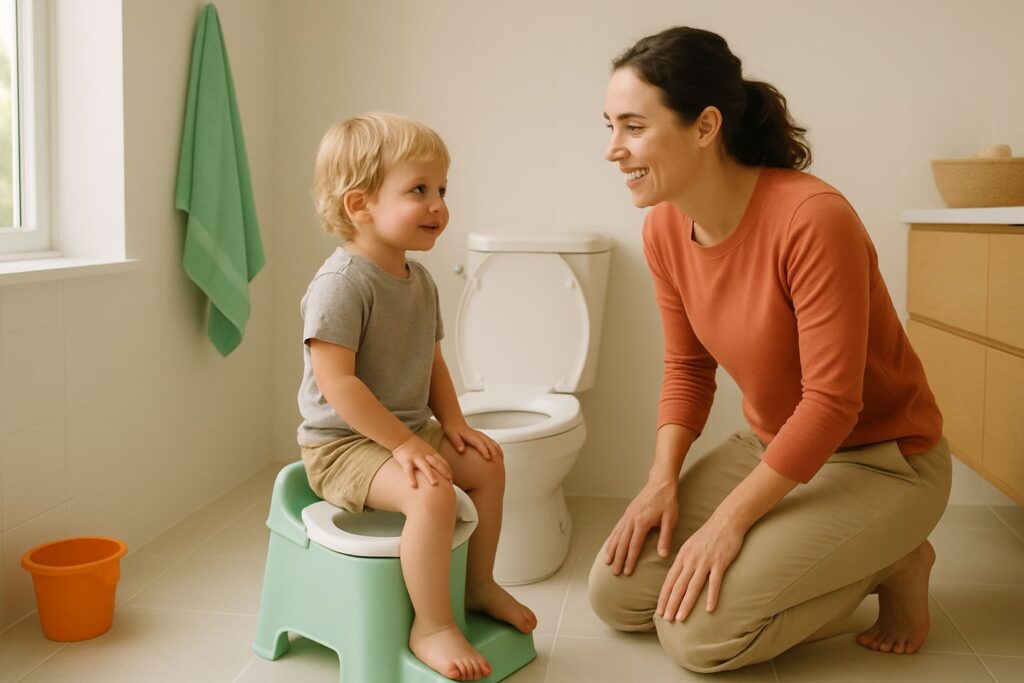
For fear specifically, pressure-free familiarity works better than persuasion. Put the potty in the room with no expectation attached, let your child sit on it fully clothed while reading a book, flush the toilet together as a non-event rather than a big moment.
Watching something together, with no demand attached to it, can help take the edge off too.
If your child is still clearly unhappy about it after a few weeks of this, the kit simply keeps until they are ready for it. There is no clock running on a box sitting in a cupboard.
Readiness looks different for some children, and that is fine
For some children, readiness is better read through signals than waited for in words. Autistic children, children with Down syndrome, and non-verbal children are potty trained successfully all the time, usually over a longer stretch than a week and by a parent learning to notice the body language that comes before the instruction cards get used.
Physical readiness, such as a bladder that can hold on, and communication readiness, such as being able to tell you about it, do not always arrive at the same time in every child. One can lag well behind the other without anything being wrong.
A highly sensitive child can also look “not ready” when the real issue is sensory or emotional rather than developmental; a highly sensitive child often needs the same groundwork done more gently and more slowly, not a different set of signs altogether. Any ongoing developmental concern is one to raise with a GP, health visitor or paediatrician rather than guess at from a quiz.
Your quiz says not yet. What do you do for the next six weeks?
A low score is not a dead end, it is a punch list. Narrate nappy changes rather than rushing through them: stand your child up, name what has happened, let them watch and ask questions if they have any.
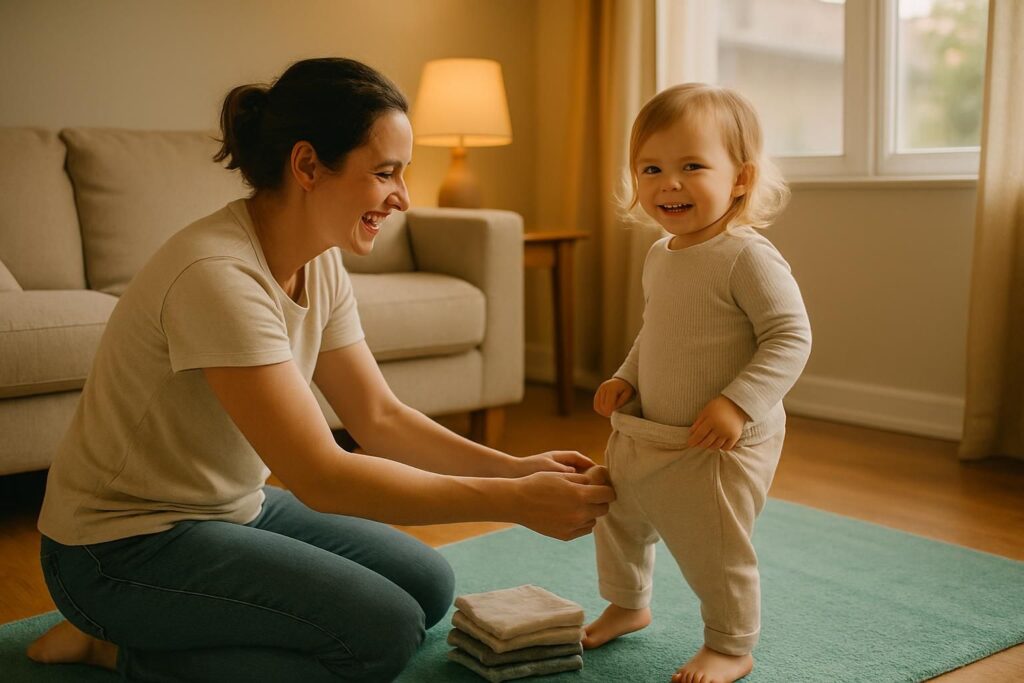
Practise the clothing side separately from the toilet side. Elasticated waists and a few rounds of pulling trousers and pants up and down, turned into a small game, build the exact hand skill you will need later without any pressure attached to it.
A picture book read together, with no agenda beyond enjoying it, does a surprising amount of the groundwork. Ready for My Potty is a gentle option for this age and stage.
Re-score the quiz in four to six weeks rather than guessing when the moment has arrived. Resist any urge to bribe or pressure during this waiting stretch; the whole point of it is that there is nothing on the line yet.
Your quiz says ready. What does the first week actually look like?
A ready score means you can pick a date and follow a clear plan rather than improvising. The Potty Training Box follows the Potty Training Box Method, a day-by-day programme over roughly a week, the first three days spent mostly at home because that is when a child learns fastest, followed by short outings once things are settled.
Nappy comes off and your child goes straight into ordinary cotton pants, not training pants, because they can actually feel what is happening rather than being cushioned from it. The tracking schedules exist to record when this particular child goes, so you learn their own timing over a few days, not to impose a fixed timetable on them.
Rather than sitting your child on the potty by the clock, the question you ask through the day is simply “will you tell me when you need a wee?”, so the responsibility for noticing stays with them. The only moments with a fixed offer are before and after sleep and before you leave the house, during the training and afterwards too. Sticker cards build from three squares up to five, seven and then nine, so the reward comes fast at the start to show your child it works, then grows rarer as the habit settles in, which is the whole mechanism rather than a single fixed card.
Results vary and that is worth saying plainly: most children are dry in the daytime in about a week, some manage it in three days, and others take two to three weeks. Night-time dryness is a separate skill that comes later on its own and is not something this week promises. You can read more detail on how long potty training usually takes if you want a fuller picture before you start.
What to have ready before day one
Alongside whichever plan you follow, it helps to have a potty ready for the first few days, a toilet seat reducer and step stool for the move to the big toilet, at least fifteen pairs of cotton pants, something to protect the mattress and sofa, a few small rewards, and pull-ups for sleeping only.
When you fill in the tracking schedule, it helps to let your child drink the whole cup in one go rather than sipping it over the course of an hour. That is the only way to see how much went in and how long it then takes before they need a wee, which is exactly the pattern the schedule is there to show you.
Some links in this article are affiliate links, which means we earn a small commission if you buy through them. It costs you nothing extra and does not affect what we recommend. A simple option for the potty is the My Carry Potty travel potty, for the toilet seat reducer the Nuby Beginner’s Potty Training Seat, and for the step stool the Dreambaby 2-Up Step Stool.
There is also a free printable tracking chart if you would rather note timings on paper from the start. If you want to try the approach your own way with a system of build-up rewards rather than the full box, the (Extra) Reward system Potty Training is sold on its own for exactly that.
If you are planning around a nursery start date or a school deadline, out of nappies before reception covers the timing question specifically.
If you start and it does not work, stopping is part of the plan
A run of accidents, a child who holds on until they get home, or sudden distress at being asked usually mean the timing was off, not that your child is difficult or that you did something wrong. These are signs worth reading rather than pushing through.
The method’s own advice when this happens is to stop, go back to nappies without any drama around it, and leave it a few weeks before trying again rather than grinding on regardless.
Day four or five is often the hardest day, not day two, because by then children frequently get bored of being asked “will you tell me when you need a wee?” so often and push back against it. The fix is asking less often and handing more responsibility back to your child, not asking more insistently.
None of this is a verdict on your child or on you. A kit kept for a few weeks, or for a second child down the line, has lost nothing by waiting.
Frequently asked questions
How can I tell if my child is ready to start potty training?
Look at four areas together: can they hold their bladder for an hour or two, can they get around and manage clothing, do they follow simple instructions, and are they generally willing to cooperate. A child showing a solid mix of these, usually somewhere between 18 months and 3 years, is likely ready, and a scored quiz like the one above turns that impression into a clearer answer.
What is the 10-10-10 rule for potty training?
It is a phrase some parents use informally rather than an official guideline from any health body or charity. There is no single agreed definition of it, so it is more useful to look at the specific, checkable signs in a proper readiness quiz, such as staying dry for a stretch, following simple instructions and showing interest in the potty, rather than trying to apply a catchy rule with no fixed meaning.
What are the UK guidelines on when to start potty training?
There is no single official age at which every child should start. Most children become able to use the potty somewhere between 18 months and 2 and a half years old, with night-time dryness developing separately and later, but the right time for any individual child depends on the specific readiness signs being present rather than the calendar.
Is 18 months too early to start potty training?
Not necessarily, some children show genuine readiness signs by 18 months, but many do not show a full combination of them until closer to 2 or 3 years old. The month on the calendar matters far less than whether the specific signs, such as staying dry for a stretch and following simple instructions, are actually present.
My child is scared of the potty. Does that mean they are not ready?
Yes, fear is one of the clearest signs that it is not the right moment yet, whatever else looks ready. The useful next step is building familiarity with no pressure attached, letting your child sit on the potty clothed and get used to it being in the room, and trying again properly once that fear has settled.
What if my child is ready but I am not?
Your own capacity genuinely counts as part of readiness, because the first three days work best spent mostly at home without other major disruptions going on. If the next fortnight is unusually chaotic, it is entirely reasonable to wait for a calmer stretch rather than start on a date that suits the calendar but not your household.
Ready for the next step?
The Potty Training Box holds the day-by-day programme this article is built on: tracking charts that show you when your child actually needs to go, instruction cards for each day, and a reward system that tapers off on its own.
This article was written with AI assistance and checked by Dustin van de Sande.