School Readiness and Toilet Training: What You Actually Need to Know Before Reception

No, there is no legal requirement for your child to be toilet trained before starting Reception. In practice most schools strongly expect daytime dryness by September and will ask you to flag it if your child is not there yet, so starting with enough runway before your target date matters more than hitting a fixed age.
What schools actually want is practical, not academic: a child who can get themselves to the toilet, pull their own pants down, wipe reasonably well, and say when they need to go. None of that requires perfection on day one of term. If your child is not there yet, that is not a failure on your part, and there is a plan that gets most children dry in the daytime within about a week once they are ready to start.
What the latest figures on school readiness and toilet training actually say
There has been public discussion about how many children start Reception still in nappies, and about when toilet training is best attempted. Where a figure cannot be checked against a page that actually states it, it is safer to leave the number out rather than repeat it secondhand, so this article does not quote a specific percentage or a specific survey result here.
What can be checked is the NHS guidance on potty training tips, which sets out the kind of signs to look for rather than a single age at which every child is ready. It does not set a deadline tied to school admission, and no official guidance recommends one method of toilet training over another.
What any figures or campaigns around school readiness do not do is set a deadline for your own child. They describe patterns across many children, not a measurement of any individual toddler, and there is no published evidence that one week is a legal or medical cut-off point. If you want the practical side of this conversation, including what to say to the school and how to plan the weeks that are left, the companion piece on starting school in nappies goes through it step by step.
What age should you start if your child starts school next September?
Work backwards from the actual start date, not from your child’s birthday. A child who turns four in August and starts Reception that same September has a far shorter runway than one who turns four in January, even though both start school at the same time.
The core training week needs three clear days at home with no holiday, house move, new sibling or other disruption, because that is when a child learns the most. Build in a buffer: aiming to be dry months before term starts, rather than in the final week of August, gives you room to consolidate the habit, handle a wobble, and still have time to try again if the first attempt does not take.
| When your child starts Reception | Latest sensible point to start the training week |
|---|---|
| Starts next September | Autumn or winter before, so there are months to consolidate |
| Starts this September, and it is spring | Pick a quiet three day stretch before the summer holidays begin |
| Starts this September, and it is already August | Start now only if your child is genuinely ready, and tell the school either way |
Summer-born children have the shortest realistic runway of all, since their fourth birthday often falls close to the school start date itself. If that describes your child, readiness matters more than waiting for a round number of months, and starting as soon as the signs are there is usually better than waiting for an arbitrary date.
Most children are dry in the daytime within about a week of starting, once they are ready. Some manage it in as little as three days, others take two or three weeks, and a small number need longer. A child who is not yet showing signs of readiness is better off waiting a little longer than being pushed to hit a date. Once you have a start date in mind, it helps to look at what to do in the week before day one so the first morning is not also the first time you are thinking about any of this.
Is your child actually ready, or just old enough?
Age on its own tells you very little. What matters is what your child is actually doing day to day. Signs worth watching for include:
- Staying dry for a couple of hours at a time, rather than needing a nappy change constantly
- Showing curiosity about the toilet or potty, or wanting to copy you or an older sibling
- Telling you after they have had an accident, then gradually telling you just before
- Being able to pull their own trousers and pants down and back up
- Following a simple two step instruction, such as fetching their potty and sitting on it
If you are not sure where your child sits against these signs, the readiness quiz can help you work through it properly.
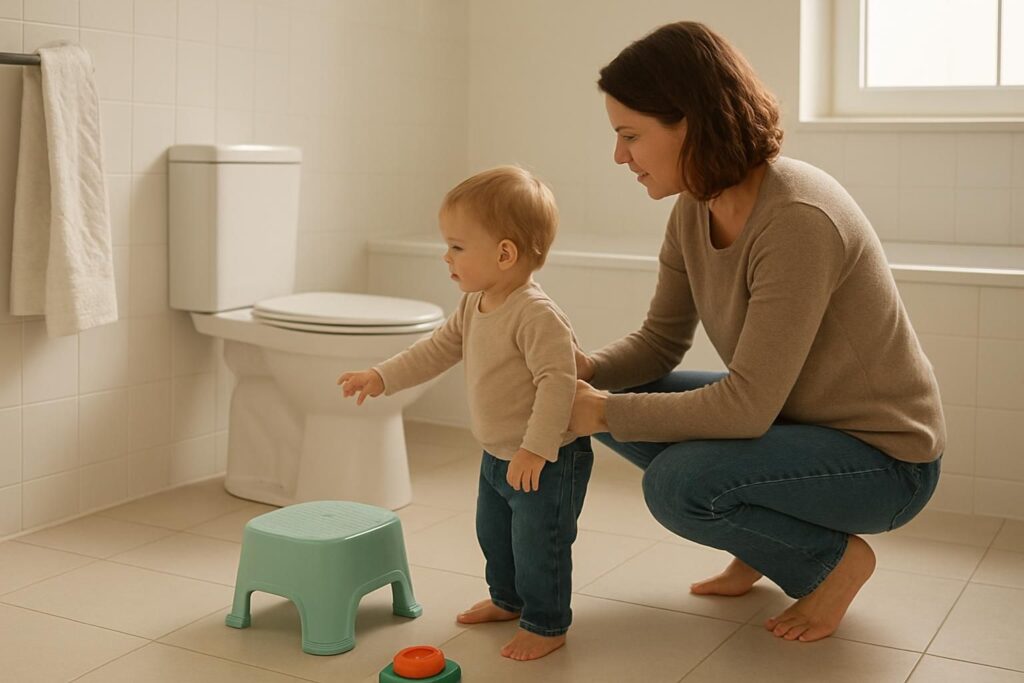
A child who is frightened of the potty or the toilet is not ready, whatever their age. The honest answer in that situation is to build familiarity first, perhaps letting them sit on it fully clothed, flush it themselves, or simply get used to it being in the room, and to start the actual training later once that fear has settled. There is no need to rush this: pushing ahead while a child is scared tends to make the fear worse rather than resolve it, and waiting a few extra weeks rarely matters against a September date.
If fear of the toilet is where you are right now, it can help to watch something together that puts the child, not the parent, in charge of getting used to it.
Some links in this article are affiliate links, which means we earn a small commission if you buy through them. It costs you nothing extra and does not affect what we recommend.
A picture book can also take some of the pressure off, since it lets your child meet the idea of the potty somewhere low stakes. Pirate Pete’s Potty is a popular choice for exactly this stage.
For more detail on the specific signs and how to weigh them against each other, the readiness signs checklist goes through each one in turn.
What the training week actually looks like, day by day
The Potty Training Box Method works like this: nappy comes off, the first three days are spent at home, the child uses the potty first and moves to the toilet as they gain confidence, and short outings follow once things are settling, with most children dry in the daytime over about a week. The Potty Training Box builds this plan around a day-by-day programme booklet, 7 instruction cards, 6 compliment cards for the days you run out of ways to say well done, 14 tracking schedules, 20 sticker cards that grow from 3 squares up to 5, 7 and 9 as your child improves, 100 animal stickers and 20 poo stickers, a wee certificate and a poo certificate, and a year of access to a community where questions get answered. If you would rather put a plan together your own way, separate reward systems are also available on their own.
Nappy off means ordinary cotton pants from the start, not training pants. A child feels wetness in cotton pants in a way they do not in a padded training pant, and that feedback is part of how they learn to notice the sensation before they go.
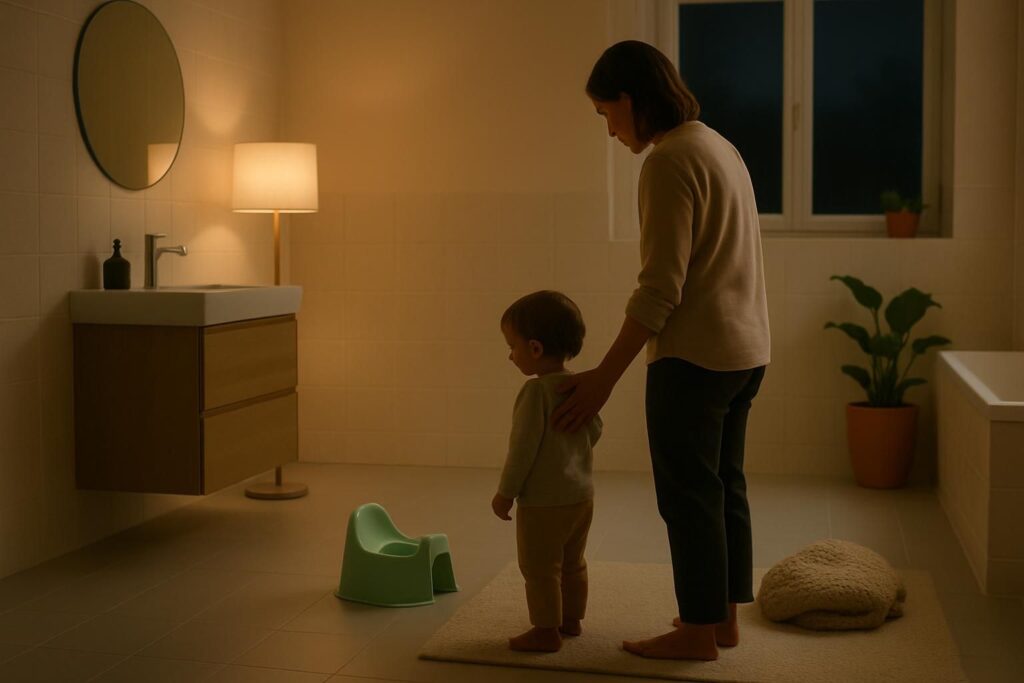
Rather than putting your child on the potty by the clock, the approach is to ask them directly: will you tell me when you need a wee? That question hands the initiative to the child instead of imposing a schedule on them. The fixed exceptions are before and after sleep, and before you leave the house, both during the training week and afterwards, since those are moments worth checking regardless of how well things are going.
A tracking schedule is used during this week to record when your particular child actually goes: what time they drank, what time they were on the toilet, whether nothing happened, and whether a wee or poo was a success or an accident, plus a notes column. For this to tell you anything useful, it helps if your child drinks a cup in one go rather than sipping it across the afternoon, since that is what lets you see how long it takes between drinking a known amount and needing the toilet. The point of recording this is to learn this child’s own timing and signals, not to build a fixed routine to follow afterwards. A printable version of this chart is available as a potty training tracking chart if you want to see the layout before you start.
Day four or five is often the hardest day of the week, not day two. By then a child is frequently fed up with being asked the same question over and over, and some resistance creeps in as a result. The fix is usually to ask less often rather than more, and to hand more of the responsibility back to your child: let a silence sit for a bit longer before you check in, and let them come to you. Accidents through this stretch are part of learning, not a sign that it has failed. If it is genuinely not working after a fair attempt, the method’s own advice is to stop, put things away, and try again in a few weeks rather than pushing through a bad run.
School toilets are a different shape and height to a home potty, so once the basics are steady it is worth reading about moving from the potty to the toilet so your child is not meeting a full-size loo for the first time on their first day of Reception.
What to have ready before day one
Alongside the box, it helps to have a few things ready: a potty for the first three days or so, a toilet seat reducer and step stool for once your child moves to the big toilet, at least 15 pairs of ordinary pants, something to protect the mattress and sofa, a handful of small rewards, and pull-ups for sleeping, since night-time dryness is handled separately and later. None of this needs to be elaborate, and most of it gets reused if you have another child to train down the line.
What to tell the school if your child is not there yet by September
Tell the school as early as you reasonably can, rather than waiting until the first day. Most primary schools have an intimate care policy for exactly this situation, and asking about it in advance means staff know what to expect and can plan for it properly rather than finding out on the morning.
Reception staff change nappies and support children through accidents every single year, and your child will not be the first or the last one in that classroom still working on it. Sending in spare clothes, pants, wipes and a labelled bag for wet or soiled clothing is standard practice, and it is worth agreeing the same wording with the teacher that you use at home, such as the same question about needing the toilet, so your child hears something familiar in an unfamiliar place.
Night-time dryness is a separate matter entirely and schools do not expect it as a condition of starting. If that is the part you are more focused on, the piece on night-time dryness covers the realistic timeline for that on its own.
Children who need longer, and why that is fine
Some children need a longer stretch than a week, and that is not a sign anything has gone wrong. Children who are autistic, have Down syndrome or are non-verbal are often trained successfully using the same principles, usually over a longer timeframe and by reading the child’s own signals rather than waiting for them to say they need to go.
A wobble after starting school is common too. A new routine, unfamiliar toilets, and simply holding on all day in a busy classroom can all cause a child who was previously dry to have more accidents for a while. This is worth talking through calmly with the school and at home, but starting the training programme over again from scratch is not the right response to this kind of regression: it tends to settle on its own as your child adjusts to the new routine.
Some issues are medical rather than behavioural, and these belong with your GP or health visitor rather than being worked through at home. This includes ongoing constipation, a child who seems to be withholding stool, repeated urinary infections, any wider concern about developmental delay, or bedwetting that continues past the age of six. None of these are things a training plan on its own can fix, and a health visitor or GP is the right first call.
Frequently asked questions
Can a school refuse my child a place if they are not toilet trained?
No. There is no legal requirement for a child to be toilet trained before starting school, and admission to a place cannot be made conditional on it. In practice schools will usually ask you to let them know in advance so staff can plan support, and most have an intimate care policy for exactly this situation.
What age do most children start toilet training in the UK?
There is no single age at which every child is ready, and NHS guidance describes the signs to look for rather than a fixed age. Many children begin showing some of these signs sometime between about two and three years old, but readiness matters more than hitting a specific birthday.
How long does toilet training usually take?
Most children are dry in the daytime within about a week once they genuinely start showing readiness. Some manage it in as little as three days, while others take two or three weeks, and night-time dryness is a separate matter that usually comes later.
My child starts Reception in September and is still in nappies. Is it too late to start?
It is not too late, but it does help to start as soon as your child shows genuine signs of readiness rather than waiting for the last few weeks of summer. If September arrives and your child is not quite there, telling the school early and agreeing a plan together is the honest next step.
Does my child need to be dry at night before starting school?
No, schools do not expect night-time dryness as a condition of starting Reception, and it is a separate skill that typically develops later than daytime control. The timeline for that part is covered separately and is worth reading on its own once daytime dryness is settled.
What if my child is scared of the toilet?
A child who is frightened of the potty or toilet is not ready to start training yet, whatever their age. The better approach is to build familiarity gently first, letting them sit on it clothed or get used to it being around, and to start the actual training once that fear has eased rather than pushing through it.
Ready for the next step?
The Potty Training Box holds the day-by-day programme this article is built on: tracking charts that show you when your child actually needs to go, instruction cards for each day, and a reward system that tapers off on its own.
This article was written with AI assistance and checked by Dustin van de Sande.