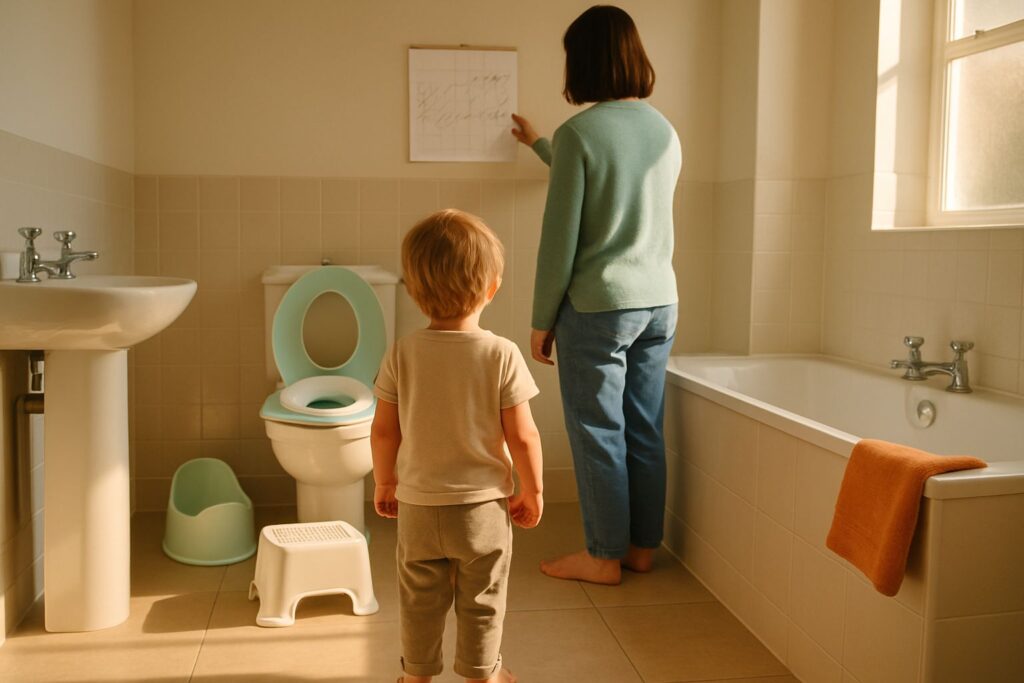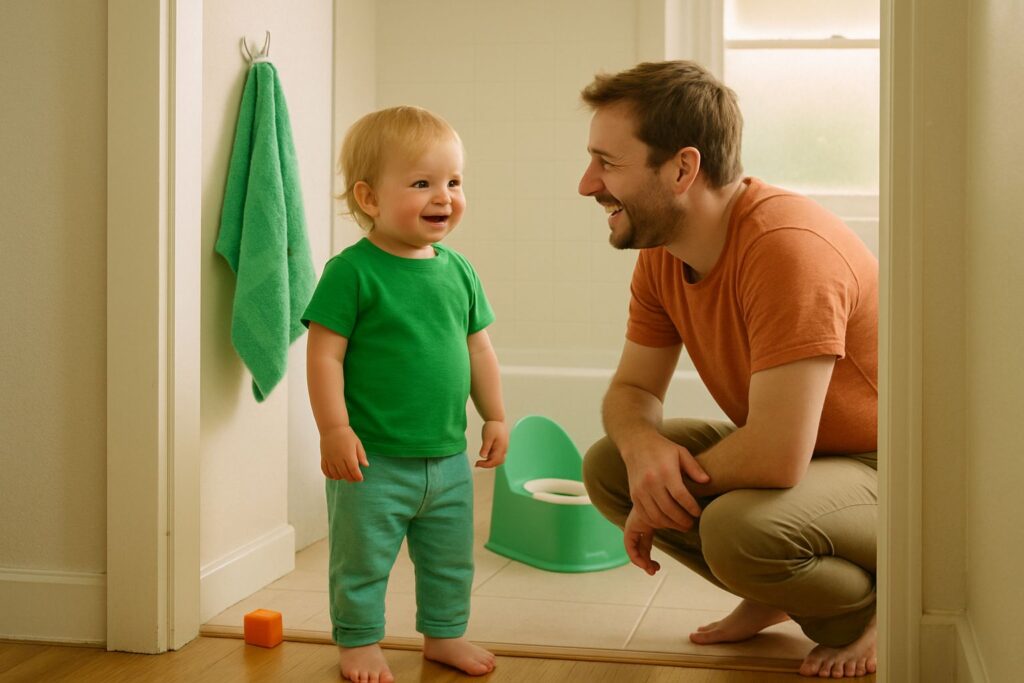


Most children are ready to start potty training somewhere between 18 and 30 months, the window the NHS Best Start in Life guidance points to. Age is only the starting point: readiness is what actually decides the moment, and some children are ready at 20 months while others need until past 3. Night-time dryness comes later.
What age should you start potty training?
There is no single correct age that applies to every child, but most families start somewhere in that 18 to 30 month window, with plenty of normal variation either side of it. The more useful question is not what age your child has reached, but whether they are showing the signs that say they are ready, which the rest of this article walks through.
Why 18 to 30 months keeps coming up
By this age most toddlers can physically do the things potty training actually requires: walk or toddle to a potty, pull their own pants down with a bit of help, follow a short instruction like ‘shall we try the potty’, and notice that their bladder is full rather than only realising once it is too late. Before roughly 18 months, bladder control is still developing, so many children simply cannot hold on for any length of time yet, however keen the parent is. ERIC, the childhood continence charity, also points to this same broad window as the age most children are ready to begin.
That is also why leaving it very late is not a neutral choice either. The longer nappies stay the default, the more habit builds up around them, and a child who already has strong opinions about everything else may also have strong opinions about giving up the nappy. None of this means there is a single correct age: a child who starts at 22 months and one who starts at 32 months can both do perfectly well. If you want more detail on choosing the right moment rather than the right age, our piece on when to start potty training goes into that.
Ready beats old enough: the signs that actually matter
A child who is ready usually shows several of these signs at once, not just one: staying dry for an hour or two, showing curiosity about the toilet or potty, telling you after a wee has happened (even if not before), going quiet or hiding somewhere to poo, being able to pull pants up and down, and following a two step instruction such as ‘get your potty and bring it here’.
Equally, some signs say wait. A child who is frightened of the potty or the toilet, who flatly refuses to go anywhere near it, or whose home life has just been turned upside down by a new baby, a house move or starting nursery, is not showing you a readiness problem, they are showing you a timing problem. A frightened child is not a child who needs more pressure, they are a child who needs more familiarity first and a later start date. The box itself keeps perfectly well until then.
If you want a clearer answer than a general list of signs, it helps to work through your own child specifically rather than guessing.
You can also work through the readiness quiz with 12 questions if you want something to go through together as a family before you commit to a date.
Is 18 months too early, and is 3 too late?
Eighteen months is not impossible, but it is worth being honest about what is actually happening at that age. Very early ‘successes’ are usually the parent catching the wee at the right moment rather than the child recognising the need and asking. That can still be useful groundwork, but it is not the same thing as the child taking the initiative, which is the whole point of the method.
At the other end, a child who is 3 or nearly 4 and still in nappies is common, not a failure of anything you have done. Children who start a bit later are often quicker through the process, because the physical and communication skills are more solidly in place by then. If you are still deciding whether to begin at all, it is worth reading about what potty training actually involves before you pick a date.
If you are worried about something that looks more medical than developmental, such as painful or very infrequent poos, visible holding on, or a child past 5 or 6 who is still regularly wet, that is a conversation for your GP or health visitor rather than something to work out from a blog post. Children who are autistic, have Down syndrome or are non-verbal are also potty trained successfully, usually over a longer stretch, led by reading their individual signals rather than waiting for them to tell you in words.
How do you pick the actual week?
Choose three clear days at home with nothing in the diary. That is the stretch where the child learns the most, and it goes better without visitors, appointments or a packed schedule competing for attention.
Avoid weeks that already have a holiday, a house move, a new sibling due any day, an illness doing the rounds, or a nursery settling-in period booked in. Warm weather makes life easier, fewer layers and less washing, but it is not a requirement if the timing otherwise suits your family. Whichever week you pick, tell nursery or your childminder what you are doing in advance, so the approach stays consistent wherever your child spends the day.
What the first week actually looks like once you start
Days one to three are spent at home with the nappy off and cotton pants on, because that is when the child learns fastest and when accidents are easiest to deal with calmly. Short outings follow once those first days are behind you.
| Day | What you do | What to expect |
|---|---|---|
| Days 1 to 3 | Nappy off at home, cotton pants on, stay close to the potty | Several accidents, occasional success, lots of praise |
| Days 4 to 5 | Ask less often, hand responsibility back to your child | Usually the hardest stretch, boredom with being asked |
| Days 6 to 7 | Short outings, pants during the day, pull-ups kept for sleep | More self-initiated trips, fewer accidents |
Day 4 or 5 is usually the hardest day of the week, not day two. By then most children are simply tired of being asked ‘will you tell me when you need a wee’, and that boredom can show up as resistance. The practical fix is to ask less often rather than more, and let your child carry a bit more of the responsibility themselves.
Accidents all through this week are part of learning, not a sign to stop or start over. Most children are dry in the daytime in about a week, some manage it in three days, and others take two or three weeks, all of which is within normal range.
Should you put your child on the potty every half hour?
No. A fixed interval or a strict timetable is a different, older approach, and it works against the aim here, which is your child telling you themselves. Instead of offering the potty on the clock, you ask something like ‘will you tell me when you need a wee’, so the initiative stays with your child rather than with a stopwatch.
The tracking schedules in the box exist to record when your particular child actually goes, not to impose a schedule on them. Writing down the time they drank, the time on the toilet, and whether it was a success or an accident lets you learn your child’s own pattern over the first days, which you then step back from as they start signalling on their own. For the clearest picture, give a drink in one go rather than in sips spread over the morning, so you can actually see how long it takes after drinking for the wee to follow. You can download a free tracking chart to use for this.
A few moments stay fixed by design, both during the training and afterwards: before and after sleep, and before you leave the house. Outside of those, the asking fades as your child’s own signals take over.
What to have ready before day one
Have a potty ready for the first few days, a toilet seat reducer and step stool for the move to the toilet, at least 15 pairs of cotton pants, something to protect the mattress and sofa, a handful of small rewards, and pull-ups for sleeping. The training works with the nappy off and ordinary cotton pants rather than training pants, because a child feels a wet cotton pant in a way they do not feel a padded training pant, and that feeling is part of how they learn.
If your child is still a little unsure about the toilet or potty, a picture book can help build familiarity before you start. Pirate Pete’s Potty is a popular choice for this.
Some links in this article are affiliate links, which means we earn a small commission if you buy through them. It costs you nothing extra and does not affect what we recommend. If you need a potty, the My Carry Potty is a straightforward option, and the Dreambaby 2-Up Step Stool works well once you move to the toilet.
What if you start and it clearly is not working?
If after a few days there is no progress at all and your child is genuinely distressed rather than just grumbling, stop and leave it a few weeks before trying again. That pause is part of the method itself, not a failure of it, and nothing you have learned about your child’s patterns is lost in the meantime.
Starting again later with a calmer, more settled child almost always goes better than pushing through tears and resistance for the sake of finishing a week you already started. There is no shame in either the pause or the second attempt.
Where the Potty Training Box fits
The Potty Training Box is a physical box built around this exact week, with a day-by-day programme booklet, instruction cards, compliment cards, tracking schedules, and 20 sticker cards across four sizes of 3, 5, 7 and 9 squares, used in that order. The reward comes quickly at three squares so your child sees straight away that it works, then grows rarer as they improve, so the habit outlasts the stickers rather than stopping the moment they do.
If your child gets there and has their first proper success on the potty, this is a nice moment to celebrate together.
Alongside the stickers are animal stickers, poo stickers, a wee certificate and a poo certificate, plus a year of access to our community, where our experts answer your questions seven days a week. What it adds over a free article is specific: what to actually do on day one, day two and day three, including the days that go badly, and someone to ask when they do.
The box is reusable for a later child, and if you would rather run your own version of the reward system, or need a refill, the reward system is sold separately. Whichever route you take, remember that daytime dryness and dry at night are separate milestones, and the second one is never something the first week promises.
Frequently asked questions
When is it realistically too early to start potty training?
Before roughly 18 months, most toddlers are still developing the bladder control needed to hold on even briefly, so very early "successes" usually mean the parent caught the timing rather than the child recognising the need. It is not that nothing can happen before 18 months, but the child is not yet the one driving it, which is the actual goal of the method.
How do I know when my child is ready to potty train?
Look for several signs together: staying dry for an hour or two, interest in the toilet or potty, telling you after a wee has happened, hiding to poo, pulling pants up and down, and following a short two step instruction. If your child shows fear or flat refusal, or your household is going through a big change, it is more honest to wait and build familiarity first.
Can you potty train a 1 year old?
It is uncommon and usually relies on the parent timing the potty rather than the child signalling, since bladder control is still developing at that age for most toddlers. Most families get better, faster results waiting until closer to 18 months or later, when the child can take more of the initiative themselves.
Is it bad if my child is 3 and still in nappies?
No, this is common and not a sign anything has gone wrong. Children who start a little later often move through the process more quickly, because the physical and communication skills involved are more firmly in place by then.
Is there a difference in when to start with boys and girls?
Readiness signs and the age window are the same for boys and girls; neither sex reliably starts earlier or later as a rule. Individual temperament and development matter far more than gender when it comes to picking the moment.
How long does potty training take once you start?
Most children are dry in the daytime in about a week once you begin, though some manage it in as little as three days and others need two to three weeks. Night-time dryness is a separate stage that typically comes later and is not something the first week of daytime training promises.
Ready for the next step?
The Potty Training Box holds the day-by-day programme this article is built on: tracking charts that show you when your child actually needs to go, instruction cards for each day, and a reward system that tapers off on its own.
Sources
- NHS Best Start in Life (The 18 months to 2 and a half years window for starting potty training)
- ERIC (Education and Resources for Improving Childhood Continence) (General guidance that most children are ready between 18 months and 3 years)
This article was written with AI assistance and checked by Dustin van de Sande.