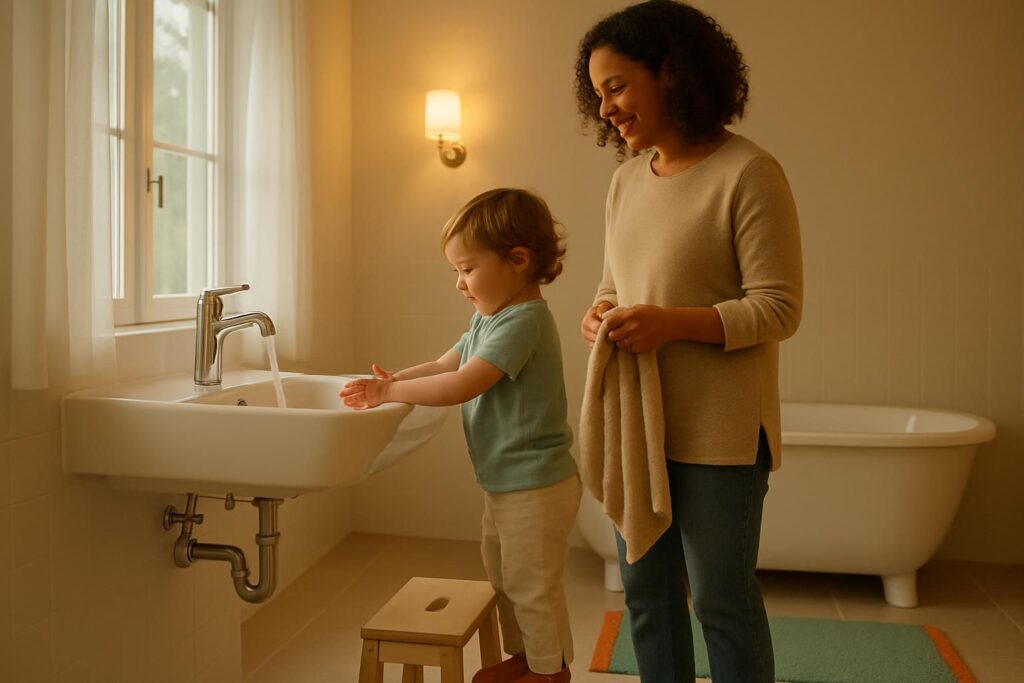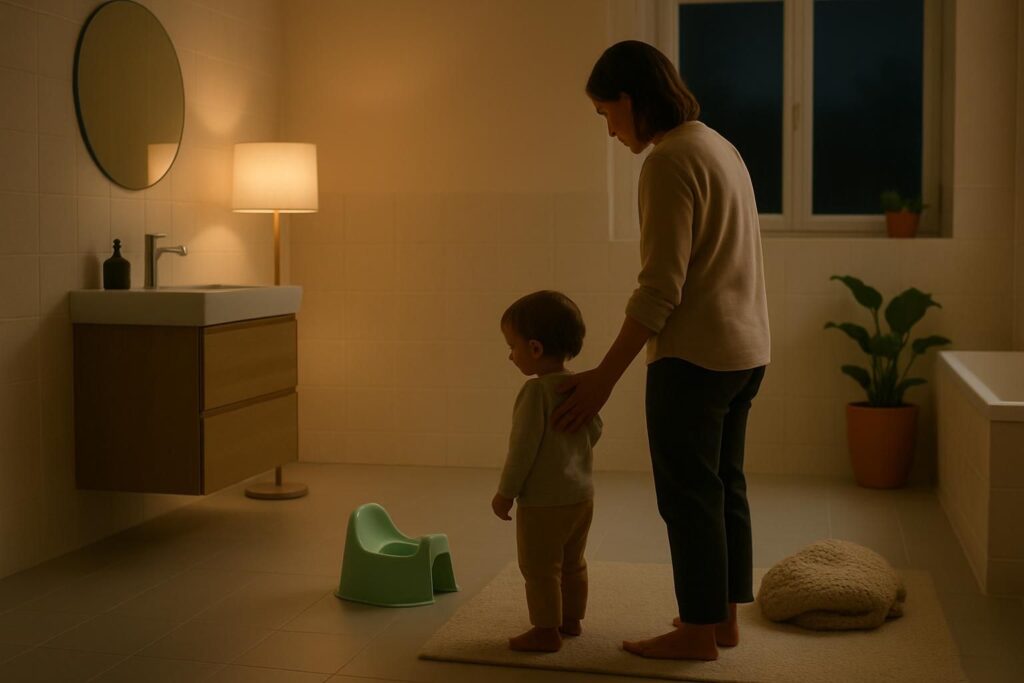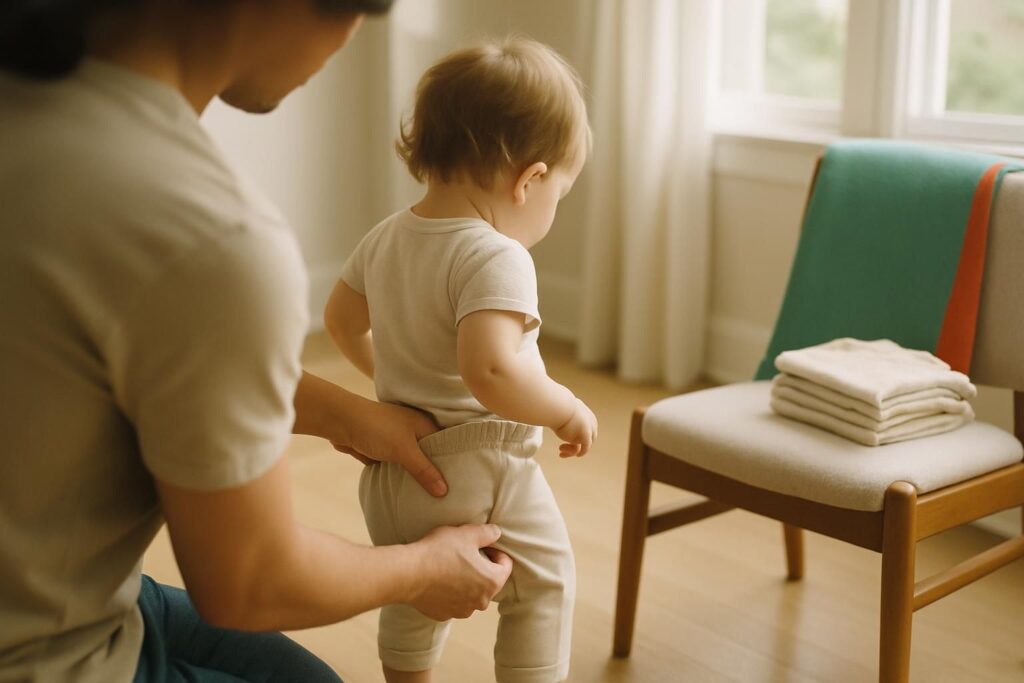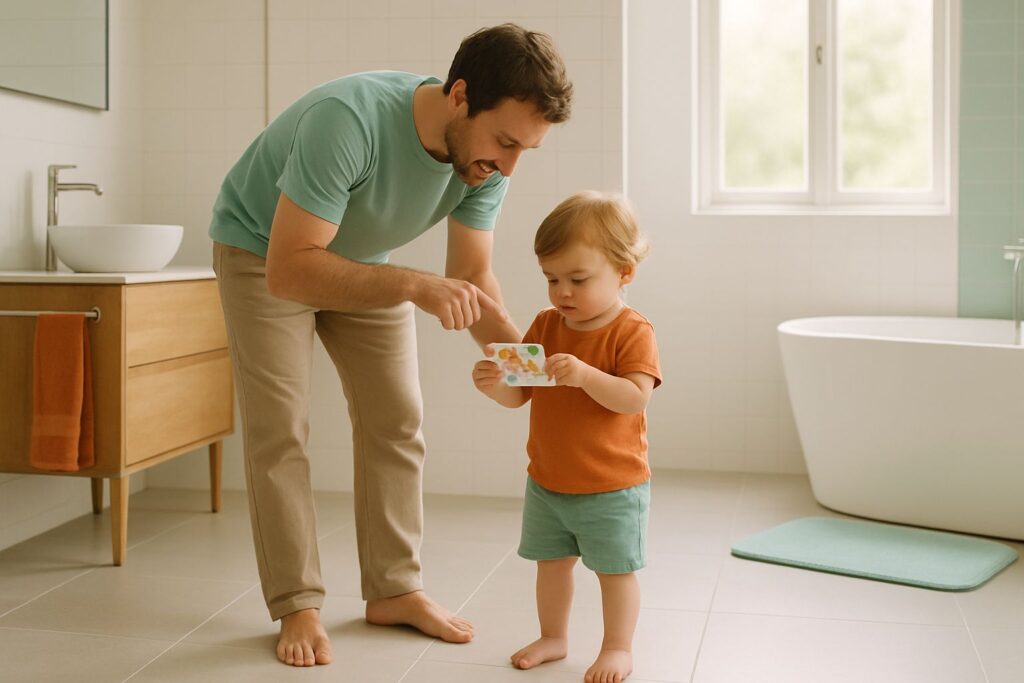


The 3-day potty training method means spending three days at home, out of nappies during waking hours, so a child can connect the feeling of needing a wee with the potty and start to signal it. Most children go on to be dry in the daytime within about a week; some manage it in three days, others take two or three weeks. Nappies or pull-ups are still used for sleep.
The “3-day” label is popular shorthand, and it describes the intensive learning phase, not a finish line. Those three days are spent entirely at home with no distractions: no coats, no car seats, no unfamiliar toilets. It is the period where the parent watches closely and the child gets the most repetition, not the point at which training is declared complete.
Does the 3-day method really work, or is three days just marketing?
Three days is realistically enough for many children to start connecting the physical sensation with the potty and to begin signalling before they go, which is the real milestone, not a completely accident-free day three. Some children get there faster, some need longer, and neither outcome means the method has failed.
Parents often feel discouraged on day three if there are still accidents, because “3-day potty training” sounds like a deadline. Accidents in this window are part of how a child learns to notice the feeling in time, not evidence that something has gone wrong.
If three days pass and the child is still resisting the potty altogether, showing distress, or clearly not interested, the honest and method-approved response is to stop and leave it a few weeks before trying again. Pushing through a bad attempt tends to build negative associations that make the next attempt harder, not easier.
Why the first three days at home matter more than any other part
The first three days matter because a child learns fastest with nothing else competing for their attention: no unfamiliar bathrooms, no waiting in a queue, no nappy as a fallback. Staying home also lets the parent watch closely enough to learn this particular child’s own timing and physical tells, which is the information the rest of the week is built on.
Once a child can reliably signal, or the parent has a good sense of their pattern, short outings follow: a trip to the corner shop, then a longer one, then a normal day out. None of that works as well if it is attempted before the child has had those quiet days to learn the basics.
None of this requires the parent to be perfect. It asks for presence over three days, not flawless execution, and a willingness to keep going after an accident rather than treat it as a setback.
Day one, day two, day three and the days after: what actually happens
Day one typically means pants on instead of a nappy, the potty kept nearby, plenty to drink, and the parent noting every wee so a pattern starts to emerge. Day two usually brings the first signs that the child is starting to notice the feeling themselves, sometimes just before an accident rather than in time to stop it. By day three, many parents are prompting less and the child is beginning to signal or move towards the potty on their own.
| Day | What the child is learning | What the parent does |
|---|---|---|
| Day 1 | The feeling of a wet nappy is gone; the potty is somewhere close | Pants on, potty nearby, lots to drink, note every wee |
| Day 2 | Starting to notice the sensation, often just after it happens | Watch for patterns, keep prompting gently, praise every attempt |
| Day 3 | Signalling before going, sometimes reaching the potty in time | Prompt less, ask instead of tell, follow the child’s lead |
| Days 4-7 | Using the toilet with a seat reducer, coping with short outings | Introduce the step stool, taper rewards, extend time away from home |
For a sense of how this looks in a real household over a full week rather than a summary, how one week looked for another family is worth reading. It is also worth understanding why the seven-day approach holds up longer term compared with treating day three as the end point.
What is the 10, 10, 10 rule for potty training, and is it the right approach?
Parents usually mean sitting the child on the potty or toilet at fixed intervals, such as every ten minutes for ten minutes, or some similar clock-based routine, rather than waiting for the child’s own signal. The trouble with training by the clock is that it can teach a child to go when they are told to, rather than to notice the feeling and act on it themselves, which is the actual skill being built.
The alternative used in the Potty Training Box Method is to record when this particular child actually goes over a few days, then read their signals, such as going quiet, wriggling or crossing their legs. Offering the potty at likely moments early on is scaffolding to gather that information, and it is meant to come down within days as the child starts to say or show they need to go on their own. The whole point of the method is reaching that moment, not maintaining a schedule indefinitely.
How often should I put my child on the potty in those three days?
The better question is not how often to offer the potty, but what to watch for so offering can stop as soon as possible. Going quiet mid-play, wriggling, crossing legs, hiding behind furniture or tugging at pants are all common signs a child needs to go, and they are more useful than any fixed interval.
Tracking schedules exist for exactly this reason, recording roughly when a child goes across a set of half days so a parent can see their pattern rather than guess at it. As the pattern becomes clear, prompts shift from statements (“let’s go to the potty”) to questions (“do you need a wee?”), and eventually the child starts telling the parent unprompted.
What you need at home before you start
A potty (mainly useful for the first three days), a toilet seat reducer and a step stool are needed for the transition from potty to toilet. At least fifteen pairs of pants get through a single day of accidents without a washing crisis, and something to protect the mattress and sofa saves a lot of stress on day one.
A handful of small rewards for the sticker-and-praise side of things, and pull-ups for sleeping, round out the list. Buying these before day one, not during it, avoids the single most common source of first-morning frustration.
What age is right for the 3-day method, and how do I know my child is ready?
Most children attempt daytime potty training somewhere between 18 months and 4 years old, and readiness matters far more than the number on the calendar. According to NHS guidance, signs of readiness include staying dry for longer stretches, showing interest in the potty or toilet, being able to pull pants up and down, and understanding simple instructions.
A child who is frightened of the potty or the toilet is not ready yet, and the honest response is to build familiarity gently, perhaps just sitting on it clothed or reading a book nearby, and try again later. Constipation, stool withholding, urinary infections, or bedwetting that continues past age 6 are matters for a GP or health visitor rather than something to work through with a training method, and ERIC, the children’s bowel and bladder charity, is a useful resource for these concerns.
The method is also used with autistic children, children with Down syndrome and non-verbal children, usually over a longer stretch of time and led by reading the child’s own signals rather than waiting for them to say something.
Why night-time dryness is a separate job
Daytime dryness and night-time dryness are different skills that develop on their own timelines, and a child who is reliably dry all day may still need nappies or pull-ups at night for months or longer. This is not a step backwards or a sign that daytime training has not worked; the two things are simply governed by different physical developments.
No honest potty training method, including this one, promises dry nights as part of daytime training. If bedwetting continues regularly past the age of 6, that is a conversation worth having with a GP, health visitor or a charity such as ERIC rather than something to solve with stickers and praise.
How the Potty Training Box turns three days at home into a plan
The Potty Training Box is a physical box built around this day-by-day structure: a training programme booklet, 7 instruction cards as a daily reminder, 6 compliment cards for when praise runs dry, 14 tracking schedules for learning a child’s own timing, 20 sticker cards ranging from 3 to 9 squares so rewards taper off gradually, 100 animal stickers and 20 poo stickers, a wee and poo diploma, and a year of access to a community where the brand’s team answers questions seven days a week. Alongside it, a parent typically has a potty, a toilet seat reducer, a step stool and plenty of pants ready to go.
What it adds over a free article online is a plan for the days that do not go smoothly, and people to ask when they do not, rather than a single piece of general advice with nowhere to turn next. The box is reusable for a younger sibling later on, and refill sticker sets are sold separately as an extra reward system if the original stickers run out. The method itself does not require the box; it can be followed by any parent willing to build the plan themselves and keep track of it by hand.
Frequently asked questions
Does the 3 day potty training method really work?
For many children, three focused days at home are enough to start connecting the physical feeling of needing a wee with the potty and to begin signalling before they go, which is the real goal. Some children need longer than three days and some are dry within them; both are normal outcomes, not a sign the method has failed.
What is the 10, 10, 10 rule for potty training?
It refers to sitting a child on the potty or toilet at fixed intervals, commonly every ten minutes for ten minutes, rather than waiting for the child's own cue. This approach can teach a child to go on command rather than to notice their own sensations, so a method built around recording a child's actual pattern and reading their signals tends to serve the underlying goal better.
What is the recommended age for the 3 day potty training method?
Most children attempt daytime potty training somewhere between 18 months and 4 years old, but readiness signs matter more than a specific age. Look for staying dry for longer stretches, showing interest in the potty, being able to pull pants down, and understanding simple instructions.
How long does potty training usually take?
Most children are dry in the daytime within about a week of starting, though some manage it in around three days and others take two to three weeks. Night-time dryness is a separate skill that typically arrives later and on its own timeline.
Should my child be naked or in pants during the first three days?
Pants are generally used rather than going nappy-free or naked, since pants let a child feel wetness quickly and start noticing the sensation, while still being a normal, dignified thing to wear at home. The nappy itself is set aside during waking hours across those three days.
What do I do if the three days go badly?
If a child is distressed, frightened of the potty, or showing no signs of progress after three days, the method's own advice is to stop and leave it a few weeks before trying again rather than pushing through. A pause is a normal part of the process, not a failure, and trying again later once the child has had time often goes more smoothly.
Sources
This article was written with AI assistance and checked by Dustin van de Sande.
Ready for the next step?
The Potty Training Box holds the day-by-day programme this article is built on: tracking charts that show you when your child actually needs to go, instruction cards for each day, and a reward system that tapers off on its own.