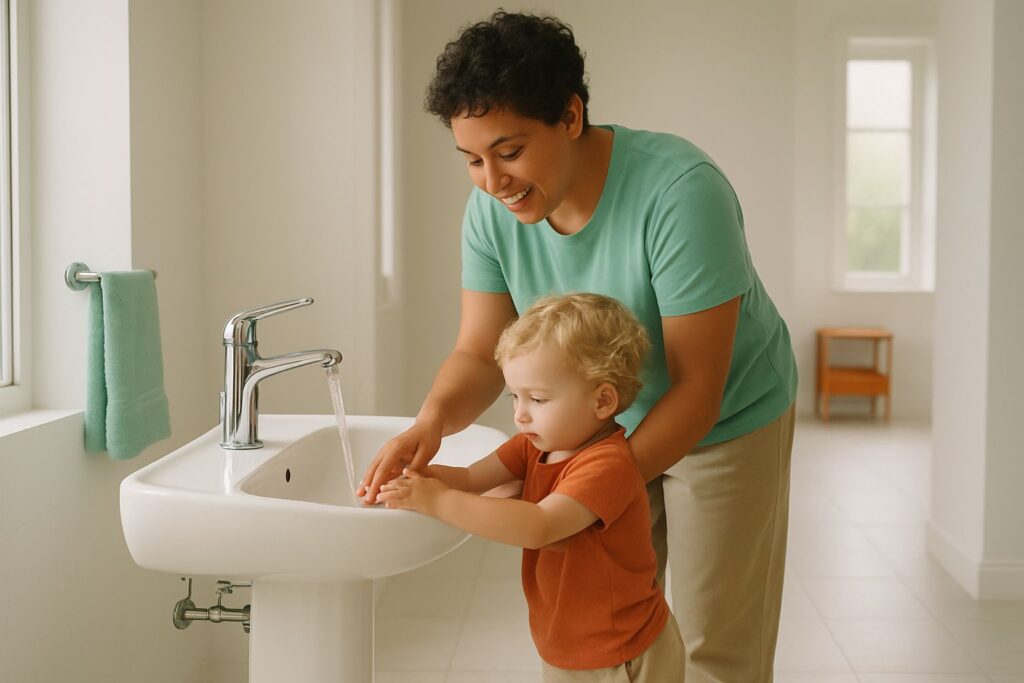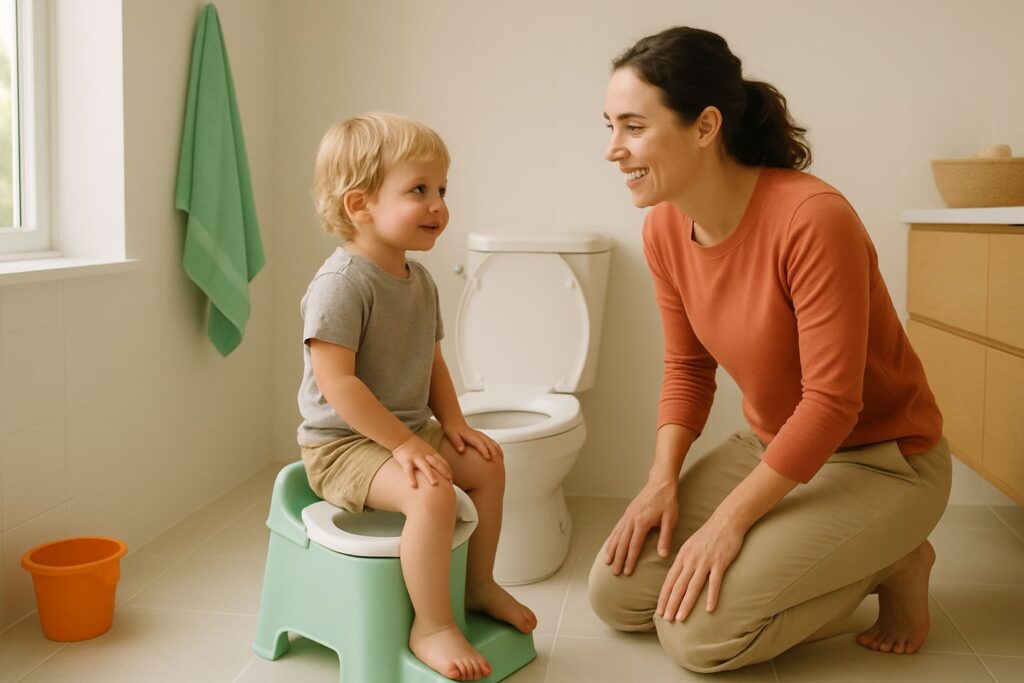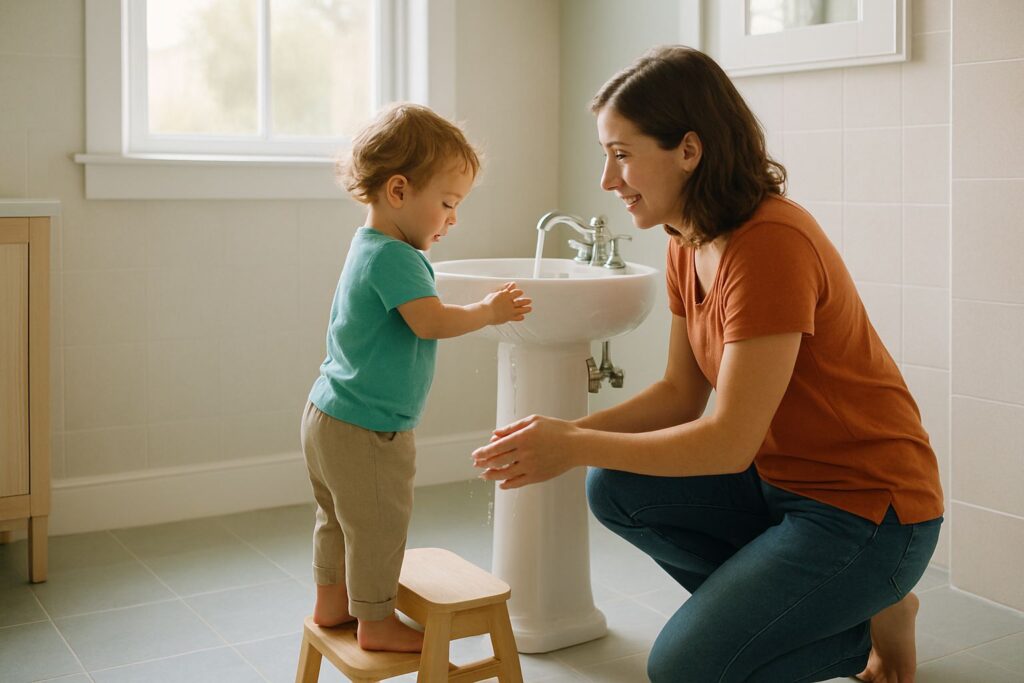
Potty Training Reward Charts: Which Kind Works, and How to Use One Without It Stalling

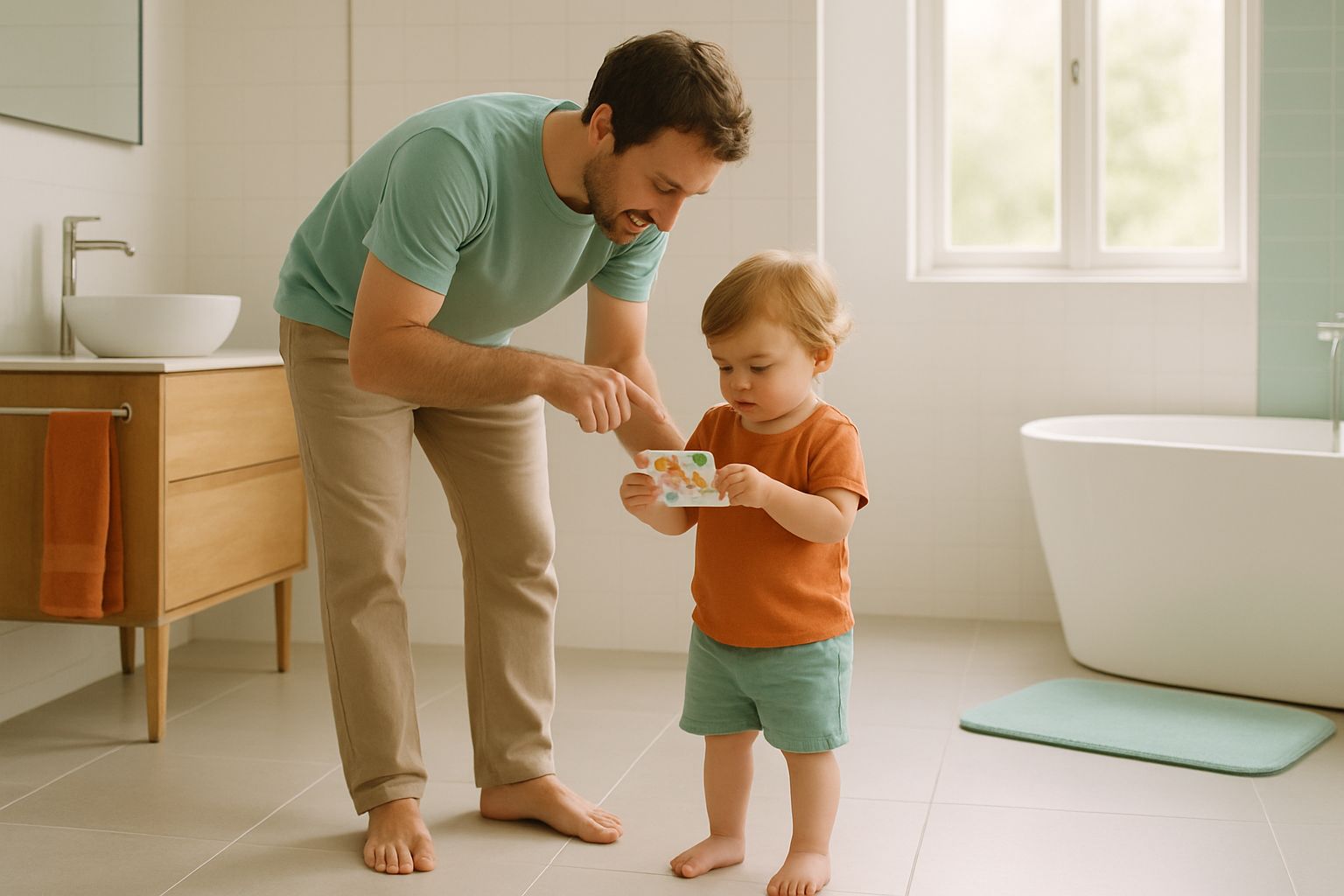
Which potty training reward chart actually works?
The reward chart that works for potty training a 2 to 3 year old is not one big chart but a ladder of small sticker cards, sized 3, 5, 7 and 9 squares and used in that order. The reward arrives quickly at first, then grows rarer, so the habit outlasts the stickers instead of stopping the moment they do.
A single large chart with fifty empty boxes asks a two or three year old to hold a promise in their head for a fortnight. At that age, that is simply too far away to feel real. A card with three squares gets filled within a day, sometimes within hours, and the child sees the connection between what they did and what happened straight away.
Once three squares stops feeling like an achievement, the next card has five. Then seven, then nine. Each step asks a little more consistency before the reward lands, which mirrors what is actually happening in the child, who is getting steadier at noticing the need to go and saying so. The chart is not the method itself. It is scaffolding that supports the habit while the child’s own signalling becomes the real thing doing the work.
| Card size | Roughly when it is used | What the reward feels like |
|---|---|---|
| 3 squares | The very start, so success arrives fast | Big and immediate, proof the system works |
| 5 squares | Once the first card is filled and confidence grows | Still frequent, but earned a little more |
| 7 squares | As the child manages longer stretches alone | A reward worth a bit of a wait |
| 9 squares | Near the end of the ladder | Rare, and closer to the child’s own habit than a prize |
Why does my toddler stop caring about the sticker chart after a few days?
A toddler losing interest in a chart after three or four days is normal and does not mean training has gone wrong. Novelty fades fast at this age, and a chart that hands out an identical reward for identical behaviour, day after day, stops registering as exciting almost as quickly as it started.
The problem is usually the chart’s design, not the child. A fixed chart with a fixed number of squares gives the same sticker for a wee on day one, when everything is new and closely supervised, as it does for a wee on day nine, when the child is managing longer gaps and more of the initiative themselves. The behaviour has got harder. The reward has not moved with it.
Rising card sizes fix this by stretching the gap between rewards as the child improves, so the excitement is rationed rather than exhausted. You can read more on why sticker charts stall and the reward ladder that avoids it.
Day four or five is often the hardest day of the week, more so than day two, and it is usually not the chart’s fault at all. By that point many children are tired of being asked ‘will you tell me when you need a wee?’ over and over, and some resistance is really just irritation at the question. Asking it a little less often, and letting the child carry more of the responsibility themselves, tends to settle this faster than any new sticker.
Reward chart or tracking schedule: what is the difference?
A reward chart is the child’s visible progress, the stickers, the praise, the certificate at the end. A tracking schedule is the parent’s private record of when this particular child actually drinks and goes, used to learn their pattern rather than to reward them for anything.
A typical tracking card has columns for the time of drinking, the time on the toilet, a yes or no for nothing happening, wee marked green for a success or red for an accident, poo marked the same way, and a notes column for anything worth remembering. It is filled in through the day, not glanced at once.
| Column | What goes in it |
|---|---|
| Time of drinking | When the child had a full drink |
| Time on the toilet | When they were offered or went themselves |
| Nothing (yes/no) | Whether anything happened that time |
| Wee (green/red) | Green for success, red for an accident |
| Poo (green/red) | Same, for a poo |
| Notes | Anything else worth remembering |
It works best if the child drinks a full cup in one go rather than sipping across the afternoon, because that is the only way to see how much went in and how long it then took before they needed the toilet. A half a cup sipped over an hour blurs that link, which is exactly what the schedule is meant to make visible.
You can get the sheet itself as a free printable tracking chart. It is worth saying plainly what it is not: it is not a list of fixed toilet times to sit a child on the potty every half hour regardless of what they are doing. If you are wondering how often to offer the potty in the first place, read about the 10-10-10 rule, but the tracking schedule described here works the other way round: it records this child’s own timing so the parent can stop guessing, not so the parent can impose a clock on them.
How do I set up a reward chart for a 2 to 3 year old?
Start with the smallest card and the smallest square count you have, three, and agree in advance, in simple words, exactly what earns a sticker. One sticker per success keeps the rule easy for a toddler to hold onto: a wee on the potty or toilet gets one, nothing more complicated.
Poos are usually slower to arrive than wees and are worth recognising separately rather than lumping in with the same sticker, since a child who is managing wees confidently may still be working up to poos for a while longer.
Put the chart somewhere the child can see and reach without help, near the toilet or potty rather than in another room, so the connection between the act and the reward is immediate. Say the reward out loud before the attempt, something like ‘if you do a wee, you get a sticker’, and hand it over the moment it happens rather than later.
Want to celebrate the moment together? Watch this short video with your child right after their first success.
The certificates, one for wees and one for poos, sit at the far end of the sequence as the thing the whole ladder has been building towards, and most children take real pride in being handed one once they have earned it.
What are good potty training rewards, and what should I avoid?
Small, immediate and repeatable beats big and distant every time at this age. A prize that arrives on the spot and can be given again tomorrow keeps working; a promised toy at the end of the month means nothing to a three year old today.
| Good rewards | Why they work |
|---|---|
| Stickers, a story, bubbles | Instant, cheap, easy to repeat |
| A silly dance, a phone call to grandma | Costs nothing, feels special in the moment |
| A few minutes of a favourite game | Immediate and easy to end fairly |
| Sweets every time | Works at first, hard to wind down later |
Sweets as a reward tend to work brilliantly for about a week and then become a habit nobody quite knows how to stop. A sticker or a few minutes of attention winds down far more naturally as the ladder of cards grows rarer.
Praise that names the specific thing the child did, ‘you told me you needed a wee, well done’, lands better than a general ‘good girl’, because it teaches the child what exactly is being celebrated. The compliment cards that come in the box exist for the days a parent has simply run out of new ways to say it.
Does the chart work if my child is not ready yet?
No chart, however well designed, motivates a child who is not ready or who is frightened of the potty or the toilet. Readiness has to come first, and pushing a reward system at a child who is not there yet usually just teaches them to dread the whole idea.
Common signs a child is ready include staying dry for a couple of hours at a stretch, showing an interest in the toilet or potty, being able to pull pants up and down largely by themselves, and telling you, in words or clearly enough in behaviour, that they are about to go or have just been.
A child who is scared of the potty or the toilet is not being difficult, they are telling you the timing is wrong. The honest response is to build familiarity first, perhaps letting them sit on it fully clothed, watch a sibling use it, or simply get used to it being in the room, and start the actual training later.
If an attempt has already started and it is clearly not working, stopping and leaving it a few weeks before trying again is part of the Potty Training Box Method, not a failure of it. Pushing on through a week that has gone badly rarely ends better than pausing would have.
How do I wind the chart down when my child starts saying they need to go?
The goal of the whole ladder is the moment the child says it themselves, before being asked. Once that starts happening reliably, the chart’s job is nearly done and it can be allowed to fade rather than kept running at full pace out of habit.
Instead of offering the potty on a schedule, ask ‘will you tell me when you need a wee?’, and as the child manages this more often, ask it less. Keep asking at a small handful of fixed moments only, before and after sleep, and before leaving the house, and it is worth keeping those particular check-ins going well after training is finished too.
As the cards get bigger, the reward naturally gets rarer, and the sequence ends with the certificate rather than with a sudden stop. Praise does not need to end when the stickers do. A quick ‘well done for telling me’ costs nothing and keeps the habit warm long after the last card is filled.
Where the chart sits in the week, and what comes with the box
The chart is one part of a wider week, not the whole plan. The first three days are usually spent at home, since that is when a child learns fastest with the fewest distractions, with short outings following once things are settling. You can read how the week actually runs for the day by day detail.
The Potty Training Box is where the sticker cards, compliment cards, tracking schedules and certificates described here actually come from, alongside a programme booklet and instruction cards that coach a parent through each day, and a year of access to a community where questions get answered. Alongside it, it helps to have a potty ready for the first few days, a step stool, plenty of pairs of ordinary cotton pants rather than padded training pants, since a child feels a wet cotton pant far better than a padded one, and pull-ups kept just for sleep.
Parents who already own a box and want a fresh set of cards, or who want to run their own version of the ladder without the full kit, can find a standalone (Extra) Reward system Potty Training, available in a boy version and a girl version.
Results vary and nobody can promise a date. Most children manage daytime dryness in about a week, some get there in three days, others take two or three weeks and that is entirely normal too. Night-time dryness is a separate skill that tends to come later on its own and is not something any chart, box or method promises to fix.
Frequently asked questions
Do reward charts work for potty training?
Reward charts can help a great deal, but the design matters more than the idea itself. A chart with a fixed, large number of squares often loses its pull within days, while a ladder of small cards that grows from three squares up to nine tends to keep working because the reward arrives quickly at first and grows rarer as the child improves.
What is a good prize for potty training?
Small, immediate and repeatable prizes work best: a sticker, a story, bubbles, a silly dance or a few minutes of a favourite game. Sweets given every time tend to work at first but become a habit that is hard to wind down later, unlike stickers or attention, which scale down naturally as the reward ladder progresses.
How many stickers should my toddler get per success?
One sticker per success is the simplest rule for a toddler to hold onto, given straight after a wee or poo on the potty or toilet. Poos are usually worth recognising separately from wees, since they tend to take longer for a child to manage confidently.
My toddler has lost interest in the sticker chart, what now?
Losing interest after a few days is common and does not mean anything has gone wrong. It usually means the chart has stayed the same while the behaviour it is rewarding has got harder, and moving up to the next size card, with a slightly rarer reward, tends to bring the excitement back.
Should I take stickers away after an accident?
No. Accidents are a normal part of learning and removing an already earned sticker turns the chart into a punishment, which works against what it is there for. Simply note the accident, clean up matter of factly, and carry on towards the next success.
Is a reward chart the same as a potty training tracking chart?
No, they do different jobs. The reward chart is the child's visible progress and motivation, filled with stickers they earn, while the tracking schedule is the parent's private record of when this particular child drinks and goes, used to learn their pattern rather than to reward anything.
Ready for the next step?
The Potty Training Box holds the day-by-day programme this article is built on: tracking charts that show you when your child actually needs to go, instruction cards for each day, and a reward system that tapers off on its own.
This article was written with AI assistance and checked by Dustin van de Sande.