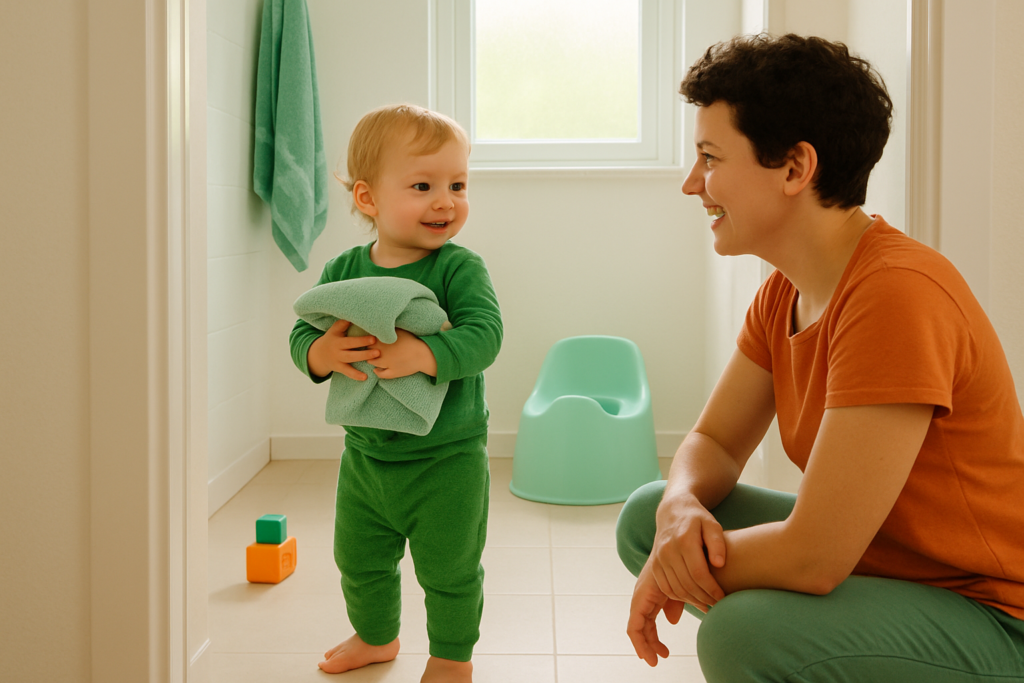

Readiness for potty training is a set of signals, not an age. Look for dry stretches of around 1.5 to 2 hours, some reliable way of communicating a need, and the ability to walk to a potty and sit down alone. Most children show early signals somewhere between 18 months and 3 years, though the range is wide and normal.
The NHS lists a child staying dry for an hour or more between wees as one sign of bladder readiness. This method looks for a slightly longer, more reliable stretch of around 1.5 to 2 hours before treating that signal as solid, alongside some way of communicating a need and the physical ability to get to a potty and sit down.
Readiness signals fall into three groups: physical, cognitive and language, and behavioural and emotional. Physical signals are about bladder and bowel control, such as staying dry for longer between nappy changes. Cognitive and language signals are about understanding what is happening in the body and being able to communicate it. Behavioural and emotional signals cover independence, interest in the potty, and the ability to sit still for a minute or two. You do not need every one of the 12 signals below before you start; use the checklist to see where your child actually stands, and take the free quiz further down if two of you disagree about the answer.
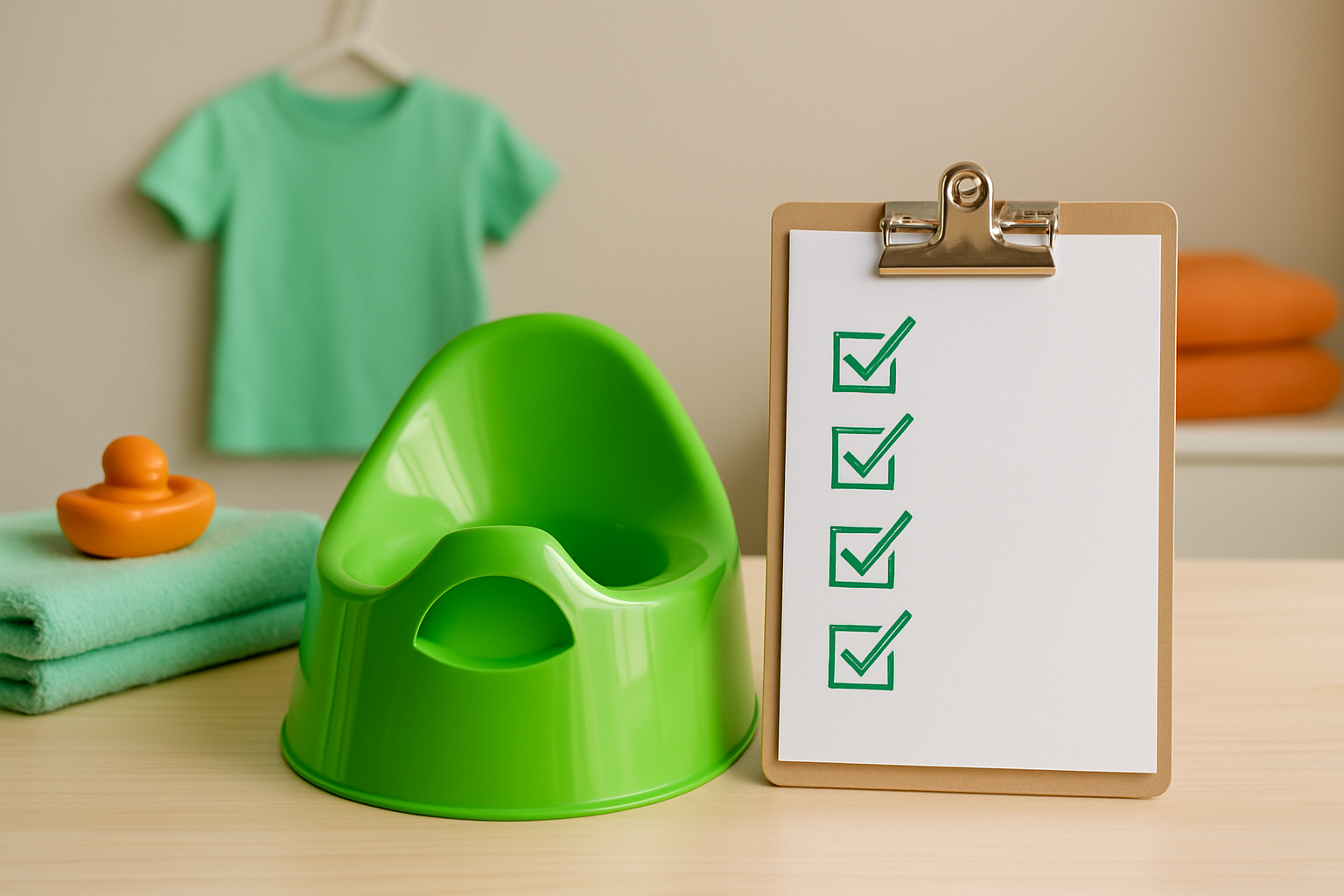
The 12-point potty training readiness checklist
These are the twelve signals worth checking for at home. Answer as your week actually looks, not as your best day looks, since a real picture is more useful than a hopeful guess. Tick off each one mentally as you go so the score in the next section is easy to work out.
| Signal | What it looks like at home | How essential |
|---|---|---|
| Stays dry 1.5 to 2 hours, or wakes from a nap dry | Nappy is not soaked every time you check it | Must-have |
| Nappies heavier but less frequent | Bladder holds more urine at once rather than dribbling constantly | Helpful |
| Fairly predictable poo timing | Poos tend to happen around the same time of day | Helpful |
| Shows awareness before, during or after | Pauses, goes quiet, hides behind furniture, or points at the nappy | Helpful |
| Can tell or show you what they need | Words, signs, or a consistent gesture towards the potty or nappy | Must-have |
| Follows a simple two-step instruction | Understands something like ‘pick up the potty and bring it here’ | Helpful |
| Walks to the potty, sits and gets up unaided | Manages the whole sequence without being lifted or carried | Must-have |
| Pulls trousers and pants up and down with a bit of help | Manages most of it themselves, even if you finish the job | Helpful |
| Dislikes a wet or dirty nappy | Pulls at the nappy, complains, or asks to be changed straight away | Nice to have |
| Shows interest in the toilet, potty, or what others do | Follows a parent or sibling into the bathroom, asks questions, wants to flush | Nice to have |
| Can sit and focus for a couple of minutes | Will sit through a short book or a couple of songs without wandering off | Helpful |
| Wants to do things themselves | Insists on ‘me do it’ with dressing, eating, or other everyday tasks | Nice to have |
If your child’s nappy pattern looks more like constant dribbling than a build up and release, it is worth reading about weeing small amounts often before you start, since that pattern can make the dry-stretch signal harder to judge fairly.
Readiness for wee and readiness for poo often show up at different times, and this is one of the most common mismatches parents describe. A child can happily sit and wee on the potty while still holding on, hiding, or getting upset at the idea of doing a poo there. If that sounds familiar, it is not a sign your child is not ready overall; it is worth reading specifically about what to do when a child is afraid to poo on the potty rather than treating it as a readiness failure.
How many of the 12 do you actually need to say yes to?
As a practical rule, 8 or more signals means you can start now, 5 to 7 means set a date and spend a week or two preparing, and fewer than 5 means it is sensible to wait and check again in 4 to 6 weeks. This is a working guideline rather than a strict pass mark, but it stops the checklist from becoming a source of guilt.
The three non-negotiables are a dry stretch of around 1.5 to 2 hours, which builds on the NHS’s own sign of staying dry for an hour or more between wees, some reliable way of communicating a need, and the physical ability to get to the potty and sit down alone. Without these three, training tends to mean a lot of carrying, guessing and frustration on both sides. Everything else on the list, from disliking a wet nappy to following two-step instructions, helps the process along but is not essential on day one.
A full 12 out of 12 is rare, and it is not something to aim for before starting. Most families begin with one or two of the nice-to-have signals still missing, and that is a perfectly normal place to start from.
Take the free readiness quiz (2 minutes)
The free readiness quiz walks through a plain-language version of the questions on this page, covering dry stretches, communication, physical ability and interest, and takes about two minutes to complete. There are no wrong answers, only a clearer picture of where your child is today.
It is particularly useful when one parent thinks it is time and the other does not, since it turns a disagreement into a shared checklist rather than two competing opinions. Take the free readiness quiz before you commit to a start date, and use whatever it tells you alongside the 12-point list above rather than instead of it.
Why age on its own is a poor way to decide
The NHS does not set a fixed age for potty training and instead advises starting when a child shows signs of being ready, with those signs typically appearing anywhere from around 18 months to 3 years old. ERIC, the children’s bowel and bladder charity, gives similar advice: watch the child’s behaviour and physical development rather than the calendar.
The normal range is wide, and it is common for one sibling to be ready well before another in the same family, with no bearing on either child’s general development. A nursery start date, a cousin who trained early, or pressure from family are not readiness signals and should not set your timing on their own.
Parents commonly describe fewer accidents and a calmer run when they start on signals rather than a birthday, since the child’s body and understanding are already able to do what is being asked, though this varies between children. Starting well before those signals are in place tends to mean more nappies, more washing, and an attempt that has to be paused and picked up again later, which is exactly the pattern behind many stories of children who started potty training too early.
Signs your child is not ready yet (and that is fine)
If the nappy is soaked every hour with no pattern at all, if your child screams or arches away when you mention the potty, or if you are in the middle of a house move, a new baby, starting nursery, or an illness, it is sensible to wait. None of these mean anything has gone wrong; they mean the timing is off, and timing can change in a few weeks.
Constipation or painful poos need attention before you start potty training, and this is a conversation for a GP or health visitor rather than something to work around at home. ERIC notes that pain during a poo can lead a child to hold on, which makes training much harder and is worth ruling out first.
A toddler who says ‘no’ to everything at the moment is very likely going through a normal phase of asserting independence, not delivering a verdict on the potty itself. If your child screams or arches away specifically when asked to sit, rather than resisting everything generally, that reaction sometimes points to a highly sensitive child who needs a slower, lower-pressure introduction rather than a change in timing altogether.
While you wait, you can still lay groundwork without any pressure: change nappies standing up so your child gets used to the position, name what is happening (‘that’s a wee’, ‘that’s a poo’), and leave a potty out in the bathroom as ordinary furniture, not a countdown to anything.
What if you have already tried once and it did not work?
A stopped attempt is not a failed child or a failed parent; it usually means the timing, the approach, or the circumstances were not quite right, and that is fixable. Leaving a clean gap of around 4 to 8 weeks before trying again, rather than restarting the next day, tends to help everyone reset without the earlier attempt hanging over it.
Second time round, it often helps to say less rather than more: fewer questions about whether they need to go, less commentary on accidents, and a clear, calmly announced start date instead of a soft ‘maybe today’. Many parents report that the second attempt goes faster than the first, simply because the child is a few weeks or months further along in the signals that matter, though every child’s pace is different.
If progress slipped away after an initially good start rather than never really beginning, that is a different pattern worth reading about separately: potty training regression has its own common causes and its own fixes, distinct from a first attempt that simply started before the signals were there.
Ready today? Here is what to have in the house before day one
Have 10 to 15 pairs of pants ready along with trousers or leggings that pull up and down easily, since your child will be changing more often than usual in the first few days. A potty on each floor of the house cuts down on last-minute dashes, and if you plan to use the main toilet, a seat insert and a step make it manageable for a small child to climb up and get down alone.
Beyond the potty itself, have a simple cleaning kit to hand, a bag of spare clothes for the car or the changing bag, and a rough plan for staying close to home for the first three days. Decide on a reward or tracking system before you start, whether that is a sticker chart or something simpler, rather than inventing one on the spot in the middle of an accident.
The Potty Training Box puts a day-by-day training booklet alongside the materials that go with it: instruction cards for each day, compliment cards for when you have run out of ways to praise, tracking schedules to learn your child’s own pattern, sticker cards that taper off as your child improves, animal and poo stickers, and a diploma for the end of the week. It is built so that parents who score 8 or more on the checklist have both the method and the materials in hand on day one, rather than assembling stickers and instructions separately at the last minute. For parents who want to read through the method first while they wait for a few more signals to appear, the Digital Handbook is a lighter option worth looking at on the same shop.
Readiness by age: what usually shows up when
These age bands describe patterns that many parents notice, not deadlines to hit. A child who is behind one of these bands is not behind in any meaningful sense; the checklist above matters far more than the calendar, and a child with additional needs may follow a different timeline altogether, which is worth discussing with a health visitor rather than measuring against these bands.
| Age band | Signals usually present | Signals often still missing |
|---|---|---|
| 18 to 24 months | Interest in the potty, awareness shortly after weeing or pooing, occasional dry stretches | Awareness before the event, reliable words or signs, undressing alone |
| 2 to 2.5 years | Awareness before the event, more words or gestures, growing dressing independence | Consistent communication every time, sitting still for more than a minute |
| 2.5 to 3 years | Can hold for a stretch of around 1.5 to 2 hours, can ask reliably, mostly undresses alone | Full physical independence, predictable poo timing |
| 3 years and over | Usually most of the building blocks above, along with stronger opinions | Varies by child; strong opinions can mean more negotiation, not less readiness |
If your child is well past 3 and showing very few of the 12 signals, or you are worried about daytime dryness, this is worth raising with your health visitor or GP rather than working through it alone with a checklist.
There is no reliable population figure for how long potty training typically takes, since it depends heavily on the child, the method and how consistently it is followed, so it is worth being wary of any page that promises a fixed number of days. Whatever band your child falls into, the same rule applies: count the signals rather than the birthday, and start when the count, not the calendar, says you are ready. When you get there, the Potty Training Box gives you the method and the first week’s materials in one place, so the only thing left to decide is the date.
Frequently asked questions
At what age should I start potty training?
There is no single correct age; the NHS advises starting when a child shows signs of readiness rather than at a fixed age, with those signs typically appearing anywhere from around 18 months to 3 years old. Some children show most of the 12 readiness signals earlier, others later, and both are within the normal range.
Is 18 months too early to start potty training?
At 18 months many children do not yet show enough of the physical and communication signals, such as dry stretches or a reliable way of telling you what they need, though some do. Rather than going by age alone, check the 12-point checklist: if only a couple of signals are present, it is sensible to wait and revisit in 4 to 6 weeks.
What are the first signs a toddler is ready for potty training?
The earliest signs are usually longer dry stretches between nappy changes, a pause or change in behaviour when they are weeing or pooing, and growing interest in the toilet or potty. These often appear before a child has the words to actually ask for the potty.
Can my child be ready to wee on the potty but not for poo?
Yes, this is very common and is not a sign anything has gone wrong. Many children manage wees on the potty confidently while still feeling anxious about poos, and our guide on being afraid to poo on the potty covers what to do in that situation.
What should I do if my child shows the signs but refuses to sit on the potty?
Refusal despite readiness signals is often about the potty itself rather than a lack of readiness, so try a different room, a different potty, or sitting fully clothed for a minute with no expectation of using it. A highly sensitive child in particular often needs a slower, lower-pressure introduction, as covered in our guide on highly sensitive children and potty training.
Does my child need to be talking before we start potty training?
No, clear speech is not required, but your child does need some reliable way of communicating a need, whether that is words, a sign, or a consistent gesture. Understanding simple instructions matters more than the number of words they can actually say.
Sources
This article was written with AI assistance and checked by Dustin van de Sande.
Ready for the next step?
The Potty Training Box holds the day-by-day programme this article is built on: tracking charts that show you when your child actually needs to go, instruction cards for each day, and a reward system that tapers off on its own.