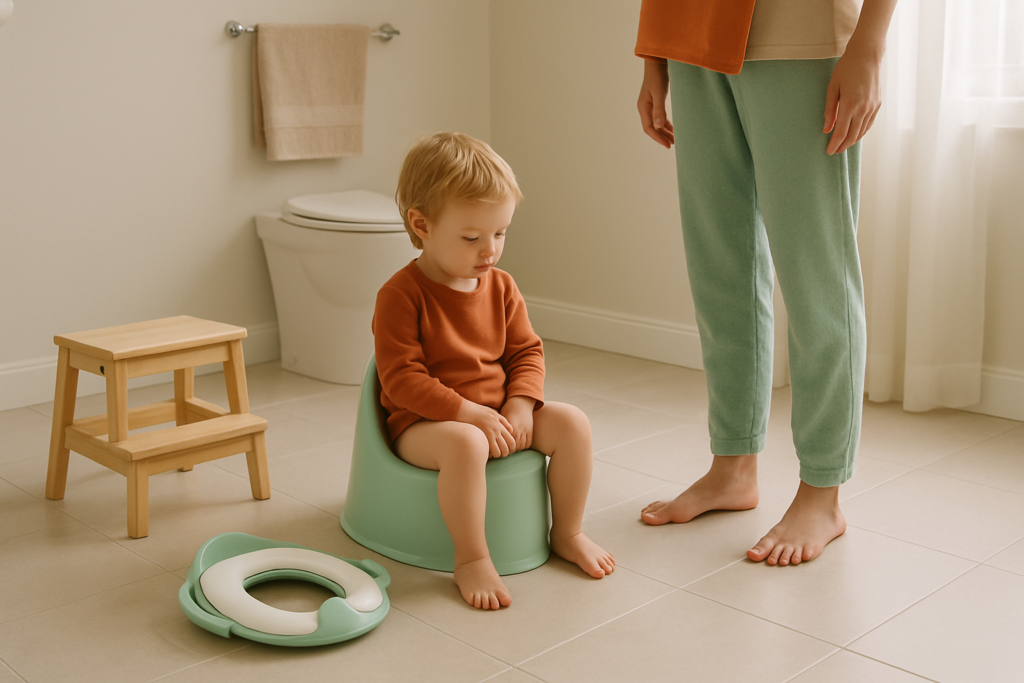


A sudden return of accidents in a toddler who was dry is called potty training regression, and it almost always has a trigger: a life change, a physical cause such as constipation, or simply being too absorbed in play to stop. It is common, not a failure, and most children settle again within a few weeks once the trigger is dealt with.
Potty training regression means a child who was reliably dry for weeks or months starts having frequent accidents again. This is different from the ordinary accidents of the first few weeks of training, which are simply part of learning a new skill and not regression at all. A child who has been dry for a fortnight and starts wetting three times a day this week is regressing. A child in their first ten days of training who still has the odd accident is doing exactly what is expected.
Either way, an accident is never treated as failure and the child is never being naughty. Bladder control that was already learned does not disappear because a child chooses not to use it; something has usually changed, and the accidents are the visible sign of it.
What actually triggers a potty training setback?
The most common triggers are changes to a child’s world: a new baby, a house move, starting nursery or preschool, parents separating, an illness, or moving to a new bed or room. Charities working with children’s bladder and bowel health note that life changes like these are a recognised and common cause of a return to accidents.
Constipation and stool withholding are an extremely common physical trigger for daytime wetting, because a full bowel presses on the bladder and makes it harder for a child to control or even feel the need to wee. This is genuinely a question for a GP or health visitor rather than something to work through with a training method alone.
Plenty of regressions have a much simpler cause. A child absorbed in play, especially around age three, will often hold on rather than stop what they are doing, right up until it is too late. A frightening or uncomfortable experience, a loud hand dryer, a cold toilet seat, or being told off after an accident, can also make a child avoid the toilet altogether for a while.
Nursery brings its own set of triggers: queueing for the toilet, having to ask an adult they do not know well, or being interrupted mid-activity. Some children also start deliberately holding on because they simply do not want to stop what they are doing. It is worth saying plainly that some regressions have no visible cause at all, and that is also normal.
How do I work out what changed for my child?
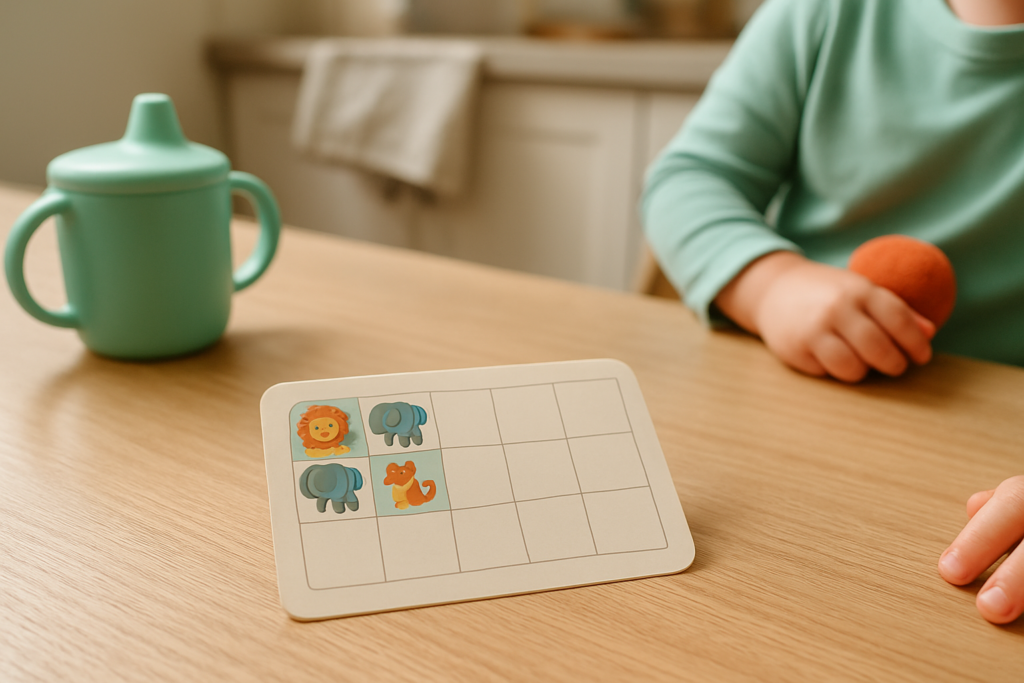
The most reliable way to find the pattern is to record it for a few days rather than guess. A tracking schedule with columns for the time of drinking, the time on the toilet, a nothing yes or no, wee marked green for success and red for an accident, poo marked the same way, and a notes column, shows you exactly when things are going wrong rather than leaving you to rely on memory at the end of a tiring day.
When filling one in, it helps to have your child drink a cup in one go rather than sipping it across the afternoon. That way you can see how much went in and how long it then takes before they need to go, which is exactly the connection the schedule is designed to show.
| Trigger | What you tend to see | What helps |
|---|---|---|
| New baby | Accidents cluster around feeding or nappy-changing times | A few minutes of undivided attention before and after |
| Starting nursery | Dry at home, wet at pick-up | Agree the same low-key response at nursery and home |
| Constipation or withholding | Small frequent leaks, hard or infrequent poo | See a GP or health visitor |
| Absorbed in play | Accidents mid-activity, child seems surprised | Gentle, matter-of-fact reminders, not scolding |
| Frightening toilet experience | Sudden refusal to sit, distress near the bathroom | Rebuild familiarity slowly, no pressure |
| Illness | Accidents alongside a cold, fever or tiredness | Expect a short dip, it usually passes with recovery |
A filled-in week often makes the pattern obvious: accidents only at nursery pick-up, only during rough-and-tumble play, or only with poo rather than wee. Once you can see that, you know what to actually work on. A free potty training tracking chart makes this easy to fill in without drawing your own grid.
The point of tracking is to learn this particular child’s timing and signals, never to build a fixed timetable to impose on them. The schedule is there so you understand your child, not so you can put them on the toilet by the clock.
What should I actually do in the moment an accident happens?
Keep it flat and brief: change your child, say something short and neutral such as “wet pants, let’s get you changed”, and move on. There is no need for a long conversation about it in the moment.
Punishment, removing privileges, or making a child clean up as a consequence all tend to make accidents more fraught rather than less frequent. If your child wants to help with the change, matter-of-factly, that is fine and often builds a bit of ownership without any pressure attached.
It helps to keep them in ordinary cotton pants during the day rather than going back to nappies or pull-ups, because a child genuinely feels wetness in cotton pants and that feeling is part of what teaches them to notice and hold on. Training pants and pull-ups are more absorbent by design, which means the child feels less, and feeling less generally means learning less.
Instead of asking every ten minutes whether they need a wee, try “you tell me when you need a wee”. Handing the question back to the child, rather than repeating it yourself, keeps the responsibility where it belongs.
Should I go back to asking my child every half hour?
No. Going back to clock-based sitting, asking or placing a child on the toilet at fixed intervals, usually prolongs a setback rather than solving it, because it takes the responsibility for noticing the need away from the child. The target throughout is always the same: the child recognising the feeling themselves and saying so.
The only fixed moments worth keeping, both during training and long after, are before and after sleep and before leaving the house. Outside of those, offering constantly tends to backfire.
If you notice you have slipped into asking constantly, it is worth deliberately cutting back and handing the responsibility back to your child rather than tightening the schedule. Interestingly, resistance during a first training week often shows up around day four or five, not day two, precisely because the child has grown tired of being asked so often. The fix in that situation is to ask less, not more.
Why do the accidents only happen at nursery?
A child who is dry at home but not at nursery is usually dealing with a different set of obstacles rather than regressing: unfamiliar toilets, having to ask an adult they do not know as well as a parent, being interrupted mid-activity, noise, or a lack of privacy compared with home.
It is worth asking the nursery directly who takes your child to the toilet, what words staff use, how they respond to an accident, and whether your child is asked regularly or simply offered the chance at set points in the day. Sending in a few spare pairs of pants and agreeing the same calm, low-key response at nursery and at home removes a lot of the mismatch.
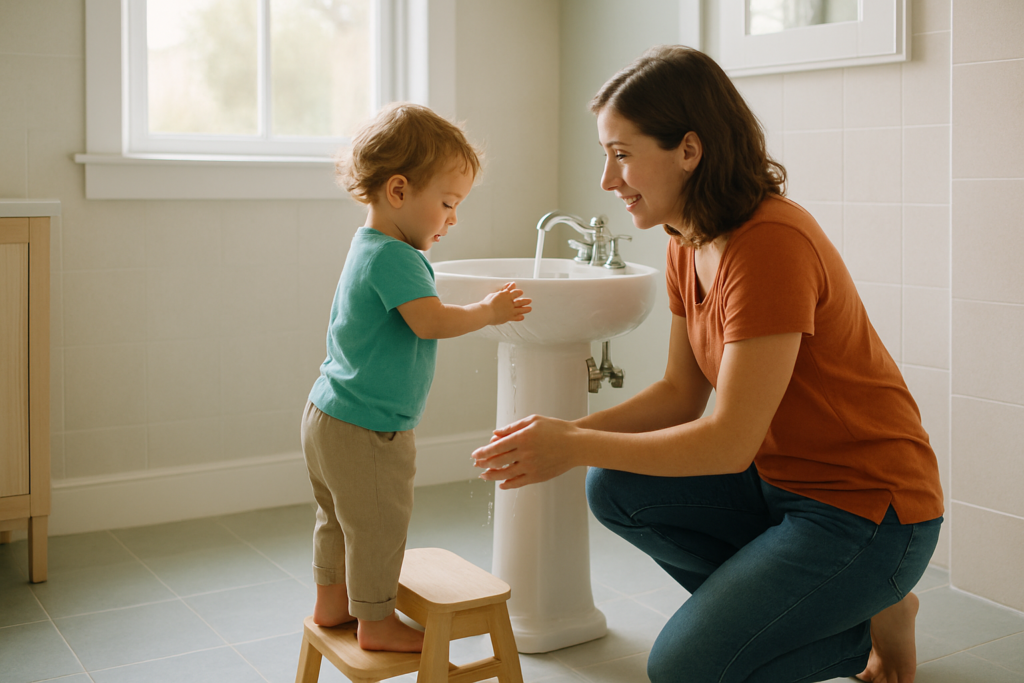
Practising the actual words your child needs to say to an unfamiliar member of staff, rather than assuming they will know how to ask, often makes the biggest difference. It is also entirely normal for a child to be dry at home months before they are reliably dry at nursery, and that gap on its own is not regression.
How long does potty training regression last, and when should I stop and wait?
There is no fixed length. Most settle within a few days to a few weeks once the trigger is identified and dealt with, though it can run longer where the trigger itself is ongoing, such as adjusting to a new baby at home.
If a first attempt at training is clearly not working, the method’s own advice is to stop: go back to nappies without any fuss, leave it for a few weeks or longer, and try again when your child seems ready. That pause is part of the method, not giving up, and a child loses nothing by waiting.
Signs a child was not ready in the first place include fear of the potty or toilet, real distress around trying, or no apparent interest in staying dry. None of these mean the child cannot do it, only that now is not the moment.
Night-time dryness is a separate matter that tends to come later and is not promised by any daytime method. A child who is reliably dry all day may still need pull-ups at night for some time, and that is entirely normal.
When is this a question for the GP rather than a potty question?
Some signs point away from a training issue and towards a medical one. Constipation or stool withholding, or hard and painful stools, is a common and genuine cause of daytime wetting and is worth raising with a GP or health visitor rather than managing through a potty method alone.
Pain or burning when weeing, cloudy or smelly urine, a fever, or a child who says it hurts should also go to a GP promptly. So should constant dribbling or wetting through the day in a child who was previously reliably dry, rather than the occasional accident.
Bedwetting is generally not considered worth medical review until around age six, according to guidance from the NHS and from ERIC, the children’s bowel and bladder charity, since many younger children simply have not yet developed night-time bladder control. Below that age it is usually just a separate stage still to come.
Any concern about a child’s wider development, or a child who suddenly loses skills in other areas alongside the toileting change, is also worth raising with a GP or health visitor rather than working through it as a potty training issue.
Does regression mean I have to start potty training from scratch?
No. A child who has already learned to recognise the feeling and use the toilet has not unlearned that skill, even during a rough patch. What usually needs rebuilding is consistency: calm, low-key responses to accidents, and handing the responsibility for noticing the need back to the child rather than taking it over again.
A little extra praise or a small reward can help briefly if plain encouragement is not landing, and separate reward systems are available on their own if you want to run something like this yourself without buying anything else.
The Potty Training Box is a day-by-day training programme built for a child who has not yet trained, or for one restarting training properly after a deliberate pause, rather than a fix for a wobble in a child who already knows how to use the toilet. It includes a programme booklet, instruction cards, compliment cards, tracking schedules, sticker cards in four growing sizes, animal and poo stickers, wee and poo diplomas, and a year of access to a community where questions get answered. If a child is genuinely refusing the potty for poo rather than wee, it is worth reading about what to do when a toddler will not poo on the potty specifically, since that is one of the biggest drivers of ongoing accidents. And if you are wondering whether any of the gadgets on the market genuinely help during a setback, it is worth reading honestly about what is actually worth buying before spending on anything, and, for a parent weighing up whether a structured restart makes sense at all, do potty training kits actually work answers that honestly too.
Frequently asked questions
Is it normal for a child to regress in potty training?
Yes. A toddler who was reliably dry for weeks or months starting to have frequent accidents again is common and usually has an identifiable trigger, such as a life change, an illness, or being too absorbed in play. It is not a sign the child has forgotten how to use the toilet, and it is not the parent's fault.
How long does potty training regression usually last?
There is no fixed length, but most children settle again within a few days to a few weeks once the trigger is dealt with. Regressions linked to an ongoing change, such as a new baby at home, can take longer to resolve than a single frightening incident.
Why has my 3 year old started having accidents again after months of being dry?
At this age the most common causes are a life change such as starting nursery or a new sibling, being deeply absorbed in play and leaving it too late, or a physical cause such as constipation. Tracking accidents for a few days usually shows a clear pattern rather than it being random.
Should I put my child back in nappies during a regression?
Generally no, since staying in ordinary cotton pants during the day helps a child keep feeling and learning from wetness. If a first attempt at training clearly is not working overall, the method's own advice is to stop training altogether for a while rather than switching back and forth day to day.
My child only has accidents at nursery, what should I do?
This is usually about unfamiliar toilets, having to ask an adult they know less well, or being interrupted during an activity, rather than regression. Talk to nursery staff about how and when your child is asked or offered the toilet, send spare pants, and agree the same calm response to an accident in both places.
Can constipation cause potty training accidents?
Yes, constipation and stool withholding are a common and genuine cause of daytime wetting because a full bowel puts pressure on the bladder. This is worth raising with a GP or health visitor rather than treating purely as a potty training problem.
Ready for the next step?
The Potty Training Box holds the day-by-day programme this article is built on: tracking charts that show you when your child actually needs to go, instruction cards for each day, and a reward system that tapers off on its own.
Sources
This article was written with AI assistance and checked by Dustin van de Sande.